


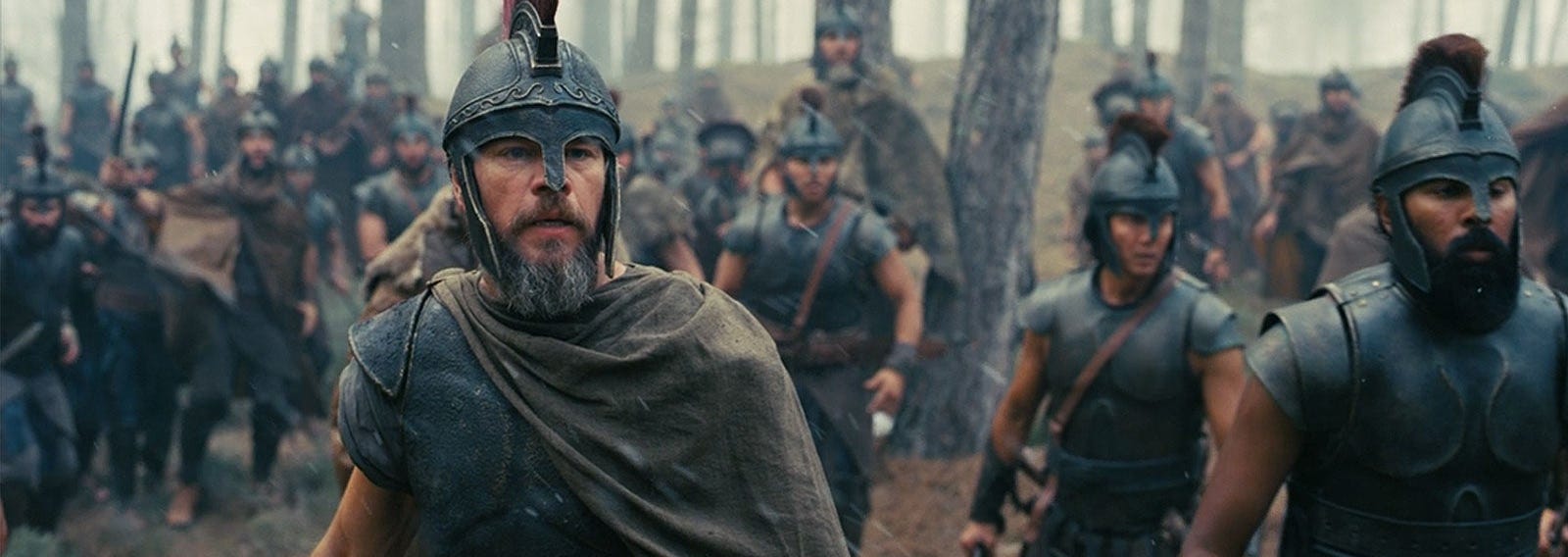
Christopher Nolan’s upcoming film The Odyssey is already facing a barrage of criticism, and it hasn’t even been released yet. Much of the fire has largely been directed at Nolan’s painfully “woke” casting choices.
His retelling of Homer’s legendary Greek epic will include transgender actress Ellen Page, rumoured to play Achilles, rapper Travis Scott as a Greek poet, Zendaya as Athena, and Kenyan actress Lupita Nyong’o portraying Helen of Troy.


The backlash has been fierce, and arguably well-deserved. Many see it not as creative licence, but as the deliberate defacement of Greek history and one of antiquity’s greatest works of literature. This is not material that should be remoulded to satisfy Hollywood’s diversity quotas.
Nolan’s defence of the casting hasn’t done much to help his cause either. When asked why he cast rapper Travis Scott in the film, Nolan reportedly explained: “I cast him because I want to nod towards the idea that this story has been handed down as oral poetry, which is analogous to rap.”
Author and Christian commentator, Eric Metaxas, came out guns blazing, stating on X: “As a lover of Western Civilization—and the proud son of a Greek immigrant—I denounce Nolan’s sacrilege in perverting this great epic with DEI [Diversity, Equity, and Inclusion] and trans lunacy.”
“Shame on him and shame on Hollywood,” Metaxas added.


Elon Musk replied, saying that Nolan has shown “total contempt for the Greek people.”

In another post, Musk said Nolan has “lost his integrity,” and accused him of desecrating Homer’s legacy entirely: “Chris Nolan is pissing on Homer’s grave,” he said. “Disgraceful.”
It’s difficult to believe that Nolan genuinely thought a woke retelling of The Odyssey would be well received by the public, most of whom are already exhausted by overtly ideological “reimaginings” of beloved stories. Public attitudes toward “woke” casting and storytelling have undoubtedly shifted in recent years, and there clear examples we can point to.
Disney’s recent live-action Snow White bombed at the box office, and it’s said to have cost The Walt Disney Company around $170 million.
Forbes reports:
Disney lost $170 million on ‘Snow White’ as studio reveals movie blew its budget. The dark spell cast on Disney’s bottom line by last year’s live action version of Snow White has been revealed in filings which show that the movie “was forecasted to be over the production budget” with costs of $336.5 million (£271.1 million).
Then there’s Disney/Marvel’s all-female superhero film The Marvels, which was reportedly the biggest bomb of 2023, and cost The Walt Disney Company a staggering $237 million.
There’s also Disney Pixar, with two 2022 animated bombs: Strange World, featuring a gay teenage romance, was the biggest bomb of 2022, and cost the company $197 million. Lightyear, the Toy Story spin-off, featured a same-sex kiss, which cost the company $106 million.
Not to mention the 2016 reboot of Ghostbusters, featuring an all-female cast. That cost Sony around $70 million. Other woke remakes that notably underperformed include Charlie’s Angels (2019), Wonder Woman 1984, and The Little Mermaid.
Surely, Nolan would be well aware of this, and his casting choices are arguably more absurd. What’s more, it’s not just a fairytale he’s reimagining. It’s one of the foundational texts of Western civilisation itself.
So, why do it?
Why imitate failure? Why jump off the same cliff? Is it some kind of humiliation ritual? Is it ideological activism masquerading as art? Is it an attempt to deliberately deface cultural heritage? What exactly is the point?
Is it simply the case that modern-day filmmaking is less about faithfully adapting cultural masterpieces and more about reshaping them to conform with contemporary political and ideological expectations? Well, Hollywood’s awards system is certainly pushing the industry in that direction. Little wonder why Musk went on to accuse Nolan of chasing awards. If Nolan is after an Oscar, he’ll have to clear a number of industry hurdles—and The Odyssey looks like it clears them all.
In 2020, the Academy of Motion Picture Arts and Sciences, or the Oscars, announced new representation and inclusion standards for films seeking eligibility for the Best Picture category at the Academy Awards, beginning in 2024.
To qualify for the top award, a movie must now cast more black, female, homosexual, transgender, or disabled characters or address themes relevant to their communities.
Academy President David Rubin and Academy CEO Dawn Hudson said in a statement: “The aperture must widen to reflect our diverse global population in both the creation of motion pictures and in the audiences who connect with them. The Academy is committed to playing a vital role in helping make this a reality.
“We believe these inclusion standards will be a catalyst for long-lasting, essential change in our industry.”
According to the Los Angeles Times:
“To be eligible for best picture, a film must meet at least two standards across four categories: ‘Onscreen Representation, Themes and Narratives,’ ‘Creative Leadership and Project Team,’ ‘Industry Access and Opportunities’ and ‘Audience Development.’ Within each category are a variety of criteria involving the inclusion of people in underrepresented groups, including women, people of color, LGBTQ+ people and those with cognitive or physical disabilities.”
The Academy’s website outlines the requirements as follows:
To achieve Standard A, a film must meet one of the three following criteria:
First, one of the lead actors or significant supporting actors must be:
Asian
Hispanic/Lantinx
Black/African American
Indigenous/Native American/Alaskan Native
Middle Eastern/North African
Native Hawaiian or other Pacific Islander
Other underrepresented race or ethnicity
In other words, fewer white people.
Second, at least 30% of all actors in secondary and more minor roles must be from at least two of the following underrepresented groups:
Women
Racial or ethnic groups
LGBTQ+
People with cognitive or physical disabilities, or who are deaf or hard of hearing.
In other words, fewer straight, white, able men.
And third, the main storyline, theme or narrative for the film must center on one of those “underrepresented groups.”
To achieve Standard B, a film must meet one of the three following criteria:
First, at least two of the creative leadership positions and department heads must be from the following groups:
Women
Racial or ethnic group
LGBTQ+
People with cognitive or physical disabilities, or who are deaf or hard of hearing
At least one of the two must belong to the following non-white racial or ethnic group:
Asian
Hispanic/Lantinx
Black/African American
Indigenous/Native American/Alaskan Native
Middle Eastern/North African
Native Hawaiian or other Pacific Islander
Other underrepresented race or ethnicity
Second, at least six other crew/team and technical positions must belong to these non-white racial or ethnic groups.
And third, at least 30% of the film’s crew is:
Women
Racial or ethnic group
LGBTQ+
People with cognitive or physical disabilities, who are deaf or hard of hearing
To achieve Standard C, a film must provide paid apprenticeship and internship opportunities for the same “underrepresented group” as well as provide them with training opportunities and skill development.
To achieve Standard D, a studio or film company must have multiple in-house senior executives who are:
Women
Racial or ethnic group
Asian
Hispanic/Latinx
Black/African American
Indigenous/Native American/Alaskan Native
Middle Eastern/North African
Native Hawaiian or other Pacific Islander
Other underrepresented race or ethnicity
LGBTQ+
People with cognitive or physical disabilities, who are deaf or hard of hearing
So, there it is: a film that doesn’t actively discriminate against straight, white males will no longer be eligible for an award.
Ultimately, the question is less about one film and more about the incentives shaping modern filmmaking itself. Is Nolan’s retelling of Homer’s classic primarily an expression of his own creative vision, or has it been largely influenced by the demands of awards eligibility and industry incentives? Given the recent track record of “woke” films at the box office, it’s difficult to see how Nolan could be pursuing anything else.
On a positive note, nominations for Best Picture will now also double as a list of pictures not worth the time it takes to watch the trailer.
both him and guy richie.. some of the directs i would get excited for 10y ago.. went horribly offtrack with their art. probably because they do not understand just how much of a movie is its characters - virtue configuration - implicitly dialog reflecting it.
when you consider wokeness and PC, said virtue will immediately be capped at mediocrity