



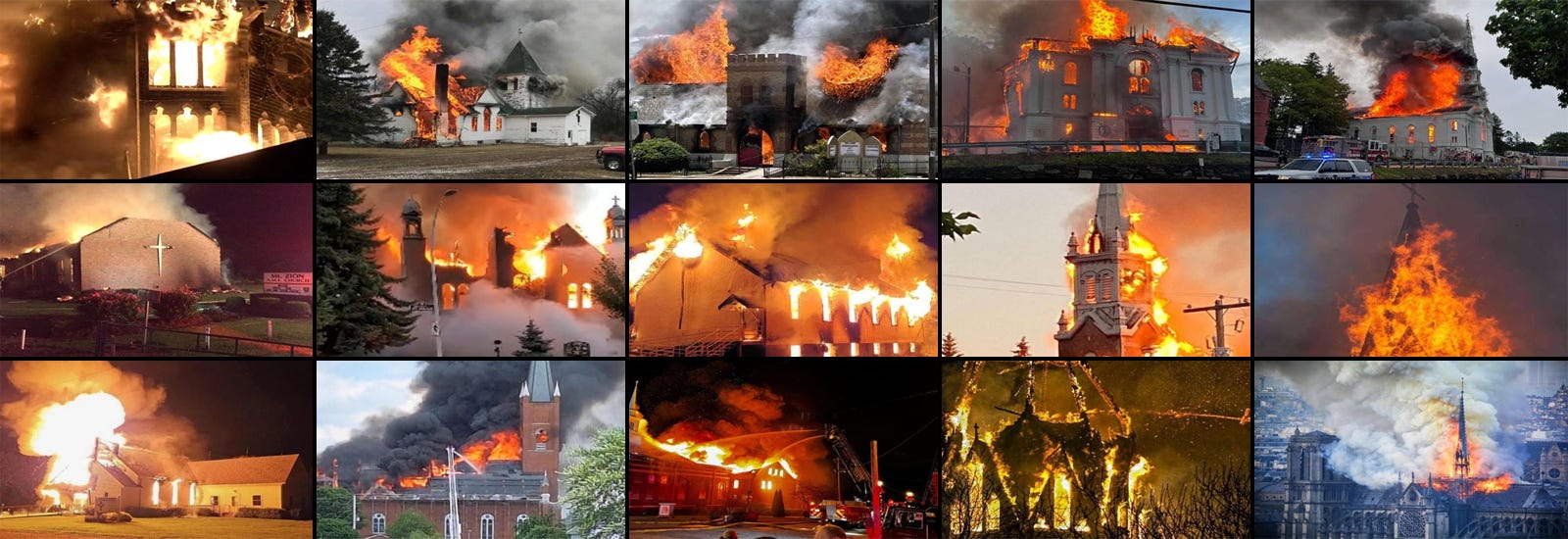
Somewhere this month, a Catholic family watched a church burn on the news and waited for someone in authority to do something — anything — that would make them feel it mattered. From their bishop, if anything came at all, they got a few lines about healing and dialogue. From their government, silence.
Multiply them by millions. The gap between what the faithful feel and what everyone charged with defending them is willing to say and do on their behalf is the real story — bigger than any single fire.
And the fires are neither rare nor small. Europe alone recorded more than two thousand anti-Christian attacks in a single year — churches vandalised, desecrated, burned, including the famous Notre Dame in Paris. The US bishops have logged over four hundred attacks on Catholic churches since 2020; in France, a Christian building is lost roughly every two weeks; in Canada, dozens have been burned to the ground, almost all by arson. Across the West it runs into the thousands, year after year.
What the ordinary believer cannot find anywhere is a single leader who sounds angry on her behalf or calling for any tangible action.
Canada’s entire arson wave has produced two convictions and not one serious prison term, while the Prime Minister called the anger “understandable” and a prominent activist leader called for more churches to be erased: “burn it all down.” And this same dynamic is repeated across Europe and the progressive leftist parts of the United States.
The same politics that casts Christianity as the villain of history is now escalating to complicity in these attacks — and, in some cases, openly urging them — while the rest of us are told to keep the tone civil and bipartisan and to ‘love thy neighbour’. Ask plainly what that civility has earned the Church, when progressive leftist policies treat a burning church as a grievance it understands and that its activists support.
The faithful can see what this is: anti-Christian hatred, from an ideology that has made their faith the designated oppressor. And they watch both their church leadership and their political statesmen decline to call it out, from fear of facing up to the cost of abandoning their comfortable bipartisan illusion. So the burning wounds them twice — once when the roof comes down, and again when the men sworn to protect them explain why nothing can be done.
This is why a twelfth-century king is suddenly on every feed. It is not bloodlust, whatever the critics say — it is passion and pride. Baldwin IV rode out at Montgisard at sixteen, deeply unwell, because he believed his people were worth defending and was prepared to sacrifice everything to do it — and when the day was won, he went home a hero. The people sharing his image are not all asking for a crusade. They are asking, in the emotive language the internet gives them, for one leader who is visibly proud of them and whom they can be proud of in return — who would put himself between them and the fire, and make a church worth defending again. They are grieving a leadership they have never had.
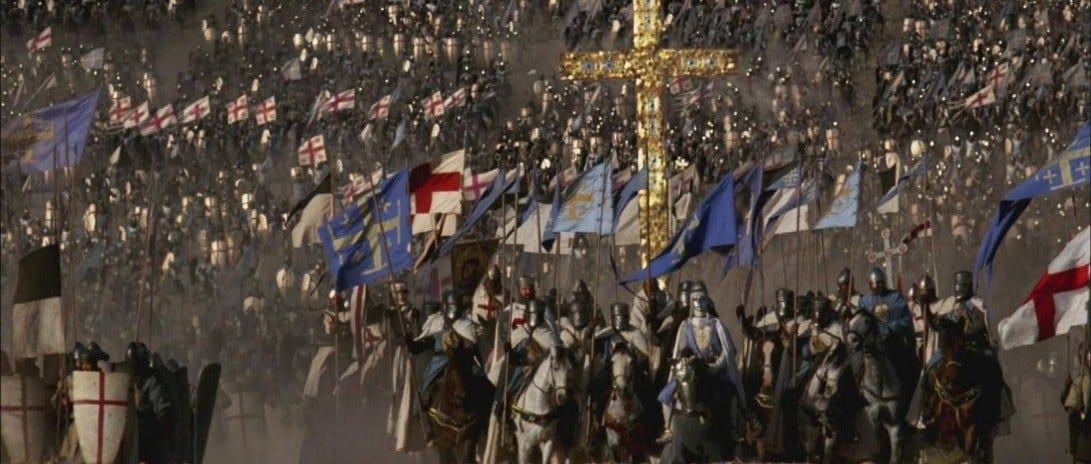
So ask the question that leadership never asks itself: who is inspired by its actions? Who walks out after listening to a diocesan statement, or a minister’s press conference, feeling prouder, braver, safer, inspired to be Christian? The answer is in the quiet emptying of his pews as congregations shrink; the politician offers thoughts and a task force. Both wonder where the young men went. They went because nothing was asked of them, and nothing was offered them to be proud of.
So what would King Baldwin do?
He would say out loud that these are his people and he will not stand for it. He would call out the people doing this without fear of being called names. He would attack the politicians who excuse it, rather than thank them for their partnership. He would treat the impunity as the emergency it is — fund the investigators the state will not, get the arsonists named in indictments, put them out of their jobs, and, where they are not citizens, deported; and throw the Church’s weight behind the representatives, prosecutors and judges who enforce the law, and against the ones who look away. He would stand in the burned-out nave and promise something taller and more beautiful in its place. And he would mobilise every angry, aimless young man watching his inheritance burn — to build, to campaign, to protest — and make him feel, for once, that his faith has a spine and he is not alone.
People do not follow press releases and bipartisanship. They follow someone prepared to sacrifice comfort for the survival of the faith.
The nostalgia for Baldwin is not a longing for war. It is a longing for leadership.
We sure are - not just Baldwin but El CID, Richard the Lionheart… anyone who will fight for us and stand up to governments who fill the west with people who hate us.