


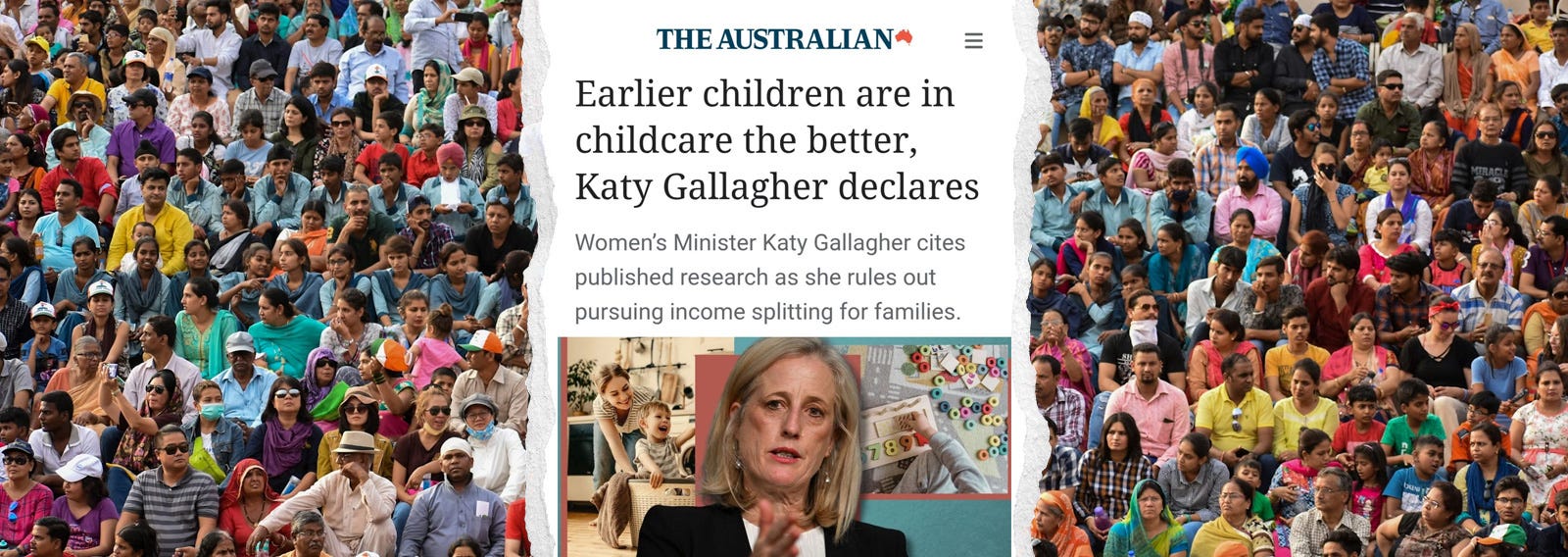
Women’s Minister Katy Gallagher is under fire—and rightly so—after suggesting that the earlier children enter child care, the better. That’s right, the Australian Minister for Women seems to believe that children, raised by their own mothers, are worse off than those raised by the employees at the local daycare.
According to The Australian, the senior Labor figure pointed to “published research” to justify ruling out income splitting for families—a policy proposed by the Nationals aimed at making it easier for parents to spend more time at home with their newborn children. A pro-family, income-splitting tax policy would allow married couples to combine and average their incomes, reducing the disproportionate tax burden that’s often placed on single-income households. In particular, it would benefit families where a mother remains home, or works reduced hours, to raise young children.
So, rather than penalising families who rightly prioritise parental care during the early years, income splitting recognises the value of unpaid household labour while acknowledging the utmost importance of child-rearing. You would think the Minister for Women would recognise that this essential and often unpaid labour is overwhelmingly carried out by women—women who, in many cases, also bear the financial burden imposed by a tax system that disadvantages families choosing to prioritise raising their own children at home.
But Gallagher’s comments reflect a religious assumption that has become increasingly entrenched in modern culture, namely, that a woman’s highest and most unquestionable calling is full-time participation in the workforce. Motherhood is treated as secondary, lesser, or even a wasteful use of a woman’s potential. Conveniently enough, this shift also happens to double the government’s taxable income base, but I’m sure that fiscal incentive had nothing to do with pushing women away from unpaid work at home and into full-time employment, right?
Now, of course, there are circumstances where childcare might be necessary or even beneficial. Not every home environment is stable or healthy. But policy shouldn’t be pushed based on the exceptions. Gallagher is effectively treating the family, and the unpaid labour involved in raising children and maintaining the home, as secondary to taxable income generation. In effect, she’s doing what all good statists do by prioritising GDP, taxable incomes, or institutional childcare over the irreplaceable and formative love of parents, particularly mothers, in a child’s early years.
Many mothers and fathers are not embracing the two-income model because it is their ideal preference, but because they feel they have little alternative. High housing costs, rising living expenses, and taxation burdens have made single-income family life virtually impossible for many to sustain. They don’t have the choice to stay home and raise their children anymore. The government has made that choice for them. Now they want to gaslight us into thinking we’re all better off this way.
By opposing income splitting, Gallagher is effectively treating the family—and the unpaid labour involved in raising children and maintaining the home—as secondary to taxable income generation. Economic participation is prioritised over parental presence, and institutional childcare over family-based care.
What’s more, Australia’s fertility rate remains well below replacement level, yet governments increasingly appear more comfortable relying on mass migration to offset demographic decline than addressing the economic and cultural pressures discouraging Australians from forming and raising families in the first place. Why prioritise policies that support Australian families when “new Australians” can simply be imported instead?
For our politicians, it would appear that supporting the growth of Australian families simply isn’t a priority. Why would it be? We all know how heavily they rely on mass immigration to sustain demographic and economic growth. Rather than creating conditions that make marriage, family, and child-rearing possible for Australians, our government’s only solution to maximising the tax base and supplementing population growth is through mass migration.
As such, our politicians have little incentive to pursue policies that strengthen and grow the natural family, reduce the financial burden on parents, or make it easier for mothers to invest time in raising the next generation. Why introduce policies that allow mothers to stay home and raise their children, when governments can keep them in the workforce, and instead rely on immigration to meet future labour and population needs?
It’s no surprise that a government whose primary strategy for demographic growth is mass immigration, rather than supporting its own families, will inevitably treat child-rearing as a private lifestyle choice rather than a social good for the future of the nation.