


There’s a message being relentlessly preached to White people across the Western world, and it’s a message we’d never tolerate being communicated to any other racial or ethnic group.
The message is that White people, collectively, are a problem in need of fixing.
A White majority is a problem. White people in positions of authority are a problem. White people in positions of influence are a problem. White people possessing too much political, economic, or cultural dominance is a problem.
And the proposed solution is always the same: Fewer White people. Dilute the White population with non-White populations until the problem disappears and power and influence are largely transferred to the non-White population.
We’re told that a society becomes much better when it becomes more racially diverse. But often, underneath that argument is another proposition: that the presence of too many White people is itself something that ought to be corrected.
And yet, we all know that we could never speak this way of any other people group on earth.
Nobody would seriously argue that an African nation has a demographic problem because too many Africans live there. Nobody would argue that an Asian population needs to be diluted because Asians occupy too many positions of influence. Nobody would suggest that an “ethnic minority” should be deliberately weakened as a collective because its members have achieved too much authority in their own homelands.
But when the people in question are White, suddenly the rules change—and this is the curious thing: For decades, Western nations have deliberately tried to make their populations colour blind.
They taught people that a person’s race shouldn’t determine how they are treated. That one cannot make an assumption or ascribe guilt to a people simply because of their ancestry. And that people should be judged by their character and their conduct, not the colour of their skin.
And, by many measures, that worked—at least, when it came to the Westerner.
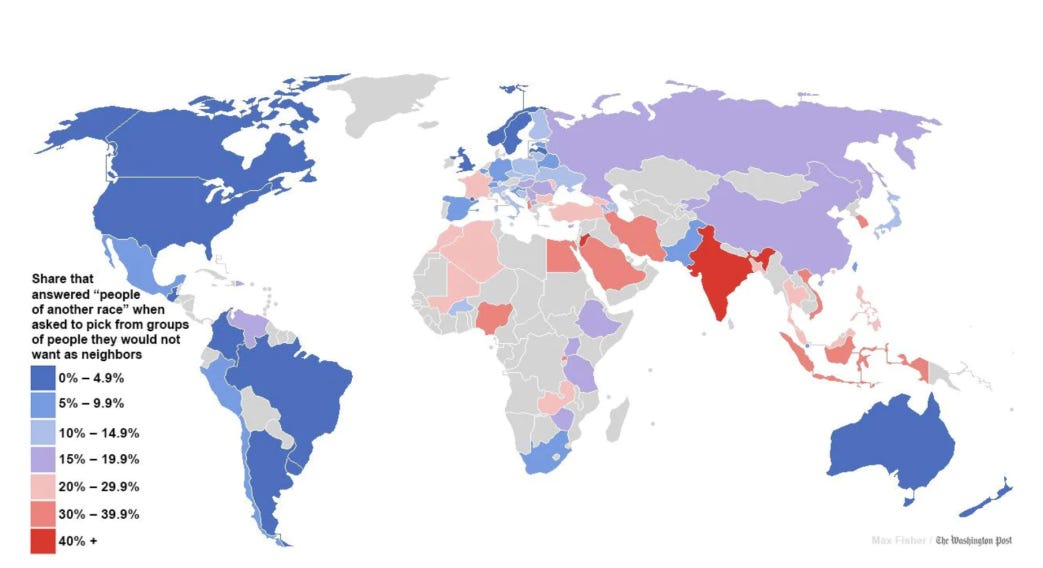
Western nations are among the least racially prejudiced societies in the world. But all that is about to come undone. Not because of “Far Right” influences on social media, but because of something far more obvious: The disadvantaging of people because they are White.
Start telling Westerners that their race actually does matter after all. Start telling them that their collective presence is a problem. Start telling them that their institutions are too White, their leadership is too White, their influence is too White, and their representation needs to be corrected.
And what will you do? You will awaken racial consciousness in the one group that has been conditioned not to think in terms of race and ethnicity. Eventually, you will make them ask a question they may never previously have thought necessary to ask:
What does it actually mean to be “White”?
Western society has long been taught that racial self-identification is a dangerous path toward extremism. At the same time, it often demands that Westerners view themselves as a racial collective when it comes to acknowledging historical sins.
White people can talk about being White when the subject is White privilege. They can talk about their ancestors when the subject is historical oppression. They can talk about their racial identity when they are being asked to acknowledge guilt, shame, or responsibility for the actions of people who came before them.
But they are not to ever think of themselves as a people with legitimate collective interests. They are not to ever celebrate their own identity in the same way other groups are encouraged to celebrate theirs. They are not supposed to organise around their own family interests.
They are supposed to understand their collective identity primarily as a moral liability. They are told to understand the differences between racial groups as a source of historical wrongdoing. They are told their ancestors’ achievements cannot be separated from unjust racial privilege. They are told that their racial identity comes with obligations, burdens, and moral debts.
But that’s not a natural posture for any people group to live with indefinitely. Eventually, people ask questions. Eventually, they begin examining themselves the way every other group has been encouraged to examine itself. Eventually, they begin thinking about their collective interests. They begin thinking about their identity. And they begin organising accordingly.
Of course, whenever that happens, we already know what the response will be. They’ll be called all the names. They’ll be accused of all the things. But the fact remains, to a large extent, they are the natural result of the societal pressures placed upon them.
If you continually tell people that race does not matter when it comes to their own people, but that it absolutely matters when it comes to everybody else’s, they will eventually grow tired of the double standards.
If you tell every other racial group that it’s legitimate to organise collectively around its identity and interests, eventually White people will ask why the same principle does not apply to them.
If you tell people that racial groups deserve special consideration, eventually people will ask whether their own group deserves it too.
And if you tell one racial group that its collective presence is a problem that needs to be diluted, eventually, members of that group will begin to wonder why they should just accept that judgment.
You can’t spend decades telling people to think in racial categories when it comes to everyone else and then be surprised when they start doing so for their own people. You can’t tell people that racial identity is enormously important for everyone except White people.
That’s simply not how human beings work.
Push people into a corner long enough and hard enough, and they will eventually re-examine the assumptions they were taught to hold about themselves. The irony is that the very people who claim to want a less racially conscious society are creating a more racially conscious one—because they are not advocating for less racial consciousness for all, only for White people.
The West spent decades trying to convince people that the colour of a person’s skin should not determine how they are treated. If we now begin treating Westerners differently because of the colour of their skin, we shouldn’t be surprised when Westerners begin to push back.
So, when White people begin thinking more consciously about their racial identity, we should not be surprised. When people are subjected to years of messaging that portrays their racial group as a problem, their demographic presence as something to be corrected, and their collective achievements as something to feel guilty about, it is entirely predictable that some will eventually reject the identity they were taught to have and begin reconsidering what it means to be White.
That is not something that happened in a vacuum. It is, in large part, the product of the very anti-White racial consciousness that has been relentlessly pushed upon them.
If you spend decades teaching White people to see race everywhere except within—unless it is viewed through a negative lens—and teaching them that their own race is uniquely problematic, you cannot reasonably expect them to remain indifferent to their racial identity forever.