


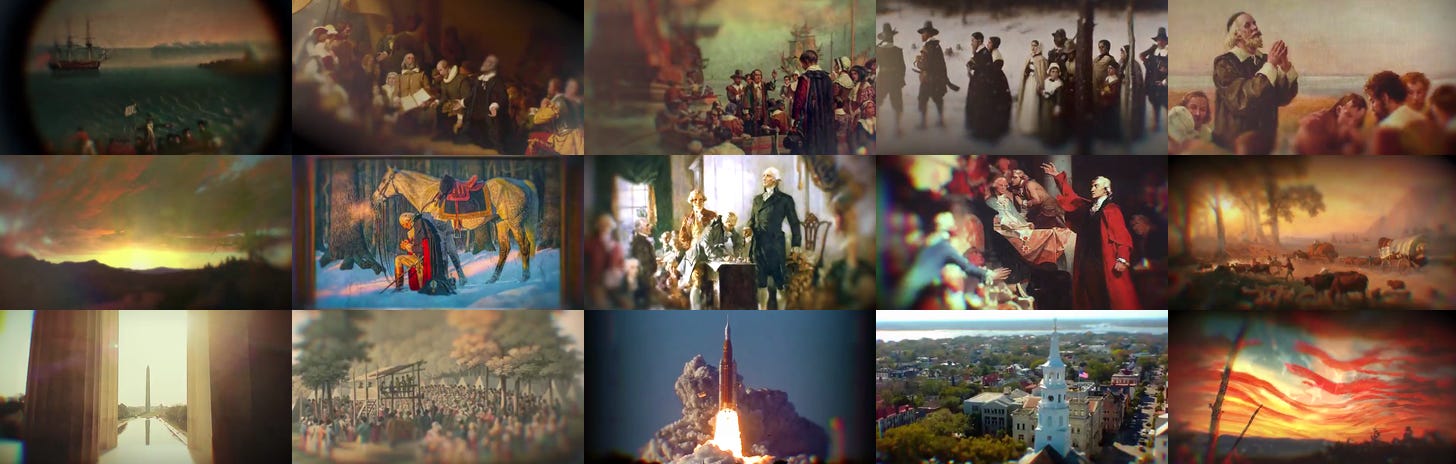
The United States Department of State has celebrated America’s Christian heritage in a social media post marking International Religious Freedom Day.
“America, more than any other nation in world history, was shaped by the Christian tradition of spreading the gospel unto all nations,” the department wrote.
The post was accompanied by a video of Secretary of State Marco Rubio, who said:
Our faith calls us outwards into the limitless darkness of the unknown. It tells us to go forth and preach the gospel to the world as a witness unto all nations unto the ends of the earth.
From that command came America. Our nation, more than any other in history, was shaped by this Christian idea. This is who we are.
And from the beginning, we have carried the belief that our country represents something new in the world. But the soul of our nation has always been rooted in an ancient faith.
For all its faults, the United States stands as a remarkable testament to Gospel truth. Its early leaders understood that the nation’s well-being and future depended upon the preservation of its religious and moral foundations.


On September 17, 1796, in his Farewell Address, George Washington described the Christian religion and morality as the “indispensable supports” of national prosperity.
For Washington, the Constitution alone was insufficient. Its stability depended upon two essential pillars: Religion and Morality.
He said:
Of all the dispositions and habits which lead to political prosperity, religion and morality are indispensable supports.
In vain would that man claim the tribute of Patriotism, who should labor to subvert these great pillars of human happiness, these firmest props of the duties of men and citizens.
The mere Politician, equally with the pious man, ought to respect and cherish them.
A volume could not trace all their connections with private and public felicity…
Washington went on to warn against the assumption that morality could be maintained without religion.
Let us with caution indulge the supposition that morality can be maintained without religion. Whatever may be conceded to the influence of refined education on minds of peculiar structure, reason and experience both forbid us to expect that national morality can prevail in exclusion of religious principle.
Topple the nation’s religious foundations, and its morality falters. Topple both, and the very basis for liberty, human rights and prosperity begins to collapse.
There’s little wonder why Washington’s fellow Founding Father, John Adams, similarly warned in 1798:
Our Constitution was made only for a moral and religious People. It is wholly inadequate to the government of any other.
Both men understood that a free society required a morally restrained people. Without that restraint, no constitution, however carefully written, could prevent its eventual decay.
The Christian religion and its moral framework were absolutely vital.
No doubt Washington would see little coincidence in the fact that America’s present disorder was preceded by decades of anti-Christian propaganda, which steadily infiltrated its institutions and public square under the guise of “secularism,” “diversity,” and “pluralism.”
For generations, Christianity has been pushed out of public life while the nation has continued to expect the benefits of the civilisation it produced.
We have been told that religion is a private matter, that morality can be maintained independently of God, and that a nation can abandon its Christian foundations without consequence.
Washington warned against precisely this delusion.
And while modern secularists insist that government must remain religiously neutral, Washington understood that the acknowledgement of God was not merely a private obligation.
In his Thanksgiving Proclamation of October 3, 1789, he declared:
Whereas it is the duty of all Nations to acknowledge the providence of Almighty God, to obey his will, to be grateful for his benefits, and humbly to implore his protection and favor.
Notice that Washington described this as the duty of all nations, not merely the United States.
This was no peculiar American obligation. Nations do not exist independently of God, nor are their rulers exempt from his moral authority.
Scripture makes this explicit. The kings and rulers of the earth are commanded to serve the Lord (Psalm 2:10–12), and Christ himself declared that all authority in heaven and on earth belongs to him (Matthew 28:18).
The state may refuse to acknowledge that authority, but it cannot escape it.
Surely, much of the moral and political chaos we are witnessing today is the inevitable consequence of neglecting this essential duty.
And it’s for that reason that the State Department’s proclamation is rightly being welcomed by Christians who have grown accustomed to seeing their nation’s religious heritage either neglected, ridiculed, or undermined.
It is an encouraging acknowledgement of something America’s founders understood, but successive generations have increasingly forgotten.
Christianity is not merely one cultural influence among many. It supplied the moral framework upon which American civilisation was built.