



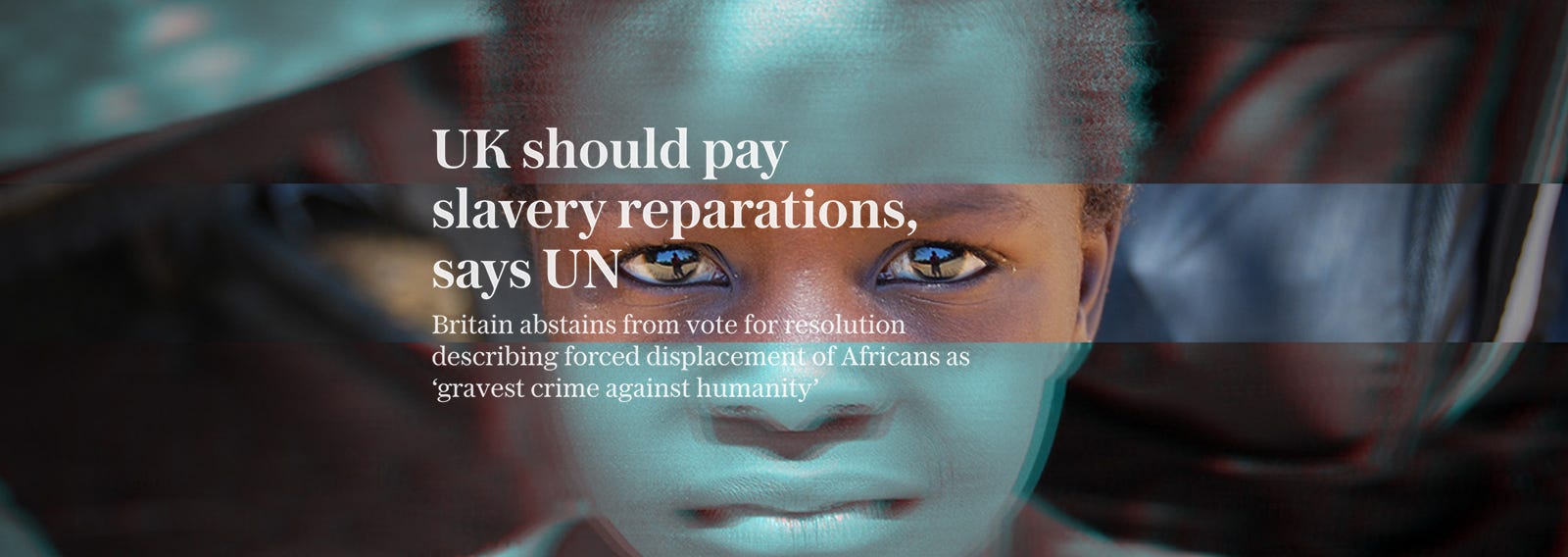
The United Nations has voted to urge Britain and other former colonial powers to pay reparations for slavery, according to The Telegraph.
The resolution, tabled at the UN General Assembly by Ghana on behalf of the African Union of countries, also condemned the forced migration as “the gravest crime against humanity”—which is somewhat rich considering the fact that there are an estimated 9.24 million men, women, and children living in modern slavery across Africa, according to the Global Slavery Index produced by the Walk Free Foundation.
These are not abstract figures. They are men, women, and children trapped in forced labour, sexual exploitation, child soldiery, and coerced marriage.
While condemnation is continually directed toward Britain and the West—the very civilisation that led the global abolition of slavery—Africa today has the highest prevalence of slavery in the world, at 7.6 victims per 1,000 people. Even more telling, forced marriage (4.8 per 1,000) exceeds forced labour (2.8 per 1,000), suggesting that exploitation is not merely economic, but deeply embedded in Africa’s social and cultural structures.
The findings also showed worldwide there were 40.3 million people in slavery in 2016, with up to 71% of the enslaved being female due to “discriminatory views of women.”
Yet when it comes to confronting slavery in the present, the contrast could not be clearer. Virtually every nation that has sought to abolish slavery and eradicate so-called “racism” is now being pressured—and even exploited—to pay for its alleged “sins.”
Countries such as the United Kingdom, the United States, the Netherlands, and the Nordic nations rank among those taking the most serious and sustained action to combat slavery. By contrast, states such as North Korea, Eritrea, Libya, and Sudan consistently rank among the worst offenders, with little meaningful effort to eradicate the practice.
So the obvious question is: why? Because the facts cut directly against a popular narrative.
We are repeatedly told that Western civilisation is uniquely defined by oppression, slavery, and exploitation. Yet history—and the present—tell a very different story. Slavery was not a Western invention. It is one of humanity’s oldest and most universal institutions, found across continents, cultures, and civilisations for millennia.
No society is uniquely guilty. But one is historically unique in something far more significant: ending it.
The British Empire, at enormous economic and political cost, led the charge to abolish the transatlantic slave trade and later slavery itself. In 1833, Britain committed a sum equivalent to roughly 40% of its annual budget to enforce the Slavery Abolition Act 1833, borrowing £20 million to compensate slave owners—an extraordinary financial burden that was not fully paid off until 2015.
This means, in a technical sense, modern British taxpayers helped bear the cost of abolition.
The Royal Navy spent decades suppressing slave trafficking on the high seas. This was not exploitation—it was costly, sustained, and morally driven enforcement against it.
As Thomas Sowell has observed, slavery has been a near-universal feature of human civilisation. What is not universal—what is extraordinarily rare—is a civilisation that develops the moral conviction to abolish it:
Slavery has been a universal institution for thousands of years, as far back as you can trace human history. We’re looking as if slavery was something that happened to one race of people in one country, when in fact, the spread of it was around the world.
In 1776… Adam Smith said that Western Europe is the only place in the world where there is no slavery. Even the Western Europeans had vast numbers of slaves in the Western hemisphere, but not in Western Europe itself. So, if you’re going to have reparations for slavery, it’s going to be the greatest transfer of wealth back and forth and between… because the number of whites who were enslaved in North Africa by the Barbary pirates exceeded the number of Africans enslaved in the United States and in the American colonies before that, put together.
But nobody is going to North Africa to ask for reparations because nobody is going to be foolish enough to give it to them. Here we have intellectuals who can imagine a different history from the rest of the world.
So again, what changed?
Historians such as Rodney Stark have argued that the answer lies in the moral framework that emerged within Christendom—a framework that affirmed the inherent dignity of every human being, grounded in the belief that all are made in the image of God.
All known societies above the very primitive level have been slave societies–even many of the Northwest American Indian tribes had slaves long before Columbus’ voyage. Amid this universal slavery, only one civilization ever rejected human bondage: Christendom. And it did it twice!1
Theologian John B. Carpenter similarly describes abolition as a “revolutionary shock” in human history—something that cannot be adequately explained by economics or political expediency alone.
Slavery was a universal human institution for all history. Normalcy. It’s impossible to isolate one group as responsible for it because all were. If we go back in anyone’s ancestry far enough, we’re almost certain to find a slave owner. We’re all the sons and daughters of slaves and enslavers.
The question is not who enabled slavery. Everyone did. The question is, who, after millennia of this fallen institution, stopped it…
Slavery had been the norm, business as usual. What is striking is when normalcy is disrupted, the bolt from the blue. Abolition was that bolt, a revolutionary shock breaking into history. Where did it come from? It wasn’t the long arc of history inevitably bending toward progress. It was a transformation from above.
For most of history, slavery was normal. Accepted. Unquestioned. Universally practised.
The real anomaly is not that human beings enslaved one another—but that a civilisation arose which decisively turned against the practice, even when it came at great cost to itself.
That moral shift did not happen everywhere. It was not inevitable. And it did not arise out of nowhere.
The claim that the West is uniquely defined by slavery—or uniquely obligated to atone for it—requires a selective reading of both history and the present. Because if moral responsibility is to mean anything, it cannot be confined to the past while ignoring the present.
If justice is the goal, then the millions currently enslaved, in Africa and worldwide, deserve more than symbolic resolutions and political theatre. They require action—real, immediate, and sustained.
And if history is to be judged honestly, then credit must be given where it is due. The same civilisation now being singled out for condemnation is the one that first turned decisively against slavery—and continues to lead the fight to eradicate it.
Given that millions remain enslaved in Africa today, calls for reparations from Britain reveal themselves for what they truly are: an exploitation of Anglo-empathy, guilt, and charity. They demand payment from people who never enslaved anyone, for the sake of slaves long dead, while millions continue to suffer in chains in their own backyard.
It is long past time for Europeans to be freed from the chains of sins they never committed—ancestral guilt and suicidal empathy alike. That is precisely what these demands exploit: a relentless call to grovel over crimes that cannot be atoned for. The more sorrow is shown, the more demands are made.
Today’s Britons are not responsible for the sins of their ancestors, nor are they obliged to pay people who were never enslaved. Few things could be more absurd than expecting those who never owned slaves to compensate those who were never enslaved, simply because the former resemble slave owners and the latter resemble slaves.
Calls for reparations are not justice—they prey on the same Anglo-empathy that abolished the slave trade and freed some 800,000 people across the British Empire. It is long past time that Europeans were freed from the delusion that they must atone for sins they never committed by paying people who were never wronged.
The Triumph of Christianity: How the Jesus Movement Became the World’s Largest Religion, Rodney Stark.