




Uganda will go the way of Egypt if a proposed bill that’s soft on Sharia Law makes it past Ugandan legislators.
A dormant clause in Uganda’s shift away from Westminster-based constitutional governance to a republic in 1995 allowed for Islamic courts (known as Qadhis).
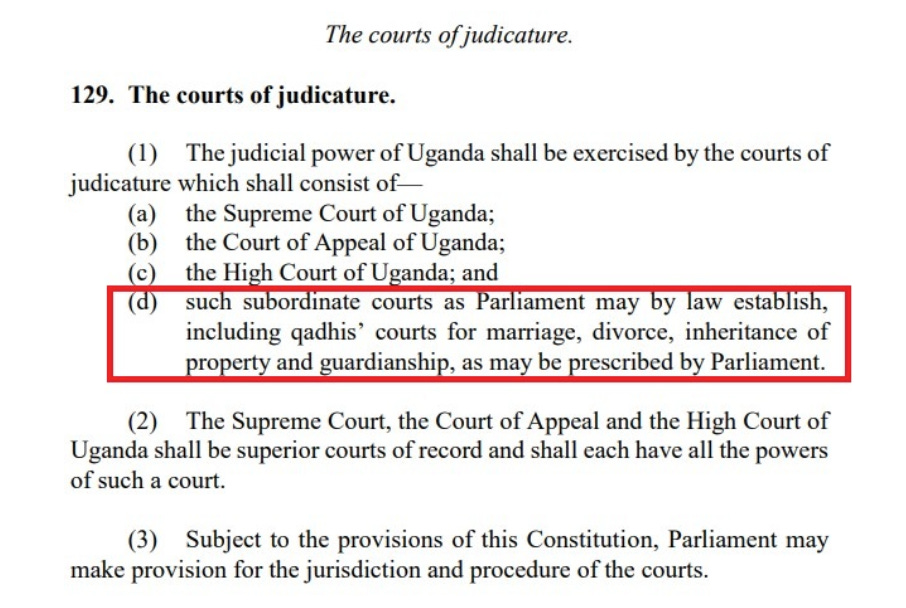
Article 129(1)(d) of the African country’s new Constitution added Qadhis as a recognised informal judiciary.
129 (1)(d) reads, “The judicial power of Uganda shall be exercised by the courts of judicature, which shall consist of such subordinate courts as Parliament may by law establish.”
This “includes Qadhis’ courts for marriage, divorce, inheritance of property and guardianship, as may be prescribed by Parliament.”
The legal pluralism clause, in effect, exists because of multiculturalism, a 2018 Ugandan government-sourced paper on the subject explained.
Centralised law, Frederick W. Jjuuko argued, holds a monopoly in the justice system, which gets backlogged, inefficient and therefore redundant.
Informal justice systems recognise this and compensate for the gaps.
This is ultimately about maintaining social cohesion by way of the meta-culture, allowing minority cultures to operate without requiring those groups to assimilate.
In sum, if the bill is enacted, culture-specific laws could inject Sharia into Uganda’s wider social fabric.
The bill could permit Muslims to ultimately “govern” themselves and extend that rule onto and over their neighbours.
Once awakened, Article 129 has the potential to seed Islamisation.
These concerns are dismissed by the bill’s supporters as either “Islamophobic” or overstated.
This is limited legal pluralism, they argue.
Culture-specific judiciaries are restricted by the constitution’s provisions for marriage, divorce, inheritance, and guardianship.
Notably, the bill is being backed by the Islamic Women’s Initiative for Justice, Law, and Peace (IWILAP).
Just as noteworthy, IWILAP are funded through Ahaki’s population control abortion program: the Litigating Reproductive Justice in Africa (LRJA) platform.
Muslims pushing abortion induced population control, while legally practising polygamy, and that Marxian Woke “social justice” rabbit hole aside, reassurances are not backed by reality.
A Ugandan parliament press release quoting the bill’s author, the Honourable Asuman Basalirwa, states that the bill,
“Would formally institutionalise Islamic personal law courts within Uganda’s judicial system in line with the values, norms and aspirations of the Muslim community.”
When measured alongside Egypt’s constitutional promises about religious freedom, and how that actually plays out next to Sharia Law, concerns about Uganda’s multicultural constitutional concessions are well and truly justified.
Egypt’s constant inconsistency when it comes to religious freedom is best filed under Taqiyya and Jihad through the judiciary.
In other words, pattern, behaviour and the devastating impact on Coptic Christians in the country all strongly suggest constitutional safeguards are no protection against Islamification made possible by legal pluralism.
Put simply, if the bill is passed, Uganda’s Christians are in trouble.
As such, Alliance Defending Freedom International (ADF) has called upon the Ugandan government to reject Basalirwa’s bill.
“The bill,” ADF said, “raises serious concerns that some Ugandans will be forced to adjudicate cases in a court system that does not recognise their faith or legal rights.”
Like Egypt:
“Because the proposed Qadhis courts would apply Sharia law, which does not recognise conversion from Islam to another religion, Muslim individuals who seek to convert into Christianity or other religions would likely be prevented from doing so.”
Citing the persecution of Christians in Nigeria, ADF added,
“The mandatory application of Sharia law would legally disadvantage Christian women and girls.”
From a Western perspective, Uganda’s legal pluralism is worth close examination.
Especially in terms of social cohesion and the meta-cultural cost of multiculturalism.
The emergence - or rather push for - Culture-specific judiciaries in Uganda is an expansion of legal pluralism, which was designed in 1995 to preserve social cohesion vis-à-vis “diversity.”
It’s currently the centre of a major debate in the country, which at its core essentially allows minority overreach and Islamic expansionism via lawfare.
Notice the irony.
For Ugandans, the law, which is touted as a push back against the evils of colonialism, will inevitably only invite Islamic colonisation.