



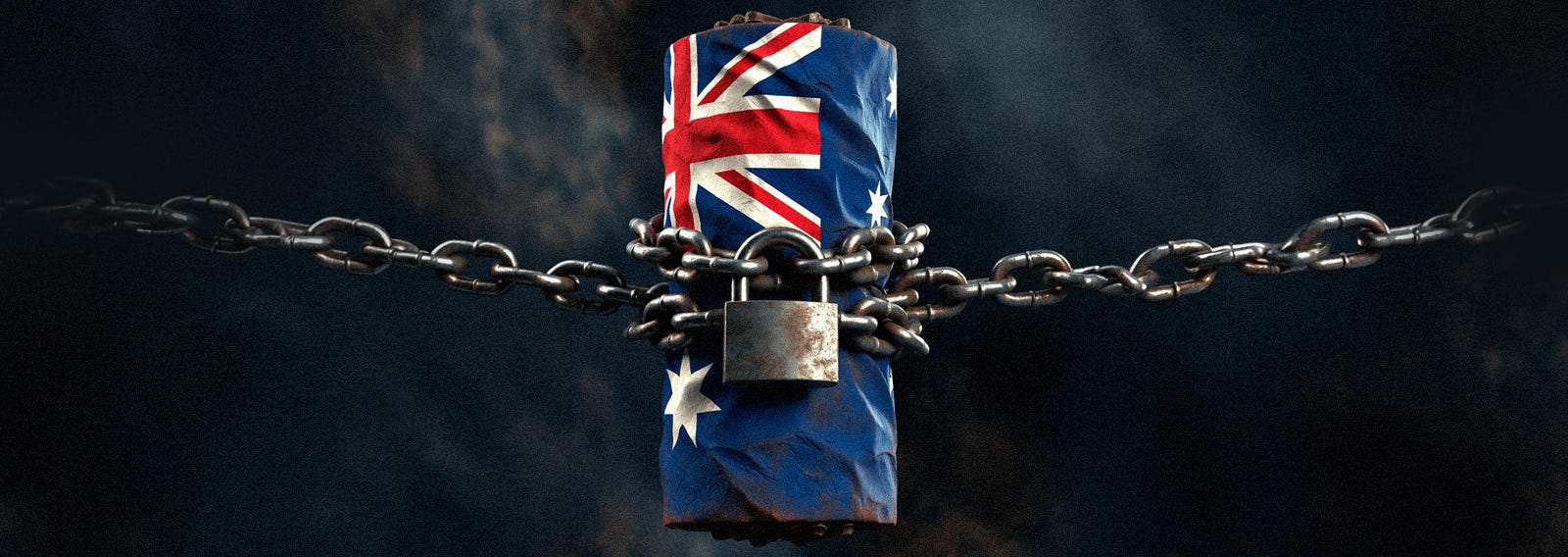
Turning Point Australia (TPAUS) is urging the Australian Senate to keep the sunset clause for counter-terror laws.
Under the Labor proposal, Australia’s 2003 add-ons to the Australian Security Intelligence Organisation Act 1979 would become permanent.
This means that ASIO’s extraordinary powers for the “War on Terror” will no longer have a use-by date.
Since their inception, Australia’s precision post-9/11 policing laws have had the necessary parliamentary review, review, review, accountability.
Labor wants the Senate to ditch this stopgap.

The bill, called the Australian Security Intelligence Organisation Amendment Bill (No. 2) 2025, will also increase the reach of the Attorney-General.
He or she is the only one with the power to issue “compulsory questioning warrants” (QW) against both suspects and non-suspects.
Under current counter-terror QW laws, no judge is required.
Naturally, under the Sussan Ley “opposition,” the Liberals helped pass the bill through the House of Representatives in February.
The battle to save judicial oversight and keep Australia from permanently becoming a police state is now in the hands of the Senate.
As Senator Alex Antic noted, this should concern every “Australian who values freedom under the law.”
Speaking about the temporary nature built into the law by design, Antic said,
“Instead of respecting that original intent, this bill seeks to remove that safeguard entirely.”
There are three main areas of concern.
First, these extraordinary powers for policing terrorism become permanent.
Second, it supercharges the policing powers of a politician.
Third, the reasons a person can be dragged in for compulsory questioning expand to include “incitement,” and potentially (so-called) “hate speech.”
As I explained in the Daily Declaration on Friday,
“Compulsory questioning warrants (QW) have granted ASIO the power to question and detain anyone, regardless of whether or not they are a suspect.
Questioning warrants apply to both adults and minors who “are at least 14” (see here).”
Keep in mind here the absence of a bill of rights in Australia.
Rights are, for the most part, considered “implied rights.”
Protections for Australian civil liberties largely come under Australia’s commitment to uphold international law.”
For these reasons, the expansion of “war on terror” powers should have churches, not just civic and civil rights groups, deeply concerned.
This is why Turning Point Australia isn’t just raising awareness; they’re firmly opposing the amendments, and asking Australians to do the same.
TPAUS see the dangers as clear and present.
Such as there being no right to remain silent. Even access to a lawyer, and the lawyer’s ability to do his or her job, is significantly restricted.
Additionally, if questioned or detained by ASIO, regardless of whether a person is a suspect or not, there is the threat of 5-years in prison for talking about the incident.
The amendment cements this denial of due process into Australian law.
Indirectly backing TPAUS, the Law Council of Australia has said – and I referred to this in the Daily Declaration – that they are seriously concerned.
Consequently, they said, “We do not support the removal of the sunset clause for these powers.”
“This is because of a longstanding failure to strike an appropriate balance between responding to the gravity of evidenced threats to national security with compliance with the rule of law, Australia’s obligations under international law, and respect for human rights obligations.”
Because of the law’s huge potential for abuse, the Law Council said policing of the legislation requires constant review.
Regular scrutiny of powers that restrict rights, and scrutiny of how that power is wielded, matters.
“Periodic opportunities to publicly make the case that exceptional powers that trespass on fundamental rights are necessary and proportionate,” the Law Council argued.
The use-by date provides “an essential democratic oversight function and should not be surrendered.”
“We maintain,” they added, “that ASIO must be required to regularly demonstrate to the Australian public that these powers continue to be both necessary and proportionate to the threat environment.”
To date, TPAUS have helped Australians send over 580,000 emails asking the Senate to save the sunset clause by voting against the ASIO amendment.
Debate was set for Friday. That date has since been pushed back to June.
Noting the reprieve, TPAUS said, Australians now have a renewed opportunity to raise awareness and act on widespread concerns.
You can join with them in telling the Senate to boot the bill by tapping here.