


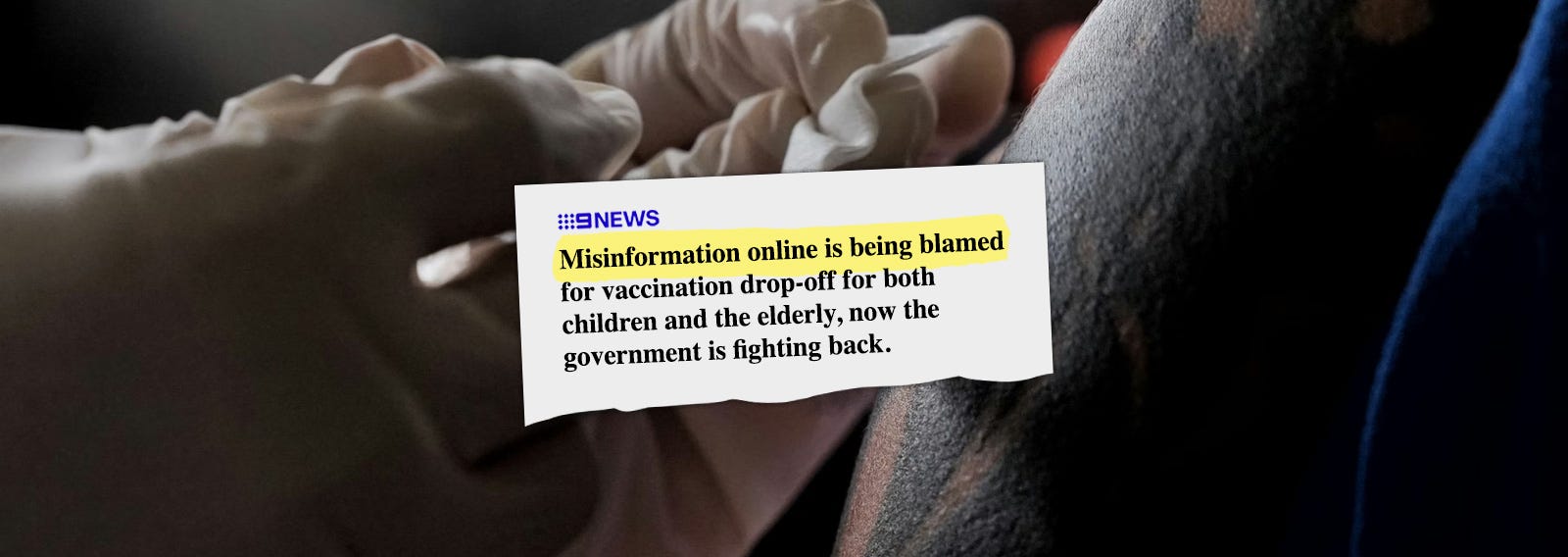
They’re gaslighting the public—again.
Online misinformation is being blamed for declining vaccination rates in Australia, particularly among children and the elderly. In response, the Australian Government is launching new national immunisation campaigns, with Health Minister Mark Butler pointing to online disinformation as a key driver of public hesitation.
While “vaccine fatigue” has been acknowledged as a contributing factor, the government still appears intent on shifting responsibility away from the very institutions now asking the public to trust them again.

The public is told the problem lies not with the decisions of government or the conduct of health authorities, but with ordinary people who have supposedly been misled. In doing so, they’re reframing their own crisis of credibility as a crisis of information. It’s those who felt duped that have been duped.
But declining trust in political and medical authorities didn’t emerge in a vacuum. It was forged and reinforced during the COVID-19 years.
Australia was once a country where public trust in institutions, such as the government, health authorities, and mainstream media, was remarkably high by historical standards. That trust was built over decades, even generations. And it was spent in a moment of madness.
During the pandemic, governments and authorities adopted sweeping, and unprecedented measures: prolonged lockdowns, blanket mandates, and restrictions applied broadly across populations regardless of individual risk or consent.
At the same time, the threat was often exaggerated. Health officials would hold press conferences, urging the public to call an ambulance at the first sign of symptoms, only for government representatives to warn soon after that ambulance services were under critical strain. The result was a constant sense of alarm. It was fear-mongering upon fear-mongering, crisis upon crisis.
Remember this?
Then came the vaccines, which were initially presented as a near-complete solution to the crisis. Over time, reports of adverse effects began to surface, yet discussion around them was often suppressed, particularly on major platforms like Meta Platforms and Google, under policies aimed at limiting “misinformation” during the global rollout.
Only years later has coverage of serious adverse outcomes begun to appear in mainstream outlets, including stories of individuals experiencing serious complications, and struggling through slow or opaque compensation processes.
Even ABC News Australia has reported on the overwhelming paperwork—hundreds of pages of medical reports, legal letters, and correspondence with the federal government—that victims are forced to wade through in years-long battles with the vaccine compensation scheme.
For many Australians, it’s not just that adverse effects occurred, but that open discussion of the risks was effectively prohibited. If you weren’t being censored by social media companies, there was a psychological campaign that turned the public into the militant arm of the government, so that neighbour turned against neighbour.
Caldron Pool, for example, was one of the few Australian platforms that consistently challenged the mandates. And it came at a cost. We were demonised, maligned, and in some circles effectively rendered “untouchable,” including within parts of the Christian community. Many in positions of leadership not only complied with every government directive but went further, framing each mandate as a practical outworking of Christian love.
The public became narrative gate-keepers—shunning family members, demanding compliance, reporting neighbours to the police—and many relationships were ruined as a result. Trust was eroding on every social level.
This is the context in which so-called “misinformation” now flourishes.
When people feel they’ve been misled, manipulated, or blatantly lied to they become less willing to accept official narratives. Suspicion inevitably fills the void left by lost credibility. In that sense, so-called misinformation is often downstream of a deeper problem: namely, a breakdown in trust between citizen and authority.
But blaming the public for that breakdown isn’t a meaningful solution. Any efforts to “combat misinformation”—one of the government’s favourite endeavours—only risk reinforcing the very environment that caused the distrust in the first place. When governments position themselves as the ultimate arbiters of truth, science, and morality, while dismissing dissent as dangerous, they don’t end up rebuilding confidence. They solidify scepticism.
As we noted in our submission opposing the Government’s 2024 misinformation and disinformation bill:
While the government may lament the prevalence of misinformation and “conspiracy theories” online, what they fail to grasp is that these things are largely the product of perceived dishonest power – which was only heightened during the Covid-era.
When the government, or the mainstream media, lies to the public, by feeding them what many believe to be blatant propaganda, it creates a suspicious people hesitant to heed the warnings or advice from those who have previously abused their trust, even when they are speaking the truth.
As such, we do not need the government to curb our freedoms to protect us from potential dangers. Freedom has never been a danger to the people. It has always been a danger to the powerful.
Censorship doesn’t protect the people from the spread of “misinformation.” It protects state-approved information from being challenged. It silences critics, undermines “democracy,” and stifles dissent, ensuring that only one approved narrative prevails.
If trust is to be restored, the starting point cannot be more messaging, more campaigns, or more attempts to police information. It must be accountability.
That means acknowledging that credibility was not stolen by fringe voices online. It was forfeited. It means admitting that communication was overly certain, dissent was wrongly punished, and the balance between public health and public trust was squandered.
It means treating citizens not as passive recipients of state-approved information, but as adults capable of weighing evidence when it is presented honestly. It means holding accountable every government employee, official, bureaucrat, and social leader who misled the public and wielded their positions of power and influence to abuse the rights of others.
Until that happens, no amount of government campaigns or advertising will reverse the trend because the issue was never simply misinformation. It was trust, and how those in positions of power squandered it.