


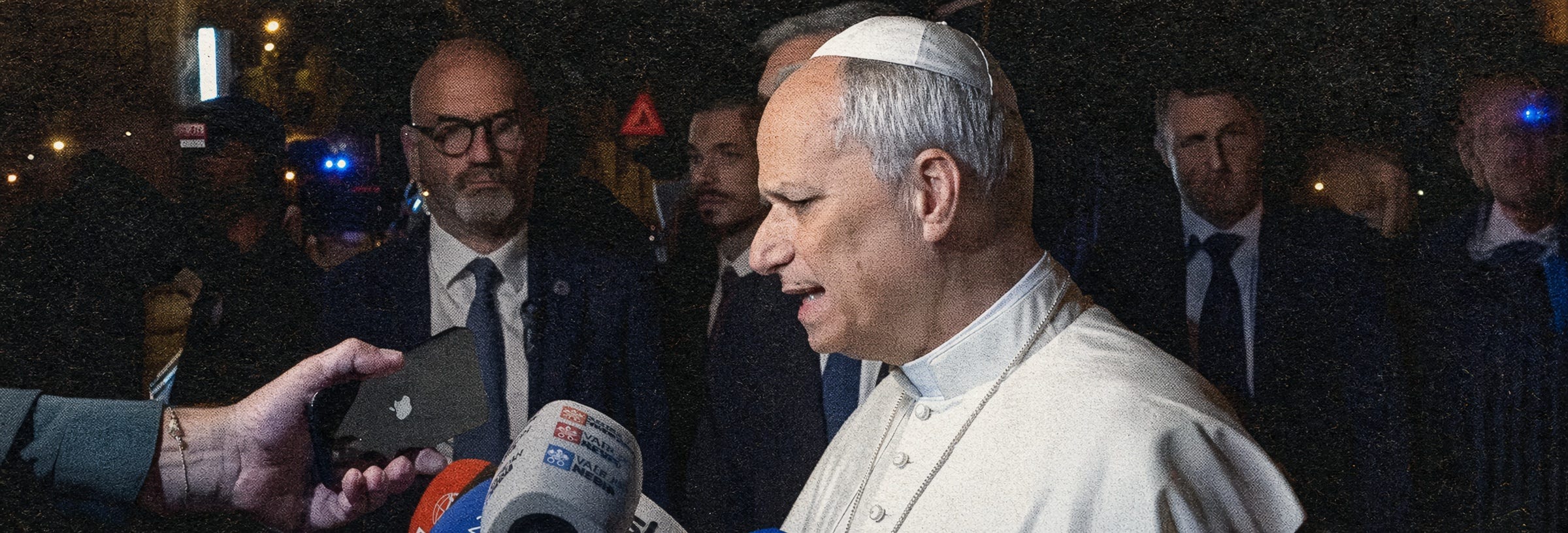
“Someone who says, ‘I’m against abortion,’ but says, ‘I’m in favour of the death penalty,’ is not really pro-life.”
That was Pope Leo XIV’s assessment. But that accusation collapses the moment we ask a question that should hardly need answering: Is there a moral difference between killing an innocent child and executing a convicted murderer? Is there a moral difference, for example, between killing a child and killing a child killer?

One sheds innocent blood. The other, when justly administered, punishes the person responsible for shedding it.
But treating these acts as morally equivalent blurs the distinction on which justice itself hangs.
A Christian doesn’t become inconsistent by opposing murder and supporting a just punishment for murder. Both convictions can flow from the same foundational truth that human beings are made in the image of God, and their lives must never be treated cheaply.
That is precisely the reason God institutes capital punishment in Genesis 9:6:
“Whoso sheddeth man’s blood,
by man shall his blood be shed:
for in the image of God made he man.”
Notice the rationale here. God grounds the punishment in the dignity of the victim. The murderer has destroyed someone who bears the image of his Creator. As such, the gravity of that crime warrants the severity of the sentence.
It is the sanctity of human life that is the foundation of the penalty.
Anyone claiming that a high regard for human life necessarily rules out capital punishment must reckon with this passage, because God expressly connects the two. It is because human life is sacred that its deliberate destruction demands such a severe reckoning.
The Pope’s formulation declares these convictions incompatible. Genesis brings them together.
For Christians, that should settle which authority requires correction. If someone’s moral assessment makes God’s judgments appear inconsistent, it is the assessment that must change. God does not answer to our standard of justice. We answer to His.
At this point, the obvious objection is that the murderer also bears God’s image. Of course he does. But bearing God’s image does not place a man beyond judgment for what he does to another image-bearer.
Human dignity includes moral responsibility. We are creatures capable of answering for our actions. The murderer’s humanity makes him accountable; it does not make his victim’s blood irrelevant.
Of course, Genesis 9:6 was not given in ignorance of the murderer’s humanity. The God who created man knew perfectly well whom He was commanding to be punished.
So, why should taking human life more seriously require treating its deliberate destruction less seriously?
A murdered person cannot be restored to his family. His children cannot recover their father. His parents cannot recover their son. The life taken is beyond the power of any court to return. Justice must reckon with that loss.
However, compassion becomes morally distorted when it has endless words for the murderer and scarcely anything to say about the person he murdered. The victim’s life mattered. His blood matters. A society’s response should make that unmistakably clear.
But it’s not just about punishment for the crime. Capital punishment also permanently restrains the offender. An executed murderer cannot kill another victim, whether in prison or after release. Society’s responsibility to protect life extends to those who might otherwise become his next victims.
Yes, imprisonment can restrain an offender too. But it is still less than just, as a life sentence could still only be carried out at the expense of the society that was wronged.
Yet, whether a murderer can be confined is distinct from whether death is a just punishment for the murder he has already committed. Justice concerns both the protection of potential victims and the punishment deserved for an actual crime.
A prison cell does not, by its mere availability, render God’s prescribed penalty immoral or unjust.
The Bible also recognises the warning carried by punishment. Deuteronomy 19:20 says that others will “hear, and fear” and refrain from committing the same evil.
This principle reflects a sober understanding of fallen human nature. Some people will refuse to do evil because they love what is good. Others may be restrained by fear of its consequences. A just society has reason to care about both.
We should therefore be slower to congratulate ourselves on our “moral superiority” over previous generations—especially at the rate at which we execute the unborn. Their willingness to impose severe punishment does not prove that they valued life less. It may reveal that they took the destruction of life far more seriously.
Of course, this is not an argument to give the state a licence to kill anyone they wish. A wrongful execution sheds the very innocent blood that justice is bound to protect. It turns the judge, jury, and executioners into the murderers themselves. It blurs and inverts the distinction between the innocent and the guilty.
The same God who authorises punishment for the guilty forbids the execution of the innocent. Exodus 23:7 commands: “The innocent and righteous slay thou not.” Deuteronomy 17:6 requires adequate witnesses before a capital sentence can be carried out.
The state must establish guilt, judge impartially and act within its lawful authority. A government cannot make an execution righteous merely by paperwork or decree.
As such, those who support just capital punishment should insist on rigorous safeguards precisely because innocent life is sacred. God’s law demands a high standard of evidence and holds malicious witnesses accountable: anyone proved to have deliberately given false testimony faces the very punishment he sought to bring upon the accused (Deut. 19:16–19).
And the New Testament gives Christians no reason to treat God’s justice as something embarrassing that must now be explained away.
Paul calls the law “holy, and just, and good” in Romans 7:12. That does not mean every Mosaic penalty transfers unchanged into every modern legal system. It does mean Christians should never condemn as inherently immoral a punishment God Himself commanded.
More directly, Romans 13:4 describes the governing authority as God’s servant, bearing the sword to execute judgment against wrongdoing. The sword is a weapon of execution.
Civilians are forbidden to pursue private vengeance. Civil authorities are charged with punishing evil. A Christian can forgive a murderer while recognising that the murderer deserves punishment. He can pray for the offender’s salvation while supporting a just sentence.
Abortion deliberately takes the life of an innocent unborn child. Just capital punishment takes the life of an offender whose guilt and liability to that punishment have been lawfully established.
The unborn child has committed no crime. The convicted murderer is being sentenced for one.
Any definition of “pro-life” that requires us to disregard that difference is a definition Christians should reject.
God forbids murder. God authorises capital punishment. And He grounds that punishment in the value of the human life the murderer destroyed.
There is no contradiction for Christians to apologise for here.
The Pope’s assertion fails because it treats the defence of innocent life and the punishment of its deliberate destruction as competing and contradictory convictions. Scripture treats them as consistent demands of justice.
We should too.