


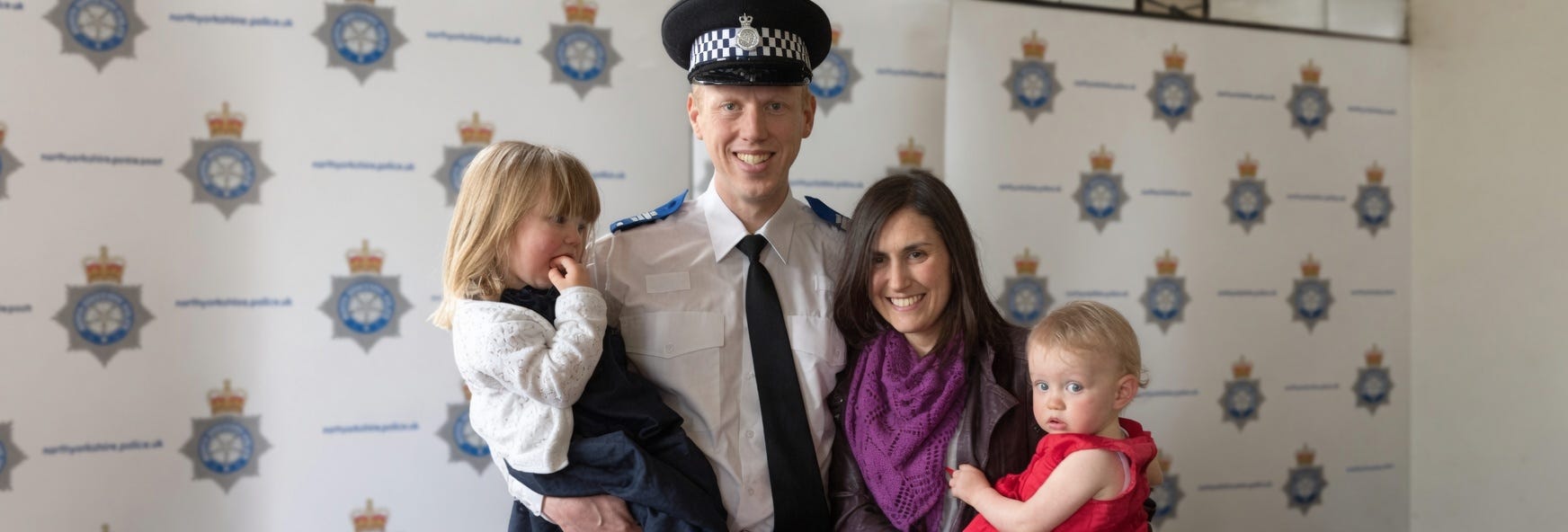
A Christian police officer in the United Kingdom says he was driven out of policing after asking questions about Islam during a Diversity, Equity and Inclusion (DEI) training course.
Luke Salmons, a former officer with North Yorkshire Police, said the force required officers to undergo DEI training in 2023 and 2024, as part of broader efforts to develop policies based on race, religion and culture.
According to the former officers, the setting was framed as an open and safe environment where participants were encouraged to ask questions and raise concerns. Salmons, however, soon discovered the limits to that “openness.”
Salmons said most of the training focused on Islam, and recounted one troubling session in September 2024, where he claimed educators walked up and down the rows of officers chanting, “Islam is a religion of peace.”
A month later, while attending yet another DEI session, this time led by a Muslim sergeant, Salmons asked how the instructor understood the concept of jihad as a peaceful Muslim, in the context of the war in Gaza.
Although Salmons maintained the exchange was respectful, just two days later, he was called into a private meeting with his inspector and suspended from his duties.
According to Salmons, the inspector told him, “I don’t like your beliefs.”
Salmons told Fox News Digital, “She took me in a room, deliberately said to me, ‘I don’t like your beliefs,’ which indicated to me that she was meaning my Christian beliefs, which is discrimination towards me and my faith.”
He was reportedly placed under investigation and advised by union representatives to apologise.
“There’s a real fear in the police about speaking out, about anything, especially to do with minorities, certainly about Islam,” he said. “There’s certainly a fear within the police and within institutions as a whole in the UK.”
Eight months into the investigation, Salmons officially resigned from the force. A month after that, a North Yorkshire Police disciplinary panel ruled that his conduct amounted to “gross misconduct” and barred him from serving as a police officer.
Salmons appealed the decision, with the help of Christian Legal Centre, and the appeal was upheld by Chief Constable Tim Forber. Forber found that while concerns had been raised, they did not amount to “gross misconduct” or a breach of professional standards.
He subsequently pursued legal action against the force, alleging he was discriminated against based on his religion. The matter has since been settled, although Salmons says he is yet to receive either an apology or an invitation to return to policing.
North Yorkshire Police stated to the BBC that it is an “inclusive employer and respects the rights of all individuals to their beliefs,” adding, “the expression of those beliefs must always be with due consideration of respect and courtesy in line with our force values and behaviours framework.”
The New Orthodoxy
Unfortunately, what we’re seeing here is not an isolated incident, but yet another example of how DEI has come to function throughout much of the Western world. It is sold with the promise of fairness and equality, but in practice, it operates as an ideological system that punishes certain segments of society, along with all those who refuse to affirm its incoherent assumptions.
And they are incoherent. A police officer attends a training course to promote diversity of opinions and beliefs. He respectfully asks a reasonable question about the subject repeatedly presented, and finds himself suspended, investigated, and ultimately driven from his career for wrongthink.
So, whatever DEI claims to be, fostering open dialogue and diversity of thought is clearly not among its priorities. And this is the problem with DEI—it doesn’t merely seek tolerance, it demands conformity. Certain groups and beliefs are granted protected status—regardless of what those groups believe—while others are placed under permanent suspicion and subject to legalised discrimination.
Christianity, in particular, is entirely unique in this hierarchy of respect and priority. Christians alone are expected to accommodate, affirm, and accept the beliefs of everyone else, forfeiting their own convictions when they clash with those of others. Yet it is often Christians who discover that the respect and tolerance demanded for other beliefs are rarely extended to their own.
It’s why stories like that of Salmons’ resonate with so many Christians. They’ve experienced something of it firsthand. There’s a pattern hard to miss. Christians are told they are free to believe whatever they like—provided those beliefs remain private. The moment Christian convictions shape public speech, prompt an uncomfortable question, or challenge an approved narrative, they have transgressed the limits of acceptability, and the Christians themselves will no longer be tolerated.
As such, Christians are tolerated only insofar as their faith remains a private matter and demonstrates little influence over what they say or do.
Of course, DEI advocates insist such programs exist to prevent discrimination based on diverse appearances, ideologies, religions, and cultures—yet, time and again, they seem to function as a weapon to silence and punish one of the only groups it is socially acceptable to marginalise: Christians—especially if you’re a White Christian.
This is why many, not just Christians, no longer view DEI as a helpful, necessary, or neutral framework. Many are seeing it for what it is. It is a weaponised ideology that divides society into approved and unapproved groups, protected and unprotected beliefs, and acceptable and unacceptable opinions.
Under the banner of inclusion, it excludes. We saw that last week in the case of Israel Folau (you can read more about that here). Under the banner of diversity, it narrows the diversity of thought and punishes all dissent. Under the banner of equity, it creates new forms of unequal treatment.
It’s not framed as such. Few institutions would openly admit to discriminating against Christians or White people, for that matter. Such a policy would be near-impossible to defend. Instead, the same outcome is achieved indirectly. Christianity is portrayed as the religion of the historically privileged White man. It is culturally dominant in Christian nations, and therefore, it is undeserving of the protections extended to others.
What you end up with is a system in which Christians are expected to not only tolerate but celebrate everything—except the public expression of their own faith.
As such, DEI programs have increasingly taken on the nature of a secular religion. It has its own doctrines, its own moral hierarchy, its own concept of sin—even a caste system! Those who question its assumptions aren’t debated, they’re denounced as heretics. They’re subjected to investigations, mandatory reeducation, professional sanctions, and social ostracism. And like all orthodoxies, it reserves its harshest penalties for those who foolishly think “diversity” means anything other than conformity to a world, not without religion, but without Christianity, in particular.
For generations, British institutions were shaped by Christian principles that emphasised justice, forgiveness, equality before the law, and the inherent dignity of every human being. Today, those same institutions are treating Christians as obstacles to progress rather than the spiritual heirs of their founders. As such, DEI turns the West against its own foundations, marginalising the Christian faith that played a central role in creating the very institutions now seeking to exclude it.
Salmons’ case isn’t an isolated incident. There’s a growing number of Christians who are finding out the hard way that there is a cost to remaining publicly Christian in modern institutions. The promise of “inclusion” extends to everyone—except those unwilling to abandon or conceal their Christian convictions.
And this is the incoherence of the DEI framework. If “diversity” cannot tolerate Christianity, if “equity” results in unequal treatment before institutional power, and if “inclusion” excludes Christians, then what is being promoted is not diversity, equity, and inclusion, but an ideological system that is increasingly anti-Christian in effect, seeking to reshape the world according to a vision in which Christianity is not just one of many options, but not an option at all.