



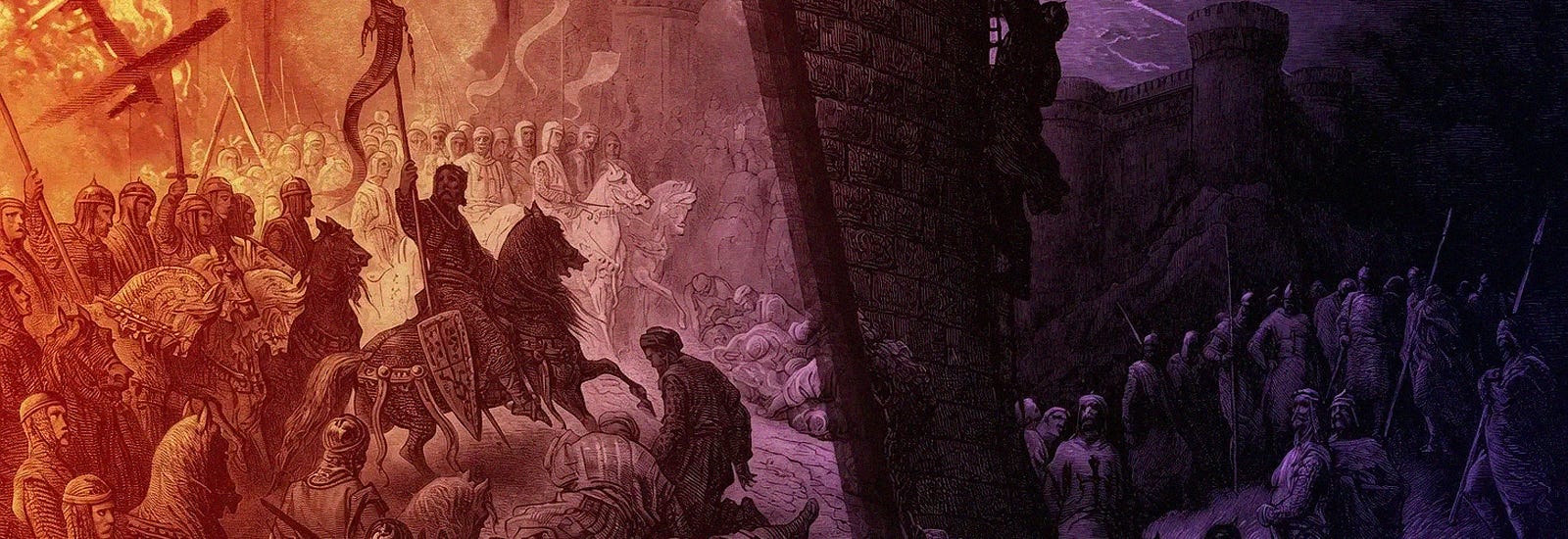
“What about the Crusades? The Inquisition? The Salem witch trials?” These are just a few of the accusations commonly levelled against Christianity by its critics.
Figures throughout history who are said to have committed atrocities or acted unjustly are often presented as acting in the name of the Christian faith, as though their behaviour flowed naturally from an overly zealous commitment to biblical teaching. The underlying aim is to appeal to the horrors of history in order to portray Christianity itself as inherently dangerous and immoral.
Today, there is an expectation that the heirs of Christendom ought to be ashamed of their spiritual heritage and even apologetic for the sins of earlier generations of professing believers. Yet this is a standard to which no other demographic is held. As such, it is a game Christians ought not to entertain. Not because Christians shouldn’t acknowledge sins—we should be the first to do that—but because the blame is entirely misplaced.
When an injustice is carried out by a professing Christian, or even in the name of Jesus, it does not follow that Jesus thereby endorses that injustice—any more than a criminal committing a crime in your name implicates you in their wrongdoing.
That is to say, if a professing Christian is out of step with the Bible, they are no longer acting consistent with their professed faith. At its heart, Christianity is a profession that Christ is Lord, and that profession implies the professor is Christ’s obedient subject. Thus, to profess to be a Christian, to profess that Christ is your Lord, while acting inconsistently with the Lord’s commands, is to deny with your actions what you profess with your mouth. It is, in essence, proof that your profession is not genuine and that you are, in fact, guided by another ideology and religion.
As such, whenever an injustice or atrocity is committed by a Christian or in the name of Christ, the question that must be asked is this: Is the injustice or atrocity consistent with the teaching and instruction of the Bible? Of course, those who seek to denigrate Christianity have little interest in honestly asking that question, since the answer would not only vindicate Christianity but also condemn them.
What they would find is that an injustice is only ever committed when one ventures beyond the bounds of Christianity. That is to say, the injustice is not an indication that the perpetrator was too Christian, but rather, not Christian enough.
In that sense, when an injustice or atrocity is committed by a professing Christian, they are ideologically closer to those who reject the Bible as their ultimate moral standard than to Christianity itself, which is defined by and confined to the bounds of Scripture. As such, Christianity doesn’t need to apologise for injustices orchestrated by professing Christians, because every injustice ever committed is carried out contrary to Christianity.
We must make no mistake: The horrors of history, and the horrors of the present, bear witness, not to the cruelty of Christendom, but to the cruelty of humanity when people deviate from Jesus’ commands to love your enemies and do good to those who hate you.
Every abuse and injustice, even those carried out in the name of the Church, is preceded by an explicit rejection of the New Testament.
What this means is that if anyone is to give an account for past acts of injustice, for historical atrocities and acts of cruelty against others, it is not the Christian who calls for stricter observance of Christian instruction, but the non-Christian who dismisses the Bible and attempts to operate outside the bounds and authority of God’s Word.
So it is not Christianity that must answer for historical injustices, but those who seek to live consistently with the ideological assumptions of the perpetrators—not the teaching of the Bible, but the rejection of it, even if it’s only in part.