


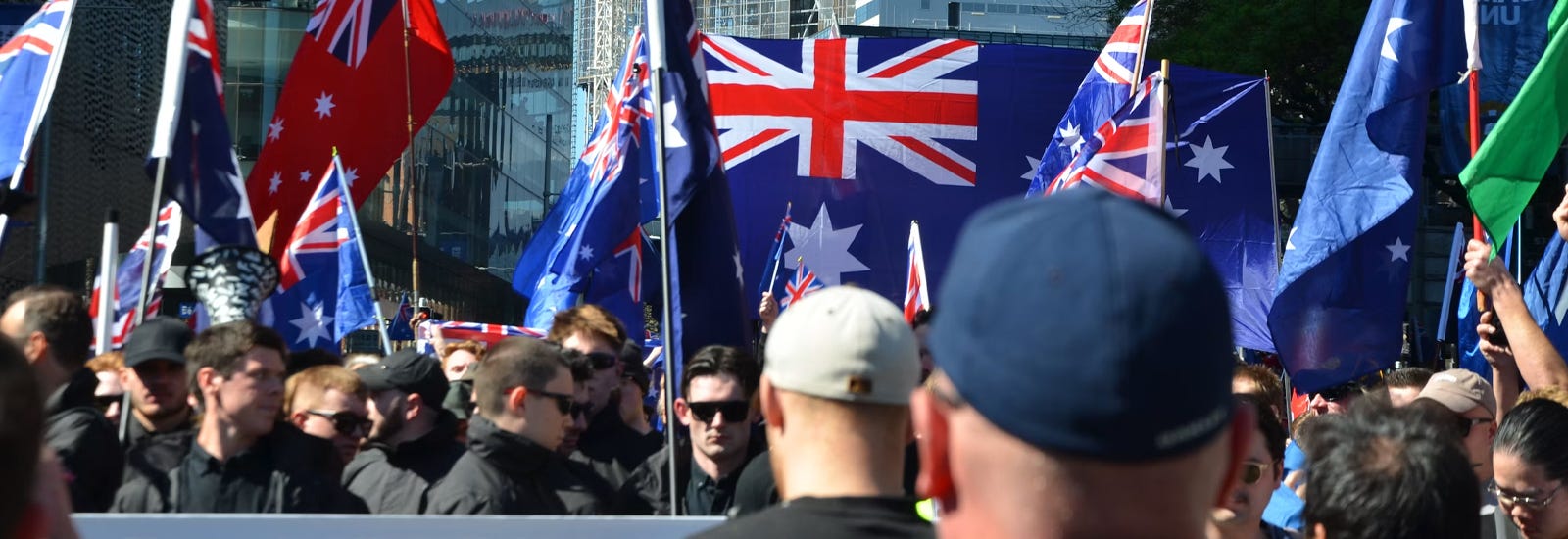
This week, the High Court in Australia is hearing a challenge brought by the White Australia Party against the Commonwealth Government’s decision to designate it a “prohibited hate group” under new federal legislation.
The designation was made by regulation in May. Under Part 5.3B of the Criminal Code, being a member of, directing, funding or otherwise supporting a prohibited hate group can constitute a serious criminal offence, carrying substantial prison penalties.
The White Australia Party is challenging the constitutional validity of the legislation itself. Among other things, it argues that the Commonwealth lacks the constitutional power to enact the regime, that it impermissibly burdens the implied freedom of political communication, and that it is inconsistent with the separation of judicial power under Chapter III of the Constitution.
But this isn’t an issue that should concern only supporters of the White Australia Party. You don’t have to agree with them, or anything they stand for, to recognise that giving a government the power to ban political organisations sets a precedent that should concern every Australian.
This is because the issue before the court is bigger than one political party. It’s about what happens when a government acquires the power to decide which political organisations Australians are permitted to form, support, and participate in.
That’s something that should concern anyone who values political freedom.
Let’s not forget how political elites and sections of the mainstream media characterised Christians and Christian organisations during the 2017 same-sex marriage plebiscite. Those who defended the biblical definition of marriage were routinely portrayed as motivated by “hate,” as though holding a traditional Christian position was not a legitimate contribution to a democratic debate, but evidence of bigotry, hatred and intolerance.
If being branded “hateful” is enough for the government to designate an organisation a “hate group”, how long will it be before churches face the same fate?
Yet democracy isn’t supposed to mean that the government decides which political opinions are acceptable and unacceptable for public life. Democracy, the kind of democracy that Australia so often prides itself on, means allowing citizens to hear competing arguments, form their own judgments and, ultimately, decide for themselves at the ballot box.
Sure, you might oppose the White Australia Party. You may believe Australians should reject its policies at the ballot box. That’s your right, and that is precisely the point.
The answer to a political opponent you dislike should ordinarily be political opposition, not political prohibition. Because once the principle is established that a government can ban a political organisation because it considers its ideology objectionable, the obvious question is: who decides where that power ends?
Perhaps today it’s a party you despise.
Tomorrow it could be a political movement you support.
The British Australian Community has raised precisely this concern, arguing that the law gives the executive government the power to shut an organisation out of public life without first proving criminal wrongdoing before an independent court.
In a recent press release, BAC President Harry Richardson argued that the regime allows serious consequences, including imprisonment for certain forms of membership, fundraising, or assistance, to flow from a ministerial designation rather than a criminal conviction.


The point is that punishment belongs in the hands of courts, not ministers.
If governments can remove political organisations before voters have the opportunity to judge them, the constitutional principle of representative government is severely undermined.
Our choices aren’t free if our options are selected for us.
Australia has confronted questions like this before. In 1951, the High Court struck down the Commonwealth’s attempt to dissolve the Australian Communist Party, finding the legislation beyond federal legislative power.
You don’t have to agree with the Australian Communist Party or the White Australia Party to understand that the state establishes dangerous precedent by undermining the rights of groups the public largely finds “indefensible.”
Who is going to stand up and say, “You can’t do that,” when doing so risks being accused of defending the “bad guys”?
To put it simply, this is about whether governments should be able to decide which political opponents are allowed to exist. That’s it.
If Labor truly believes in “democracy,” then it should trust Australians to reject “bad ideas” at the ballot box, not ensure that Australians can never vote on them at all.
That matters, especially when our governments are increasingly deciding which moral beliefs are acceptable and which are not.
What happens when the ideas deemed unacceptable include the moral teachings of Jesus?
We already know what they think of the Bible. We all remember the condemnation directed at Rugby player Israel Folau after he quoted 1 Corinthians 6:9–10 on social media.
At the time, Prime Minister Anthony Albanese called Folau’s beliefs “reprehensible” and “rubbish” that should be “called out” and “rejected.”

The question is not whether you agree with the political views of the White Australia Party. The question is whether you are willing to defend the principle of political freedom even when it protects people with whom you profoundly disagree.
Because the freedom you defend for your political opponent today may be the freedom you need for yourself tomorrow.