


It’s fairly obvious that much of the political establishment has lost its grip on the public mind. Across the Western world, a growing number of people are no longer swayed by emotional manipulation, celebrity endorsements, or the moral grandstanding of morally compromised politicians. They have seen the issues, from economic instability to social fragmentation, the eroding of culture and religion, and the degradation and squandering of our inheritance. It feels like everyone, everywhere, is suddenly beginning to question the ideological commitments that helped produce these devastating results.
This explains the surge in support for populist and right-leaning movements across Europe, the United States, and, increasingly, Australia. Whether one agrees with everything those movements represent or not, the shift itself signals something quite significant. Large numbers of ordinary people are no longer convinced that the political status quo serves their interests, their neighbours, or the nation as a whole.
People are beginning to ask simple questions: What changed? Why does life feel less stable than it did for our grandparents? What ideas and ideologies did we embrace that altered the social fabric so dramatically? What poisonous ingredient did we add to the mix that is currently spoiling the whole?
When the political class cannot—or will not—answer those questions persuasively, then it faces a serious problem. If it can’t win back the public mind with sound argument, it must resort to another strategy.
From Persuasion to Intimidation
Healthy politics relies on healthy debate. Competing and contradictory ideas are tested through reasoned argument. But when argument fails, when a political faction can’t justify its policies or defend its record, it’s forced to either abandon its position or else abandon persuasion, and instead opt for intimidation.
It’s an old tactic, really. If you can’t convince people not to choose an alternative, make them afraid to choose it. If you can’t lure them over, force them to flee.
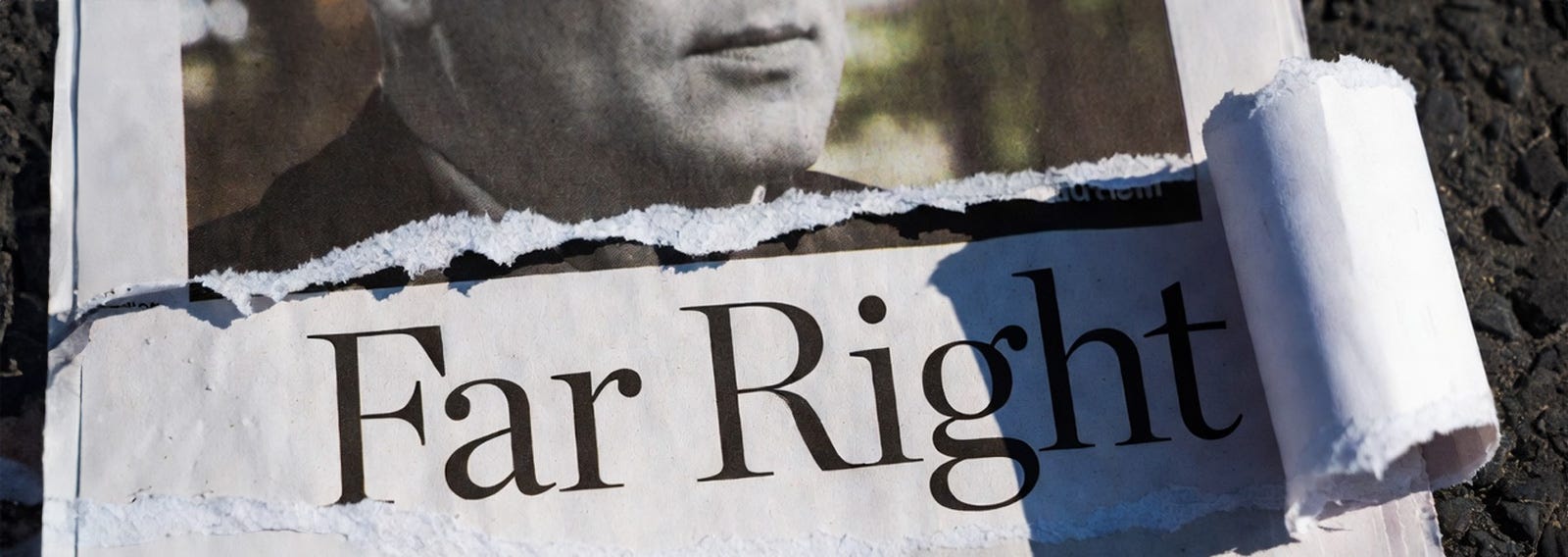
In recent years, we’ve seen this play repeatedly. Rather than engage populist or right-leaning movements on policy grounds, opponents simply seek to frame them as dangerously compromised. Bad names replace good arguments. “Far-Right” is now synonymous with everything slightly right of centre-left. “Nationalist” is now akin to “fascist” and “racist.” Anyone who isn’t committed to the establishment’s vision for the nation is basically a “Nazi.” Of course, the goal clearly isn’t to debate, but to stigmatise—to make a movement appear untouchable.
Once a movement is successfully branded socially heretical, ordinary citizens hesitate to associate with it—not necessarily because they’re convinced by the scare tactics, but because they fear the social consequences of associating with the socially ostracised. But what happens when the public is unfazed by the smear campaign? What happens when the public is no longer buying it? Because that’s a reality we’re now facing too.
When Smear Fails to Stir Fear
If bad labels alone don’t suffice, the demonisation often escalates to public lynchings.
The personal lives of figures who represent the movement are intricately scrutinised. Old social media posts resurface. Distant associations are examined and examined again. A long-forgotten handshake, a retweet, a careless remark, a photograph taken out of context, scorned former-lovers are platformed—all of these will now become grounds for national outrage and 24/7 news coverage.
Of course, the purpose isn’t merely to damage one individual’s reputation, but to manufacture a climate of fear around the entire movement. If supporting the movement risks public shaming, job loss, or reputational ruin, well, many will simply remain silent.
If public support continues to grow despite the smear job, the next step may even be legal, so that associating with the movement or those connected to it doesn’t just appear socially undesirable, but potentially criminal.
We’ve seen those in power artificially linking policies or positions to extremism and violent behaviour. This often looks like efforts to criminalise certain speech, restrict discussion of “controversial” topics, or redefine political dissent as a form of social harm or a threat to social cohesion.
Consequently, public debate is almost entirely avoided because voicing alternative ideas is now too costly. Citizens begin to wonder not only whether they should voice their opinions, but whether doing so could invite severe legal penalties if they unintentionally echo a view now deemed “extremism” by the establishment.
This approach doesn’t signal political confidence. It’s an admission of political insecurity.
An Old Strategy
None of this is new.
In the book of Nehemiah, as the walls of Jerusalem were being rebuilt, opposition arose—not through open military assault, but through false accusation. Nehemiah and his fellow Israelites were branded dangerous political extremists. They were accused of plotting a violent rebellion (Neh. 6:6). The aim was simple: intimidation.
Nehemiah recognised the strategy immediately: “They all wanted to frighten us, thinking, ‘Their hands will drop from the work, and it will not be done’” (Neh. 6:9).
Truly, when debate is lost, slander becomes the weapon of the loser.
The enemies of Jerusalem did not refute Nehemiah’s mission. They simply rebranded it as dangerous. They attempted to paralyse conviction and stifle the movement through fear.
We can learn from Nehemiah’s response. When his enemies falsely charged him with evil, hoping the accusation would cause him to abandon his mission, Nehemiah didn’t retreat, and he didn’t allow the false charge to define him, change him, or alter his purpose. Instead, he prayed, “O God, strengthen my hands” (Neh. 6:9).
The Safety of Silence
Today, the pressure is sometimes subtler but very similar. Many remain silent, not because they have abandoned their convictions, but because they fear being labelled bigoted, extremist, or dangerous—especially by those threatening to put them in jail should they be any of those things. Reputation, career, social standing, and even freedom can feel fragile. Silence appears safe.
But silence, when driven by fear of false accusation, is cowardice—and cowardice is sin (Rev. 21:8). If Nehemiah yielded to intimidation, the wall would have remained unfinished. If citizens today surrender their voice out of fear of slander, then public discourse evaporates, and freedom is eventually lost.
Of course, this isn’t a licence for recklessness or cruelty. It’s not permission to speak without understanding or charity. The Bible has a lot to say about taming the tongue. It is a reminder that fear mustn’t become the governing principle of civil life. It is a reminder that wisdom must control the tongue, not fear.
Charles Spurgeon once observed that it is no new thing for the best men to be evil spoken of. If they spoke evil of Jesus, why would we imagine we could avoid it? The world has always used slander to restrain those it cannot refute.
Faith Not Fear
When those in power, or those striving for power, abandon persuasion and reach for scare tactics, they reveal their own fragility. Confidence welcomes scrutiny, and truth isn’t intimidated by lies. It’s why Christians are virtually the only religious group not to demand special state-protections against criticism. Insecurity demands silence.
So, what is the answer? What’s the solution to the name-calling? The antidote to intimidation isn’t aggression, but courage. This is something we must be committed to. If we’re not, we risk turning our society from one governed by reason to one governed by fear.
Let us pray with Nehemiah, “O God, strengthen my hands” (Neh. 6:9).