


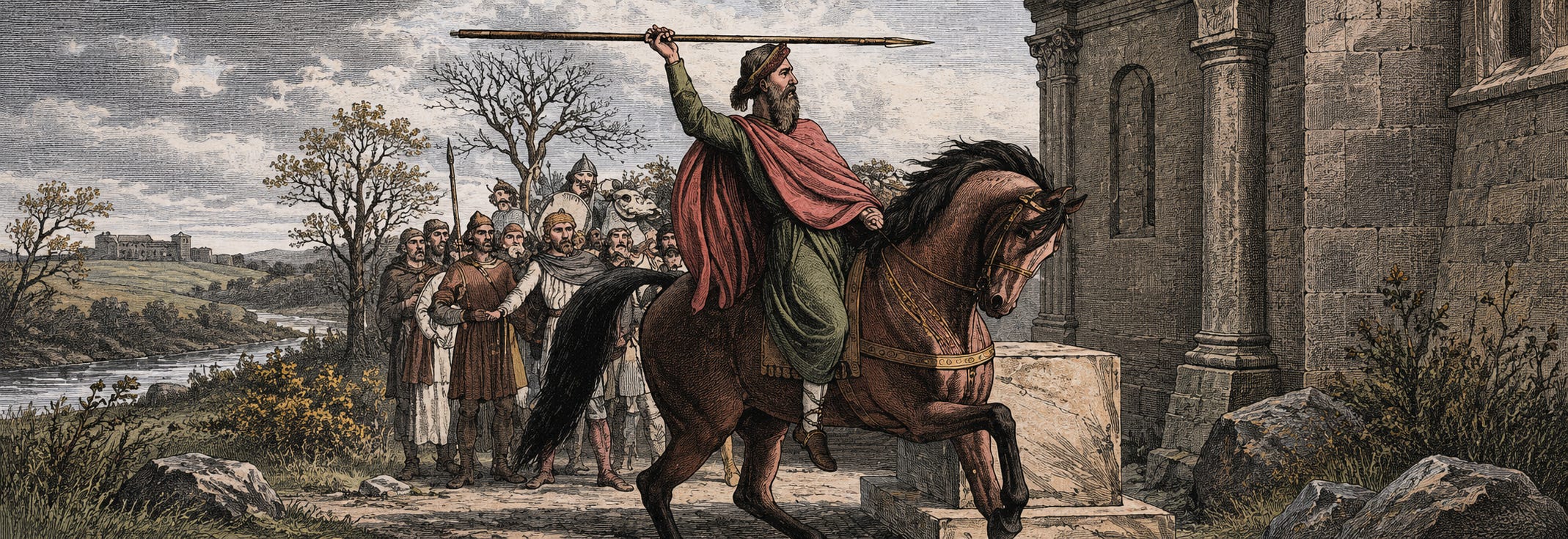
When Christianity began to spread throughout the Anglo-Saxon kingdoms of Britain, among those who embraced the faith was a man who had devoted his life to the service of the pagan gods.
Coifi, the high priest of King Edwin of Northumbria, had grown increasingly disillusioned with the religion he served. The more diligently he sought the truth in the worship of his gods, the less he found it.
In AD 627, having heard the preaching of the Christian missionary Paulinus, Coifi urged the king to abandon paganism and embrace the Christian faith. But Coifi wasn’t content merely to renounce his former religion. He volunteered to personally destroy the very temples and altars he had once consecrated.
As Bede records in his Ecclesiastical History of the English People:
“Coifi, hearing his words, cried out, ‘I have long since been sensible that there was nothing in that which we worshipped; because the more diligently I sought after truth in that worship, the less I found it. But now I freely confess, that such truth evidently appears in this preaching as can confer on us the gifts of life, of salvation, and of eternal happiness. For which reason I advise, O king, that we instantly abjure and set fire to those temples and altars which we have consecrated without reaping any benefit from them.’
“In short, the king publicly gave his licence to Paulinus to preach the Gospel, and renouncing idolatry, declared that he received the faith of Christ: and then he inquired of the high priest who should first profane the altars and temples of their idols, with the enclosures that were about them, he answered, ‘I; for who can more properly than myself destroy those things which I worshipped through ignorance, for an example to all others, through the wisdom which has been given me by the true God?’
“Then immediately, in contempt of his former superstitions, he desired the king to furnish him with arms and a stallion; and mounting the same, he set out to destroy the idols; for it was not lawful before for the high priest either to carry arms, or to ride on any but a mare.
“Having, therefore, girt a sword about him, with a spear in his hand, he mounted the king’s stallion and proceeded to the idols. The multitude, beholding it, concluded he was distracted; but he lost no time, for as soon as he drew near the temple he profaned the same, casting into it the spear which he held; and rejoicing in the knowledge of the worship of the true God, he commanded his companions to destroy the temple, with all its enclosures, by fire.
“This place where the idols were is still shown, not far from York, to the eastward, beyond the river Derwent, and is now called Godmundinghan, where the high priest, by the inspiration of the true God, profaned and destroyed the altars which he had himself consecrated.”
Perhaps those seeking to revive the paganism of their ancestors today ought to consider why their ancestors were so willing, and indeed so eager, to abandon it.