



As public trust in legacy media continues to decline and audiences increasingly turn to alternative platforms such as YouTube for news, commentary, and entertainment, the UK government is proposing an Orwellian attempt to reshape the online marketplace of ideas by effectively seizing control of your algorithm.
Under the proposals contained in its consultation, Watch This Space: A New Strategic Direction for UK Media, the government is considering a mandatory “prominence regime” that would require platforms, such as YouTube, to give preferential treatment to public service broadcasters, including state-media outlets like the BBC, ITV, and Channel 4.
In effect, this would amount to government-directed manipulation of online algorithms, which would artificially elevate state-backed and legacy media while making it more difficult for independent journalists, commentators, educators, and digital creators to reach and grow their audiences organically.
In other words, rather than allowing users to decide what they see first on their social platforms, the proposal would allow the government to dictate that decision for them.
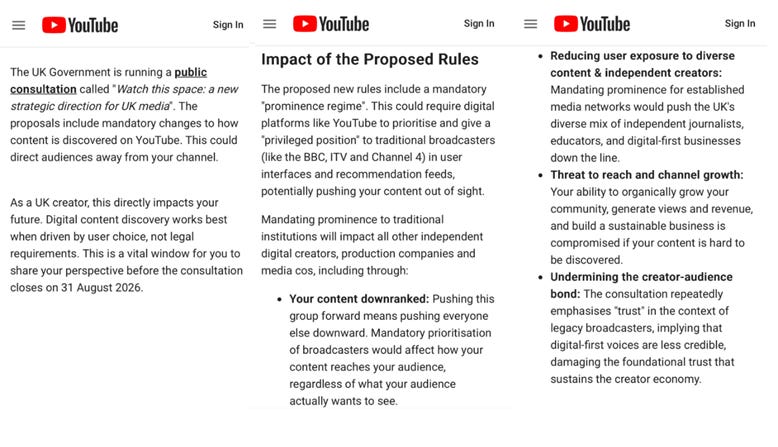
YouTube itself has issued a warning to UK creators concerning the move and has encouraged them to make submissions for the consultation, which closes on 31 August 2026.
In a statement widely shared on X, the company wrote:
“The UK Government is running a public consultation called ‘Watch this space: a new strategic direction for UK media’. The proposals include mandatory changes to how content is discovered on YouTube. This could direct audiences away from your channel.”
It continued:
“Digital content discovery works best when driven by user choice, not legal requirement.”
According to YouTube, the proposed rules could have far-reaching consequences for independent creators, with the company warning that content could be down-ranked, independent voices could lose visibility, creator growth could be restricted, and user choice could be diminished.
The move has sparked backlash online, with many warning that the concern extends well beyond YouTube.
Reform UK leader, Nigel Farage, slammed the proposal, describing it as “appalling state censorship.”
“Labour now want to seize control of YouTube’s algorithm,” Farage warned in a post on X. “They want YouTube to artificially boost BBC and Channel 4’s content, and suffocate independent journalists and producers.
“The BBC has been biased to pro-mass migration, open borders, and Net Zero views these past few decades. It’s part of the reason we’re in a mess. The BBC’s own internal reports admit and document some of this bias.”
Farage said the public shift towards alternative platforms, such as YouTube and X, comes, in part, as a response to that bias.


The proposal is just another example of governments attempting to regain influence over public discourse after losing their longstanding dominance through traditional media outlets.
The invention of the internet brought with it a new form of media that the mainstream simply couldn’t compete with. After holding the monopoly for decades, legacy institutions are now, for the first time, facing genuine competition.
But rather than adapting organically to this new environment, the state appears to be attempting to intervene in order to cripple the competition, artificially boost its content, and regain that dominance through legislative power.
Public trust is earned, not demanded. And the state’s suppression of alternative voices in order to elevate its own only underscores why so much of the public has tuned it out.