



Libertarian NSW MLC John Ruddick has condemned Australia’s ongoing and ever-growing assault on free speech, accusing Australia’s eSafety Commissioner of waging a campaign against independent media and online communication platforms.
Speaking in the New South Wales Parliament this week, Ruddick pointed to the federal government’s legal action against the encrypted messaging platform Telegram and the recent suspension of independent Australian news outlet The Noticer from X as evidence that governments are increasingly seeking to control what Australians can see, read, and say online.
“The battle over free speech will go on and on until we amend the New South Wales Constitution and the Commonwealth Constitution to enshrine the citizens’ right to free speech,” Ruddick said.
Ruddick’s motion comes after the eSafety Commissioner launched civil penalty proceedings against Telegram in the Federal Court on June 30, alleging the platform had failed to comply with Australian online safety requirements.
Ruddick argued that targeting entire communication platforms over posted content sets “a dangerous precedent for government control over digital speech.”
He said Telegram is relied upon by millions of users for private communication, journalism, and everyday conversation, and argued that criminal activity online should be dealt with by prosecuting the offenders, not by censoring or shutting down platforms used by law-abiding Australians.
Ruddick also noted the recent suspension of popular Australian-first news outlet The Noticer from X.
“The timing of The Noticer’s suspension, coming shortly after the eSafety Commissioner’s aggressive action against Telegram, raises legitimate questions about whether Australian regulators or other agencies are applying pressure on platforms to silence dissenting or independent voices,” he said.
He further argued that the eSafety Commissioner has developed a pattern of regulatory overreach, citing several recent legal defeats. Among them, he referenced the Full Federal Court’s dismissal of the Commissioner’s appeal in the Baumgarten case involving criticism of a primary school’s queer club, the Administrative Review Tribunal’s decision overturning a takedown order against commentator Chris Elston, also known as Billboard Chris, in 2025, and the Commissioner’s abandoned Federal Court case against X after the court refused to grant a global injunction over footage of the stabbing of Bishop Mar Mari Emmanuel.
Ruddick rightly noted that those defeats demonstrate that the regulator has repeatedly exceeded its authority.
“These repeated losses expose overreach by an unelected regulator, risking further chilling of lawful speech, independent journalism and open debate,” he said.
Ruddick went even further and argued that the government’s actions form part of “a broader and ongoing attempt to censor right-leaning political commentary and discussion in Australia.”
He said lasting protection will only come through constitutional reform, arguing that Australians should have an explicit constitutional guarantee preventing governments from restricting access to lawful information or policing public debate.
Sharing a video of his speech on X, Ruddick said, “There is only one solution to the free speech crisis in Australia—a constitutional amendment which prohibits the government from curbing what information you can and cannot access.”

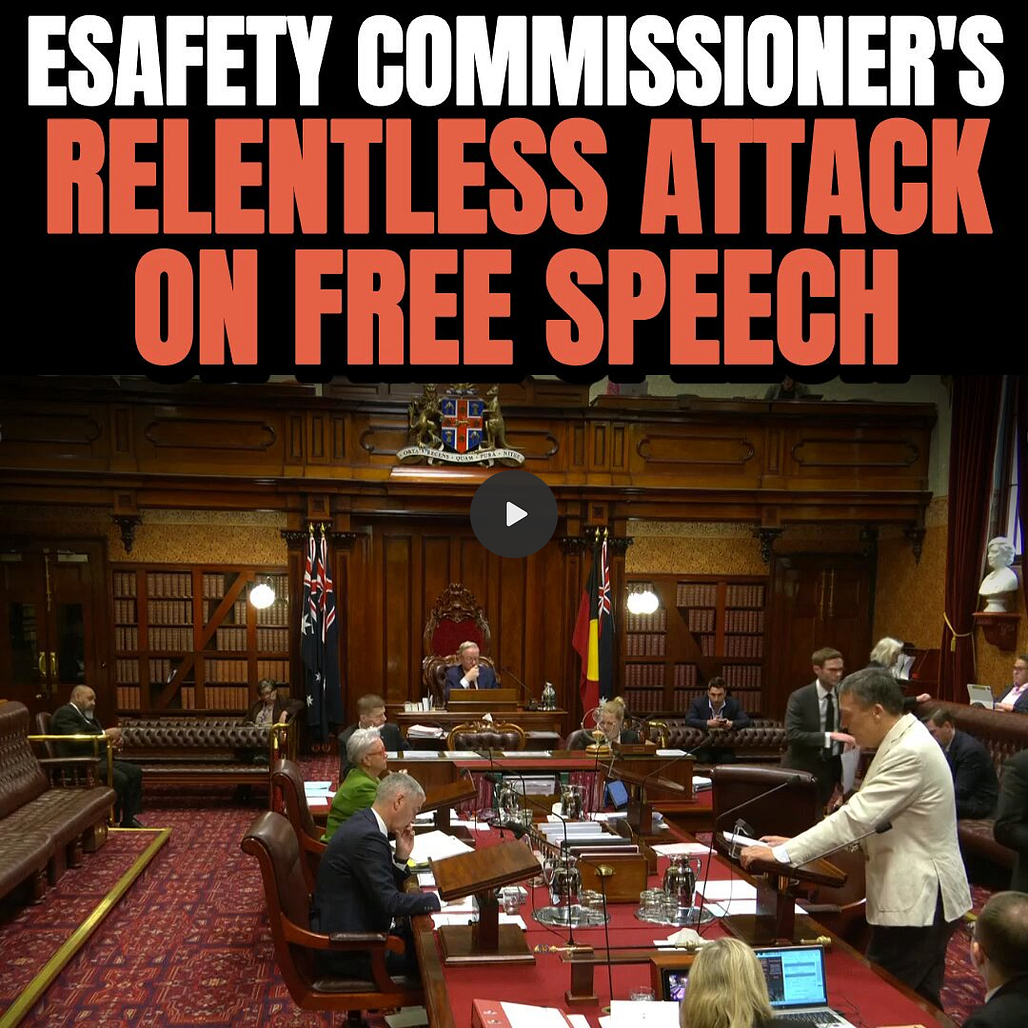
Ruddick is absolutely correct. Australia likes to pride itself on being a “democracy,” yet democracy depends on the fundamental right of citizens to speak freely—and therefore to think freely—without fear of persecution, reprisal, or punishment.
Just as there is an inseparable connection between a free society and the freedom to communicate, there is an equally vital link between free speech and free thought. Speech is, after all, the outward expression of thought. It is how ideas pass from one mind to another.
In a country where people face consequences for what they say, there are inevitably consequences for what they think. When certain opinions become too costly to express, they are gradually driven from public discourse. As a result, the range of ideas that can be freely debated is narrowed only to those the state is willing to tolerate.
To restrict speech is to restrict thought—not only by limiting what people can say, but by limiting the ideas others are permitted to hear, consider, and ultimately accept.