



The Presbyterian Church of NSW and the ACT has voted 136–61 to reaffirm that the office of elder is reserved for qualified men, bringing it into line with every other state church in the Presbyterian Church of Australia.
While many who have no intention of ever attending a church have responded with a barrage of criticism, the question that was before the Church is not whether the culture approves of male eldership, but whether Scripture teaches it. The decision is therefore not one based on tradition, preference, or cultural attitudes, but on the authority of God’s Word.
The Bible does not present male eldership as a secondary issue or a matter of personal opinion. Rather, it is rooted in the order God established from creation and reaffirmed throughout Scripture.
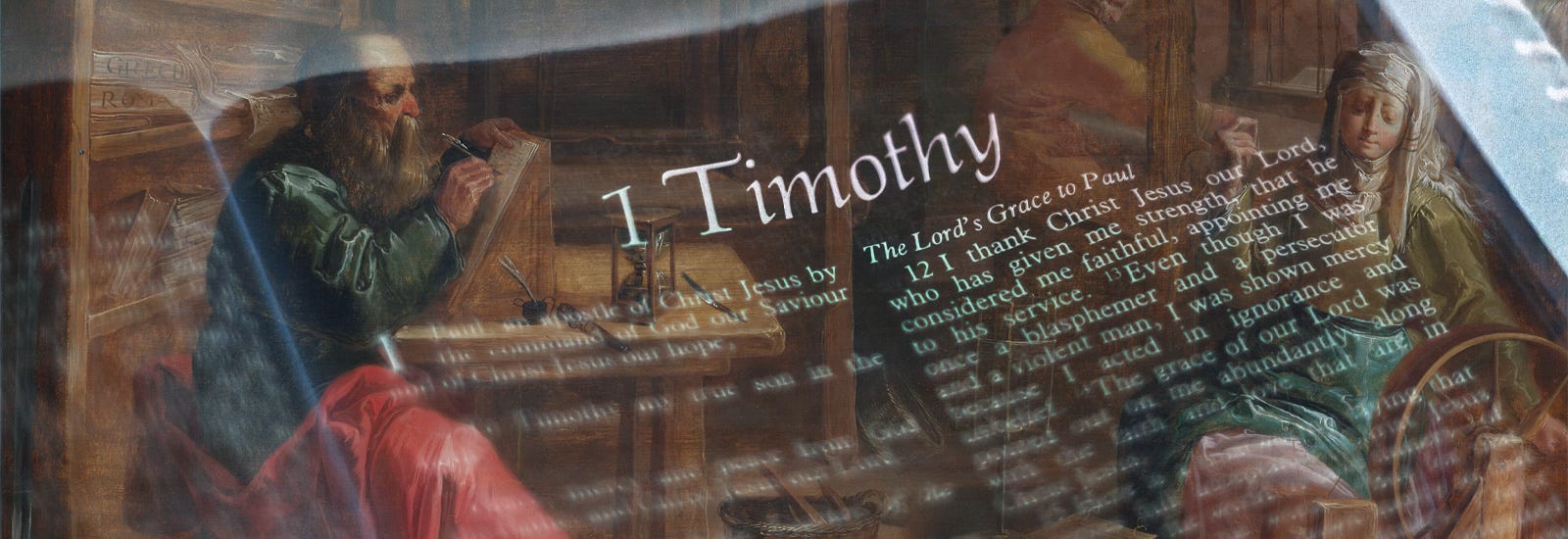
In 1 Timothy 3:2, Paul defines the qualifications for an elder:
“Therefore an overseer must be above reproach, the husband of one wife…”
Paul does not provide qualifications for a female elder, but repeatedly describes the office of overseer in terms of qualified men. The same pattern appears when Paul gives qualifications for deacons, again describing them as “the husband of one wife” (1 Tim. 3:12).
He explicitly addresses the question of authority and teaching in 1 Timothy 2:11–14:
“Let a woman learn quietly with all submissiveness. I do not permit a woman to teach or to exercise authority over a man; rather, she is to remain quiet. For Adam was formed first, then Eve; and Adam was not deceived, but the woman was deceived and became a transgressor.
Of course, since the militant rise of feminism, endless attempts have been made to make Paul mean anything and everything other than what he plainly says. Some have sought to redefine what “teach” and “exercise authority” could possibly, maybe, might mean, rendering his command virtually unknowable, or even irrelevant to the question of female ordination.
Others have suggested that Paul is speaking only to a specific situation that arose in Ephesus, where Timothy was ministering. Historically baseless theories have been put forward about a particular group of disruptive women who allegedly interrupted church services with objections and commentary. Yet neither Scripture nor history provides any evidence for such claims. They are imposed on the text for the sole purpose of rendering Paul’s command outdated and therefore irrelevant.
More importantly, however, Paul himself gives the reason for his instruction. He doesn’t appeal to some temporary cultural situation, but to the timeless, created order itself:
“Because Adam was formed first, then Eve.”
Paul’s argument is not that women in Ephesus were uniquely problematic, but that God established a pattern in creation that is to be emulated within the Church. His reasoning reaches back before Greek culture, before the first century, and even before the Fall itself. Paul’s basis is found in the opening chapters of the Book of Genesis.
What’s more, Paul explicitly tells us that this is not a rule limited to Ephesus, but one established in “all the churches of the saints.”
In 1 Corinthians 14:33–35, the Apostle says:
“...As in all the churches of the saints, the women should keep silent in the churches. For they are not permitted to speak, but should be in submission, as the Law also says. If there is anything they desire to learn, let them ask their husbands at home. For it is shameful for a woman to speak in church.”
The consistency of Paul’s teaching across different churches demonstrates this command was not a local solution to a local problem, but part of the order he expected the churches of Christ to follow, regardless of where they worshipped and when.
Some, of course, have pointed to notable women in Scripture, such as Deborah, Phoebe, or even Priscilla, as though they prove Paul wasn’t serious about excluding women from the official office of elder.
But none of these examples makes that case. Not only are they exceptions to the ordinary pattern, but none of them ever functioned in the covenant offices reserved for men. Deborah was not a priest or elder. Phoebe is not identified as an elder. Priscilla helped teach Apollos alongside her husband, but she never held the governing office of the church.
The question is not whether God has used women in significant ways; He clearly has. The question is whether Scripture establishes women as holding the governing office of elder. The biblical evidence simply does not support that conclusion.
So, when Paul taught that the church was to be led by qualified men, he was not instituting a new principle of covenantal male leadership. Rather, he was reaffirming a pattern established from the very beginning.
Throughout Israel’s history, God’s people were represented and governed by male heads of households. These elders led the congregation in the worship of the true God under His Law.
The New Testament does not overturn this creational and covenantal order. Rather, it re-establishes it in the church through the leadership of qualified male elders and deacons.
Male-only leadership in the church is therefore not an isolated Pauline command. It is the continuation of a biblical pattern that begins in creation, continues through the covenant people of Israel, and is carried into the New Covenant Church.
Fatherly rule on earth—in the home and at church—ought to reflect God’s fatherly rule in heaven. That is why the modern war on the patriarchy is ultimately a war against God and the order He has established.
That said, the fact that the official office of elder is reserved for men does not mean women have no role to play within the church. Scripture does not merely restrict; it positively assigns different responsibilities to people on the basis of their God-given sex. As such, God has given women important ministries that are distinct, unique, valuable, and necessary within the life of the Church.
Older women have a responsibility to teach, but that responsibility is to be defined and limited by Scripture alone.
In Titus 2:3-5, Paul writes:
“Older women likewise are to be reverent in behaviour, nor slanderous or slaves to much wine. They are to teach what is good, and so train the young women to love their husbands and children, to be self-controlled, pure, working at home, kind, and submissive to their husbands, that the word of God may not be reviled.”
In other words, women have a teaching and training ministry, but it is not directed towards instructing other women’s husbands on how to worship God, lead their families, or live as Christian men. Rather, it is directed towards other women—young women in particular—teaching them the practical outworking of faithful Christian womanhood.
That Paul assigns this responsibility to “older women” suggests that this is a ministry born of years of wisdom, first-hand experience, and a deep familiarity with marriage, motherhood, and family life. It is a responsibility he does not assign to the older men.
Ultimately, the question is not whether modern sensibilities find the Bible’s teaching acceptable, but whether the Church is willing to submit to the authority of Christ speaking through His Word. If Scripture is our final authority, then it cannot be reinterpreted every time the culture changes.
The Bible ought to shape the culture, not the culture shape the Bible.
In an age increasingly hostile to God’s created order, the Presbyterian Church has chosen fidelity over popularity, conviction over compromise, and obedience over cultural approval. And for that, they ought to be commended.
The only question that remains is what they’ll do about the women who have already been ordained as elders in the Presbyterian Church.