


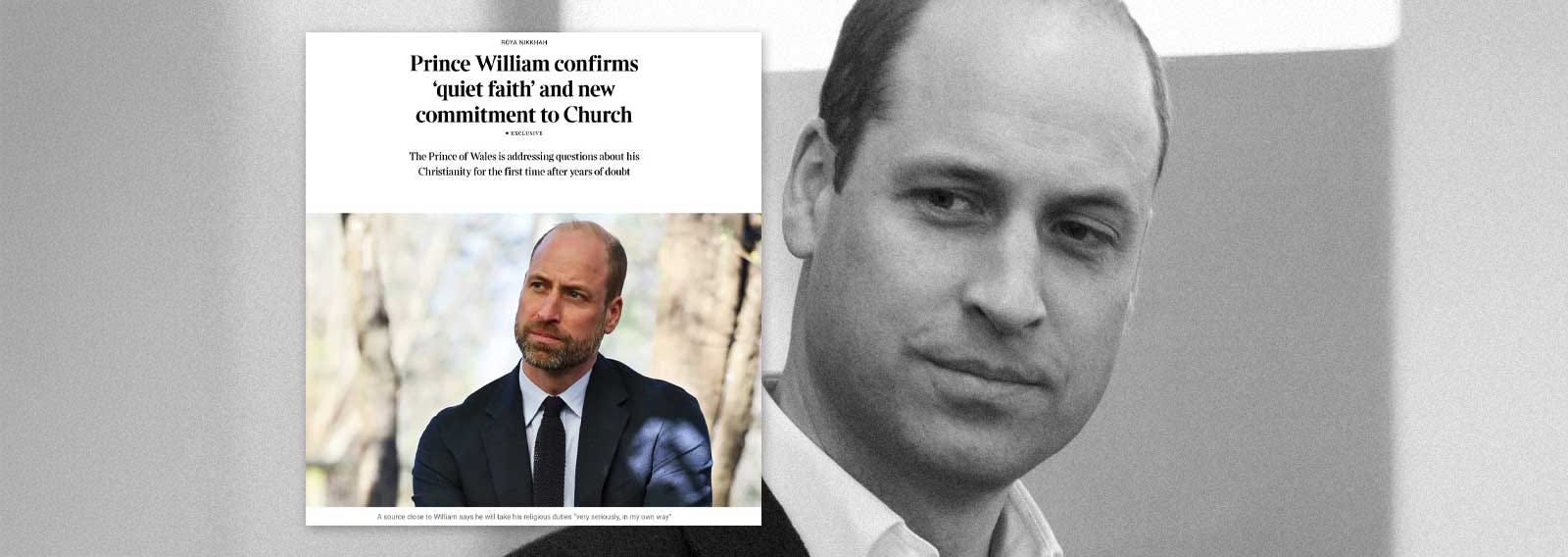
After years of public silence and plenty of speculation, Prince William has finally offered a glimpse into his religious life, describing his commitment to Christ as a “quiet faith.” For a man who will one day become Supreme Governor of the Church of England, the description is rather underwhelming.
It also appears consistent with his practice. Reports have long suggested that William is not a regular churchgoer, certainly not with the consistency of his father, King Charles III, or his grandmother, Queen Elizabeth II. While some have welcomed his emphasis on a personal, inward faith, others see in it something less reassuring. Perhaps it’s a signal that Christianity, the established religion he’ll eventually represent, is not much of a priority.
That concern was highlighted by Fr Calvin Robinson, who remarked on the original story, stating: “Now is not the time for ‘quiet faith.’” He’s right. A future king’s religion is never merely private. It inevitably carries public consequences. Not only for his own soul, but for the moral and cultural direction of the nations he will serve. And that’s as important today as it’s ever been.
Experts have warned for some time that the United Kingdom is a powder keg, ready to erupt into civil unrest—much of it driven by deepening religious and cultural tensions. In such a moment, a purely private and “quiet faith” isn’t going to be all that effective in solidifying the kingdom’s identity and direction.
This matters because Britain is not religiously neutral in its history or its institutions. Its identity has been profoundly shaped by Christianity. The Union flag itself bears the crosses of St George, St Andrew, and St Patrick, and its legal and political traditions have long been influenced by biblical categories of justice, authority, and order. In short, Christianity has been a defining force in the nation’s formation, and must remain at the forefront if the nation is going to maintain its identity.
Yet modern Britain, like much of the West, is wrestling with an identity crisis. It is unsure of what it is—at least, at the levels of power—and therefore uncertain of where it is going. The attempt to be everything to everyone, religiously, culturally, and morally, has left a vacuum. A nation that refuses any defining centre risks becoming, in the end, defined by nothing at all.
None of this means that what Britain needs right now is mere religious performance. A hollow, public religiosity would serve no one. A king who professes Christianity without genuine conviction would likely only deepen cynicism. And yet, there remains a meaningful distinction between a “quiet faith” and a visible commitment. Even a sincere private faith, if it never expresses itself publicly, can’t offer much guidance to a nation desperately in need of direction.
Like them or loathe them, the royals still hold significant influence. As heir to the throne, William already represents stability, family, and continuity. These are no small virtues. But if they were joined to a serious, articulate, and unashamed Christian faith—one consistent with the vows he will one day make at his coronation—that witness could become a powerful force for good, both in Britain and beyond.
What’s the alternative? The monarchy won’t collapse overnight, but will gradually become more and more irrelevant. A monarchy that no longer embodies the convictions it was established to defend will eventually fade into ceremonial insignificance. And that sort of influence, once lost, is rarely regained.
There is real potential here. But it won’t be realised through a faith that remains entirely private.
And yet, for all the focus on princes and institutions, the responsibility does not rest with them alone. There is something ordinary Christians can do. Something far more accessible and far more powerful than political leverage or cultural influence.
The New Testament places this responsibility squarely before the Church. Writing to Timothy, the Apostle Paul urged that “supplications, prayers, intercessions, and thanksgivings be made for all people, for kings and all who are in high positions” (1 Tim. 2:1–2). It is a remarkable command, especially given the context in which Paul was writing. These were rulers who severely and violently persecuted Christians.
The purpose of the petition, according to Paul, is exactly what most of us desire, namely, “that we may lead a peaceful and quiet life, godly and dignified in every way.” Do you want a peaceful life? Pray for the powerful. Do you want a quiet life? Pray for kings and queens. Do you want a godly life? Pray for governments. Do you want a dignified life? Pray for those who wish to dominate you.
Such prayers are not selfish or self-serving. As Paul goes on to say, they are “good and pleasing in the sight of God our Saviour, who desires all people to be saved and to come to the knowledge of the truth” (1 Tim. 2:3–4). The hope of Christianity is not reserved for the weak or the marginal; it extends to kings, ministers, and presidents alike.
So if the question is what can be done in uncertain times, the answer isn’t “cross your fingers and hope.” It is prayer.
Pray, in the fullest sense, “God save the King”—not merely for the preservation of a crown, but for the salvation of the one who wears it and the well-being of the people he represents. Pray that those who govern, whether in Britain or elsewhere, would rule with justice, humility, and a deep accountability before God. Not a “quiet faith” that is outwardly irrelevant, but a living conviction that shapes both word and deed.
History has shown, more than once, that by God’s grace, even a Nero can become a Constantine. And God knows we need that kind of leadership today.
Jesus. On the right track. But you forget Jesus. We don’t follow an Old Testament or a New Testament or Paul. We follow Jesus. And we can pray for William to have a life-changing encounter with his Lord and King.