


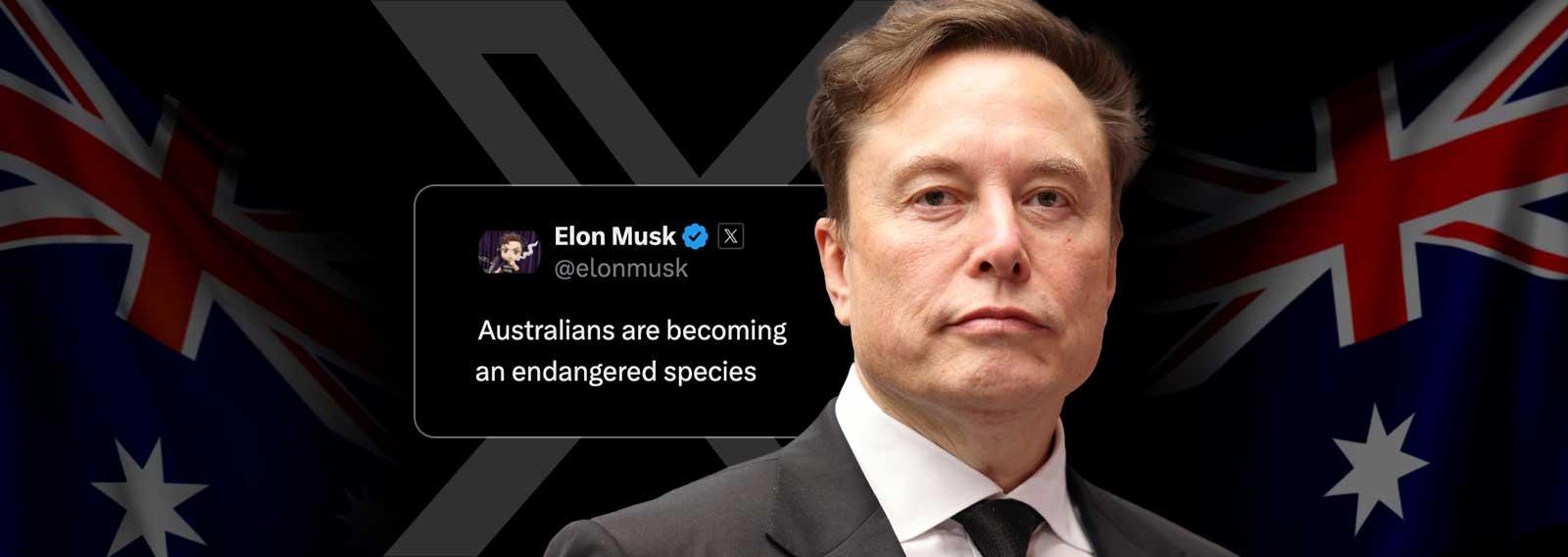
Elon Musk has commented on Australia’s declining birth rate, warning that “Australians are becoming an endangered species” in response to a post on X discussing the country’s latest fertility figures.
The remarks follow reports that Australia’s total fertility rate has fallen to approximately 1.48 in 2025, marking the second consecutive record low since national records began in 1924. Projections cited suggest the rate could decline further to around 1.42 in the coming years.


Demographers generally consider a fertility rate of 2.1 births per woman to be the “replacement level” required for a population to sustain itself without replacing itself through immigration. Australia’s current rate remains well below that threshold, which is part of a broader trend we’re witnessing across many Western nations.
While major political parties have employed mass immigration as a way to offset slowing population growth by cloaking the issue, critics have long argued that such reckless policies risk exacerbating the problem further. Today, with more than 3,400 migrants added every 24 hours, many contend that increased migration clearly places additional pressure on housing supply and infrastructure, contributing to rising property prices and increased demand, which in turn drives up the overall cost of living.
For many Australians, the prospect of starting a family is increasingly seen as financially challenging. Rising housing costs and broader cost-of-living pressures have contributed to a shift away from the traditional single-income household, with dual incomes now common in order to meet basic expenses.
Economists and social researchers note that such pressures can lead couples to delay having children until they feel more financially secure, a trend reflected in the rising average age of first-time parents. Housing affordability, in particular, has been identified as a key factor influencing family planning decisions.
Of course, a larger workforce means a broader tax base, which gives governments little incentive to reverse these trends. Instead, the response often takes the form of expanded public funding for childcare and education—effectively saying, “You have the children, and we’ll raise them.” Yet such measures always come at a cost. Governments do not generate wealth; they redistribute it. And that redistribution ultimately relies on taxpayers, compounding the underlying pressures through higher public spending and higher taxes.
As such, the tax system stifles family growth. The heavy burden of taxes discourages extra effort, longer hours, or the pursuit of higher earnings. One of the biggest penalties the taxpayer faces is a fine they are slapped with every few months, just for earning income. The government takes half of what they make in taxes, fees, and rates, and the more they earn, the more they owe. And rarely, if ever, do they receive back in services what they pay out in taxes.
Australians now need to work 107 days a year just to cover their tax bills. On average, over 45% of Australians’ income goes to taxes at the federal, state, and local levels—that’s more than two days of every five-day work week spent labouring for government revenue.
What we need is a seriously low cap on how much money a government can legally take from the public before being forced to concede they’re simply not able to do the job they’ve been tasked with. Excessive taxation exists to fund the campaign promises and fix the mistakes of inept and incompetent politicians, their bloated governments, and bureaucrat mates.
And bloated they are! In the United States, 6.68% of the population is government employees. In the United Kingdom, that figure is 8.75%. In Australia, a whopping 9.50% of the population is employed by the government, and funded by the taxpayer.
In other words, one in five workers is a government-employed, “public servant.”
“Australia had 2,517,900 public sector employees in June, with 365,400 of those in the federal government, 1,939,100 in state government and 213,500 in local councils, according to the Australian Bureau of Statistics (ABS). That equates to more than 17 per cent of the total working population, which was 14,402,500 in the same month.”
As such, the burden of electing an already bloated and ineffective government invariably falls on the hardworking populace, seldom on the incompetent politicians themselves.
Thomas Sowell aptly said, “It is hard to imagine a more stupid or more dangerous way of making decisions than by putting those decisions in the hands of people who pay no price for being wrong.” It’s a system that’s simply not sustainable, not without inflicting irreparable damage on the average Australian.
In the end, it’s clear that the current system is not just a financial burden, but a barrier to personal growth, family building, and generational prosperity. We shouldn’t be surprised that many Australians are now left wondering whether building a family is even a possibility.
Unless these underlying pressures are seriously addressed, it is difficult to see how the decline in birth rates will stabilise, let alone reverse. Sadly, it seems Musk is correct. Australians are becoming an endangered species, indeed.