



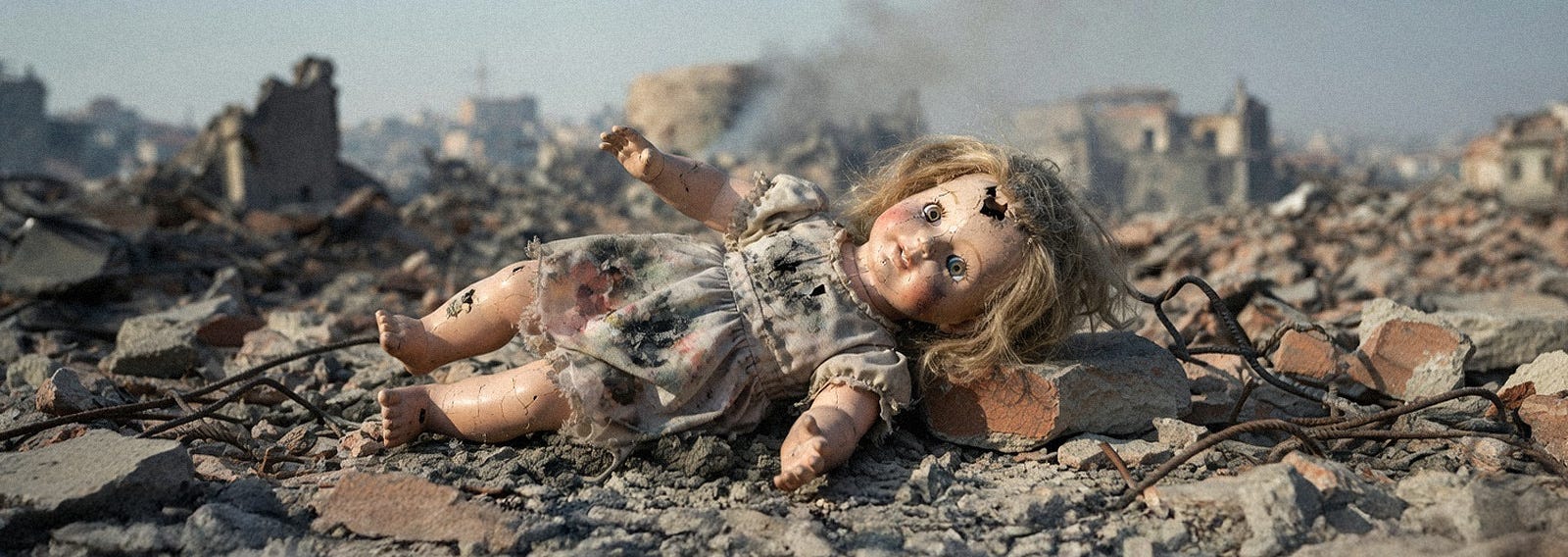
Recent events in the Middle East have reignited debates about war, justice, and the limits of violence in wartime. The disagreement is no longer simply between pacifists and those who believe war can be justified. Increasingly, it is unfolding among Christians themselves, and in particular, those who accept that war may at times be necessary, and even a moral good.
The question that is now being asked is not whether force can ever be used, but where the moral line must be drawn when innocent lives are at stake, regardless of which side of the border they’re born on.
For some, the answer appears straightforward and obvious. If a military strike eliminates a dangerous enemy but also knowingly kills nearby civilians in the process, the deaths are tragic but morally permissible. It’s just “collateral damage,” an unfortunate, but unavoidable aspect of modern warfare.
Consider, for example, the Allied framing of the bombings of Hiroshima and Nagasaki, which resulted in more than 210,000 civilian deaths—not including those who would later succumb to long-term radiation effects. In Hiroshima, approximately 90% of the total deaths were civilians. These deaths are often justified as a necessary means to end the war swiftly, with the argument that more lives were ultimately saved.
The issue being debated here is not unintentional civilian deaths that unknowingly occur or eventuate despite efforts to avoid them. The question is whether a moral line is crossed when civilians themselves become targets, or when their deaths are knowingly accepted as instruments for achieving military objectives.
When we step back from our political or national loyalties and examine the question through the lens of the Bible, a troubling possibility emerges that Christians have begun to justify something Scripture consistently condemns: the intentional shedding of innocent blood.
Throughout the Bible, the killing of the innocent is never treated as a regrettable necessity. It is consistently portrayed as a grave injustice, an abomination in the eyes of God (Prov. 6:16–17), one that defiles the land and brings guilt upon those responsible (Deut. 19:10; Ezek. 18:20; Ps. 106:37–38). The Bible makes clear that innocent blood cannot be excused by expediency, strategy, or perceived necessity.
According to God’s law, the lives of the innocent are sacred, and their destruction provokes God’s judgment on the guilty.
But here’s the thing: even those who claim that the intentional or reckless killing of innocent people in warfare can sometimes be morally permissible rarely hold that position with any meaningful degree of consistency.
Condemning the Innocent with the Guilty
Consider a hypothetical situation. Imagine discovering that your neighbour had been an extremely evil person, responsible for horrific and violent crimes. Now imagine the police arrive to arrest him, but he violently resists. In the chaos, the police response is reckless—destroying his house and, unintentionally, your own—killing your wife and children in the process.
Now imagine the community applauds the police for their actions. When you voice objections to their tactics, you are not recognised as an advocate for your innocent family, but are instead accused of supporting your evil neighbour.
Of course, not everyone who objects to the methods used to eliminate evil people is endorsing evil people. We instinctively recognise the moral problem when the victims are people we love. We all want evil removed. But the deaths of innocent people cannot simply be dismissed as unfortunate yet morally permissible.
Take, for instance, Genesis 18, where Abraham learned that God intended to destroy Sodom, the city where his nephew Lot lived. In response, Abraham interceded for his nephew and protested:
“Far be it from you to do such a thing, to put the righteous to death with the wicked, so that the righteous fare as the wicked! Far be it from you! Shall not the Judge of all the earth do what is just?” (Gen. 18:25)
Abraham’s concern was not for the wicked, but for the righteous. He couldn’t fathom God eliminating a whole city of evil people if his innocent nephew was killed in the process.
True justice, according to Scripture, does not punish the innocent alongside the guilty. To condemn the righteous is no better than justifying the wicked—both are an abomination to God (Pro. 17:15).
Do Unto Others
Consider another scenario: An incredibly evil man has taken your child hostage. Now, suppose, in this hypothetical, you only have two options before you: Rescue your child and allow the villain to escape, or else kill the villain, but in doing so, your child will also die.
Which option would you choose?
Almost no parent would sacrifice their own child—even if it meant eliminating the worst of villains. Most of us love our children more than we hate anyone else. That is right and good. Yet many people who would never accept that cost for their own children are willing to accept it for someone else’s.
Why is that? Because we naturally don’t love other people’s children the way we love our own. Their loss does not feel like our loss. It’s natural and right to love your children more than you love others, but the double standard is precisely what Jesus warned against among His followers.
As He taught in Matthew 7:12, “Whatever you wish that others would do to you, do also to them.” In other words, treat other people’s children the way you would want them to treat your own.
So, if you wouldn’t permit someone to sacrifice your child in order to eliminate an enemy, how can you justify sacrificing someone else’s child for the same purpose? The Golden Rule simply doesn’t allow it.
The Greater Good
Some argue that the killing of innocent people can be justified if the number of lives potentially saved outweighs the number of lives lost. But this is a moral position no one can consistently maintain—nor would they ever want to. Once that principle is accepted, the moral precedent it sets is terrifying.
Suppose a healthy patient went to the hospital for a routine checkup. Doctors discover his healthy organs could save the lives of eight dying patients on the organ donor list. Killing him and harvesting his organs would produce a net gain of life. So, should they kill a healthy man to save eight other lives?
Most people would instinctively protest such a decision, especially if that healthy patient were a family member. But why? Because we recognise a fundamental moral boundary, that innocent people may not be killed simply because doing so might produce a beneficial outcome to others.
Once that line is crossed, right and wrong become nothing more than a matter of cold calculation. This is no longer Christianity; it is pragmatism—the notion that the end justifies the means. It is utilitarianism—the idea that an action is right if it is judged to produce a beneficial outcome.
If the rightness of an action were measured only by its outcome, those who crucified Christ would effectively be blameless. After all, his death brought about the greatest good. But God’s justice does not operate simply by results. Scripture holds Christ’s killers fully accountable for their evil. How God sovereignly uses that evil does not diminish the seriousness of the crime or the severity of the punishment its perpetrators will face.
“Woe to the man by whom the Son of Man is betrayed! It would have been better for that man if he had not been born.” (Matt. 26:24)
The pages of history are stained with the blood of innocent people, all shed under the godless rationale that the end justifies the means. Virtually every villain responsible for the mass slaughter of the innocent carried out their atrocities under the assumption that their actions would achieve some perceived greater good and were, therefore, justified.
Divine Warnings
From the earliest pages of Scripture, the shedding of innocent blood is treated as a particularly grievous sin, carrying the weight of the harshest penalties. In Genesis 9:6, God declares both a warning and a sentence: “Whoever sheds the blood of man, by man shall his blood be shed, for God made man in his own image.”
Again, in Deuteronomy 19:10, God warned the Israelites about the dangers of shedding innocent blood: “lest innocent blood be shed in your land…and so the guilt of bloodshed be upon you.” It’s no surprise then to find the book of Proverbs lists “hands that shed innocent blood” among the things that God hates (Prov. 6:17).
The prophets repeatedly condemn Israel for this very sin. As Jeremiah declared: “If you do not oppress the sojourner, the fatherless, or the widow, or shed innocent blood in this place… then I will let you dwell in this place.” (Jer. 7:6-7) Similarly, Ezekiel decried the corruption of leaders who “shed blood in the midst of your land…you have become guilty by the blood that you have shed” (Ezek. 22:2-3, 27).
The Psalmist also condemned those who “shed innocent blood, the blood of their sons and daughters…and the land was polluted with blood” (Psa. 106:38). Similarly, God’s law in Exodus 23:7 highlights God’s standard of justice: “Keep far from a false charge, and do not kill the innocent and righteous, for I will not acquit the wicked.”
This concern for innocent life continues into the New Testament. Jesus explicitly condemned those responsible for the murder of God’s prophets, from Abel to Zechariah (Matt. 23:35), and Peter later held Christ’s killers fully accountable: “You crucified and killed by the hands of lawless men” (Acts 2:23). Finally, the faithful cry out in Revelation: “O Sovereign Lord…how long before you will judge and avenge our blood on those who dwell on the earth?” (Rev. 6:10).
The biblical witness is undeniable. The intentional or reckless shedding of innocent blood is not merely unfortunate. It is a violation of the image of God. It pollutes the land. It is something the Lord Himself explicitly abhors. And it will result in divine judgment.
At the very least, these warnings alone should give Christians pause before casually accepting civilian deaths as an unavoidable, but sometimes necessary, aspect of warfare.
The Old Testament Wars
To this, some Christians might point to the Old Testament, where God sentenced entire peoples to destruction—including women and children. At times, God’s judgment came through supernatural acts, at other times through natural disasters, and on some occasions God carried out his sentence through human agents.
But these events were not ordinary wars. They were specific acts of divine judgment carried out under the direct command of God. The fact that Scripture records these events does not grant us a licence to execute such judgments on innocent civilians and non-combatants today. Not everyone who is “evil” deserves immediate death—at least, not at our hands.
In Genesis 15:16, God tells Abraham that his descendants will not return to the land of Canaan for four generations because “the iniquity of the Amorites is not yet complete.” In other words, God Himself determined when a nation’s wickedness had reached its limits. As such, God decides when a people’s accumulated wickedness has reached the point where He will no longer tolerate their presence in the land.
The timing, the guilt, and the judgment all belong to God. Not us.
In other words, just because God flooded the world in Noah’s day does not permit us to drown our enemies’ children today. In the same way, the fact that God once used Israel to carry out His judgments on the Canaanites does not give modern nations the right to destroy whomever they wish.
Those events were divine judgments, not moral precedents.
No One Is Innocent
Another justification sometimes offered for the killing of innocent people in warfare appeals to the doctrine of human sinfulness—that is, Original Sin and Total Depravity.
Since all people are sinners, the argument goes, no one can truly be regarded as innocent, at least not before God. Therefore, it is said, killing the “innocent” is impossible, because no one is truly innocent to begin with. According to this reasoning, the shedding of innocent blood becomes a sin that cannot actually be committed.
But this rationale is wholly unbiblical. As we have already seen, Scripture repeatedly speaks of “innocent blood.” If no one could meaningfully be described as innocent, such language would be meaningless, and the many biblical warnings against shedding innocent blood would be redundant.
What’s more, God explicitly forbids punishing children for the sins of their parents. As it is written in Ezekiel 18:20, “The son shall not suffer for the iniquity of the father.” Human sinfulness does not give us permission to kill indiscriminately. It simply reminds us that final judgment belongs to God alone.
Love Thy Enemies
Ultimately, we cannot have a meaningful discussion about how we ought to treat others without taking into account Christ’s command to love not only our neighbours but even our enemies (Matt. 5:44; Luke 6:27). This is not a call to cultivate vague or sentimental feelings for those who wish us harm; rather, it concerns the just and consistent application of God’s law.
As Christ taught, loving God and loving one’s neighbour is the summary of the law (Matt. 22:37-40). The command to love our enemies, therefore, does not give us license to deny them justice—or their families.
On the contrary, we are under a necessary and divine obligation to treat even our enemies lawfully and justly. This does not mean they cannot be killed in warfare or neutralised as legitimate threats. It does mean that, in doing so, we are bound to act with justice. We are not free to act unjustly, even toward those who are our enemies. In short, to love our enemies is to treat them lawfully. If this is true of our enemies, how much more must it be true of the innocent caught in the crossfire?
A Line Not to Cross
We may disagree about many aspects of war and national defence. But Scripture consistently draws a line that must not be crossed: the shedding of innocent blood, either intentionally or recklessly.
Once we decide that innocent people may be sacrificed for a perceived greater good, we abandon the moral boundary that God established to restrain human bloodshed. And history repeatedly shows what happens when that boundary is transgressed.
Virtually every atrocity in history has been justified by someone who believed the outcome was worth the cost. Christians cannot adopt that position without abandoning the witness of the Bible. The moment innocent lives become acceptable collateral damage, we’re no longer fighting evil. We’re justifying it.