


Written by Paul Facey.
Introduction
Growing up in Western Sydney in the early 2000s, my neighbourhood was genuinely Australian. Almost all my street friends were of multi-generational Australian stock, and later on one Australian-born Indian. The same was true of my soccer club and church. Even outside of church, almost everybody in my life shared the same Christian faith, that which formed Australia’s culture from the beginning.
Fast forward almost two decades, and living only a few minutes’ drive from where I grew up, it is the opposite. I know almost none of my neighbours. Almost all of them are recent arrivals from various parts of India. We have nothing in common: not ancestry, culture, religion, and barely even the English language. The same is true for the wider town. Where I once had a strong community, formed of common blood and faith, I now have only strangers. This commonality remains solely with people far outside of my town, even as far as regional NSW, where I like to visit just to feel like I am in Australia again, like I am truly home and with my own people.
“Where I once had a strong community, formed of common blood and faith, I now have only strangers.”
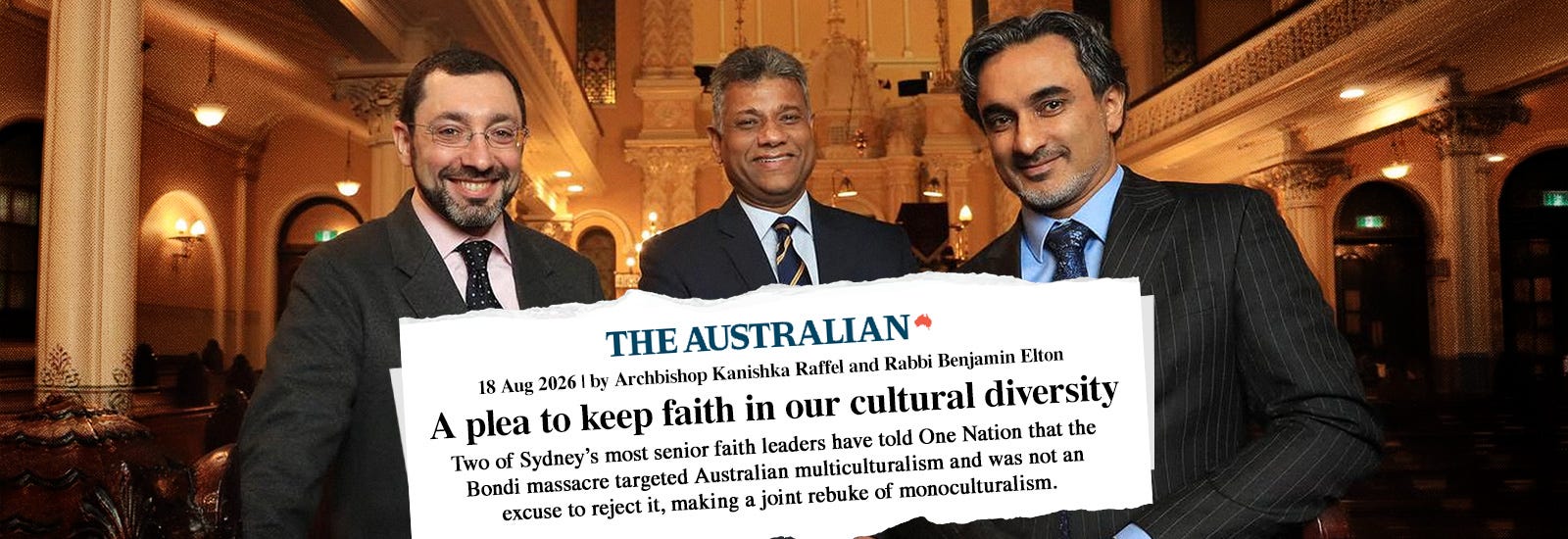
But according to Archbishop Kanishka Raffel—my Archbishop, as I am an Anglican—and Rabbi Benjamin Elton, this destruction of kinship and community built over two centuries is not the problem. In fact, it is those who complain about it that are the problem. The Archbishop & Rabbi recently co-authored a piece called ‘A plea to keep faith in our cultural diversity’; a title that is fascinating in itself, which I will address later. In it, they attack Pauline Hanson’s recent call to restore a “monoculture” in Australia, providing a three-fold response: that Australia was never a “monoculture,” that the problem is not multiculturalism as such, only certain applications thereof, and that Judeo-Christian teaching requires us to “love the stranger.”
Being a young Australian man at the receiving end of replacement migration, the article read to me like a prolonged insult, especially as it came from my own episcopal head. Why this is so will be made clear as I dispatch of the arguments.
Claim 1: Australia Was Never a “Monoculture”
A monoculture “never even existed in Australia.” Before colonisation, over 200 languages and even more dialects were already present on the continent. Even when the first European settlers arrived, they did not bring a monoculture, but a mix of “English and Irish, Anglican, Catholic, Nonconformist and Jewish and, yes, Muslims too.” Two problems ring like a noisy gong from this claim.
First, a reductionist strawman is imputed to Hanson, that “monoculture” means utter ethnic and cultural sameness, to the extent that there are no local or group-level variations. Upon my learning of the term, I had no such illusion, only that Hanson was calling back to the common experience of Australia as a shared cultural infrastructure. Do the Archbishop & Rabbi seriously think Hanson is unaware of local flavouring across Australia? Not even how drinking XXXX is treated in Queensland versus New South Wales? I cannot but read this as an extreme lack of charity, especially when the article itself explicitly acknowledges a “distinctive and overarching Australian culture.”
The second problem is more serious. The impression is given that Australia’s first settlers were a true melting pot, an ethno-cultural tertium quid. Of course, a basic perusal of demographic data from the colonial age shows this to be utterly false. As just one example, the 1846 census of the ‘Middle District’ (NSW) records 27,361 people born in the colony itself, 33,756 from England, 22,445 from Ireland, 6,409 from Scotland, and 364 from Wales. Those born in other British possessions totalled 1,153, and from countries outside the Empire a total of 901.
This data shows the Anglo-Celtic constitution of Australia even well into the colonial era, towards the tail end of convict shipments. English and Irish dominated the demographics, individually outnumbering every other non-Australian-born demographic combined. And when we look at religion, the demographic dominance of Anglos first and Irish second remains: 79,810 adherents to the Church of England, 47,187 for Roman Catholicism, 16,053 for the Church of Scotland, 6,338 Wesleyan Methodists, and 3,681 “Other Protestants.” Jews constituted an overwhelming 969 persons, and “Mahaomedans and Pagans” an incomprehensible 135. “Other Persuasions” totalled 361.
As my sarcasm should make clear, the idea that Australia was a mere mix from which an abstracted culture was born is a lie. It was not English mixed with Jews, but an overwhelmingly English society with a handful of Jews. It was not Irish mixed with Muslims, but a sea of Irish with a spoonful of Muslims.
“Australia did indeed have a ‘monoculture,’ rightly defined, and it wasn’t an illusory melting pot, but had a distinctive Old World identity.”
One may here point out that I admit an English-Irish (Anglo-Celtic) mix, and this is indeed true, yet it cuts against the multiculturalist framing. The Anglo demographic and religion (Anglicanism) were both the substantially larger portion and the dominant religio-cultural standard (hence the Church of England having functional de facto status in the early colonial era). Yet even with the critical Irish mix that would help constitute the Australian people at large, this only further shows Australia to be a British project: British people, British customs, British religion. To be blunt about it, neither Jews nor Muslims have anything close to an equal-parts claim to Australia’s founding and formation, and this article’s attempt to assert such should be treated as a contemptible act of cultural displacement.
So much for claim one; Australia did indeed have a “monoculture,” rightly defined, and it wasn’t an illusory melting pot, but had a distinctive Old World identity.
Claim 2: Multiculturalism is not the Problem
There are “problems with some forms of multiculturalism,” even “challenges associated with the positive integration of some parts of the Muslim community, and indeed of other communities.” Yet, we must not give up on multiculturalism, but “take inspiration” from Australia’s varying localities, “with its churches, synagogues, mosques and temples.” Ultimately, “[w]e should invest our efforts in nurturing a form of collaborative multiculturalism that serves Australia and all its people, creating an Australia that is stronger precisely because it is diverse.”
In short, the “Diversity is our strength” mantra.
I found it difficult to respond to this point, not because of any rigorous logic or voluminous evidence, but its vacuity. Problems are conceded, and the answer is just “c’mon, give it another chance,” with more flowery language. So what is there even to say? Yet, I am sure many would be moved by these words anyway, and so they must be addressed.
The article tacitly exposes the fatal flaw of multiculturalism as such, not merely “some forms” thereof. Fundamental divisions within society are baked into its very definition and nature. Multiple cultures means at least two sets of customs, two norms of social etiquette, two ethical codes, and often two languages and religions. By necessary consequence, these are points of division between people, which can be dormant for a period, but will frequently flare up, as is happening in Australia today. If, per multiculturalism, everything from daily mannerisms to belief in what constitutes the foundation of reality is an open question, then what does an “overarching Australian culture” even mean? Empty platitudes like “have a fair go”? Getting the magical citizenship paper? Stepping on the magical Australian dirt? How do you weave together a society from that? And we need not even get started on the fundamental civilisational problem of Islam.
“Fundamental divisions within society are baked into its very definition and nature.”
On the contrary, we know even within living memory that a culturally and religiously united people is a good in and of itself, critical for a healthy and self-perpetuating society. As such, consciously dismantling this via the policy of multiculturalism is in and of itself evil. I would ask anyone old enough to think back and see if they can say, with a straight face, that Australia today is more peaceful, prosperous, and united than when it was overwhelmingly Anglo-Celtic and Christian.
It is especially unacceptable that the Archbishop, the episcopal head of the Sydney Anglican Diocese, a herald of the exclusive rule and worship of the Triune God, yet promotes the taking of “inspiration” from “synagogues, mosques and temples”; houses of false worship, where God is blasphemed and demons are worshipped, per the consistent Christian position since the Apostolic age. This too shows a critical evil of multiculturalism; for it to live, Christian leaders must give up Christ’s own command to baptise the nations. We are just a Sunday social club with a budget.
Claim 3: The Scriptures Say “Love the Stranger”
Hebrew Scripture “insists repeatedly on the imperative to love the stranger.” Christians also have the parable of the Good Samaritan, who cared for an innocent man of foreign stock. It is this ethic that we must adopt, not “retreating into detachment and alienation.”
The article here promotes a common abuse of the Holy Scriptures in service of a deracination program. Merely wanting a home specifically for one’s own people — a norm for all of history — is condemned as not “loving the stranger.” Specifically, it is a problem for British Australians to desire such; non-British, non-European peoples can agitate for self-determination until the cows come home.
The simple response is twofold. First, this same Hebrew Bible ubiquitously frames itself as the ruleset of a particular people. Israel is a specific ethnic unit, distinct from others, and its security and prosperity is the goal of the Torah. Thus, the loyalty of Israelites to each other over foreigners is a given, and often explicitly stated, such as the requirement of releasing debts every seven years to one’s “neighbour and his brother,” while yet foreigners may still be required to honour their debts (Deut. 15:1–3). It is in this context that “you shall love your neighbor as yourself” is coined (Lev. 19:18), explicitly in reference to fellow kinsmen. It is only commanded further down that one is to love the “stranger” as he loves himself (vv.33–34).
The Torah thus clearly held a both-and dynamic; there is a basic love of natural justice we must hold for all men, and there is an order of particular loves, with one’s kinsmen taking priority over foreigners. The New Testament examples show likewise; the Good Samaritan shows natural justice to the half-dead Judean. Is he therefore endorsing the ethnic replacement of Samaritans in Samaria? Obviously not. And further, we have explicit acknowledgement of the good of ordered loves in the Apostle Paul’s own statement that one who does not provide for “his own, and especially for those of his household, he has denied the faith, and is worse than an unbeliever” (1st Tim. 5:8). A man’s kin, and especially his close family, is to be the closest object of his affections.
“Love of the stranger does not entail multiculturalism, that Australians do not have a right to their own country, that we must tolerate endless thousands of foreigners pouring in over the border.”
And so the article’s bait-and-switch is here defanged. Love of the stranger does not entail multiculturalism, that Australians do not have a right to their own country, that we must tolerate endless thousands of foreigners pouring in over the border. This is nothing more than a lie of the modern liberal order, and it must be treated as such in the churches.
Conclusion: The Elephant in the Room
The article has been soundly refuted in each of its major claims, and ordinarily that would be enough. But I feel obligated to address what I see as its motivating context, yet which in today’s society can cause an uproar. Having already been at the receiving end of (failed) cancel-campaigns, I fear moths in my room more than I do public outrage.
Archbishop Raffel was born in London and eventually settled in Australia with his family as a child; most of his life has been spent here. Yet, his background is Sri Lankan. Rabbi Elton is an English-born, well, Rabbi, a cleric of Judaism. A major aspect of both authors’ identities is foreign to Australia; ethnically in one, religiously in the other. There is a palpable atmosphere of vested interest in promoting the multicultural experiment. Without it, these men (chiefly the Archbishop) would not be considered full Australians, if at all. They would be welcomed, respected, given opportunities for prosperity, but in the end, they would always be guests.
Many foreigners have been satisfied with this condition, as their self-esteem does not live or die on being Australian. But others have found this unacceptable, an assault on their dignity. I sense this exact attitude in the authors of this article. They do not want to be guests, but full Australians without qualification, even if it means dispossessing those whose ancestors built this country of their identity, rendering common what was once precious. I do not mince my words here; this is a disgraceful act, an insult to Australians.
Public prejudice against Anglo-Celtic Australians (that is, ethnic Australians) should no longer be tolerated from our clergy, and conversations should be forced onto the table. And I more than most have the bona fides to make this claim, as I am only half-Australian myself, the other half being Lebanese. My dignity as a man and a son of God is not predicated on my being a pure Australian, and so I happily grant my partial status. Despite this, as a servant cannot serve two masters, so a man cannot have the same loyalty to multiple peoples. And as one of my parents came to Australia and chose to marry a local, the promise of Ruth was thus made: your people shall be my people (Ruth 1:16). I carry on that promise, never agitating for Lebanese to be considered as Aussie as the man or woman whose forebears colonised regional New South Wales.
To conclude, I want to return to the article title, “A plea to keep faith in our cultural diversity.” That word choice, “faith,” is telling. Multiculturalism, visibly, is a disaster, rending Australia into a thousand ribbons. But we mustn’t believe our lying eyes.
Multiculturalism is an article of faith, immune from judgement according to the empirical evidence of its effects. It is also like a sacrament; a visible sign of an invisible grace. It becomes that glorious thing hoped for, the evidence of things unseen (Heb. 11:1). The less its promised harmony can be observed, the greater the imperative to keep the faith.
Paul Facey is a Sydney-based Anglican with a Bachelor of Theology from Alphacrucis College. He has since pursued independent studies across a range of academic disciplines. He runs the YouTube channel The Other Paul, where he explores theology, Church history, and politics, regularly engaging in debates with Christians from various denominations. You can follow him on X at @TheOtherPaul2