



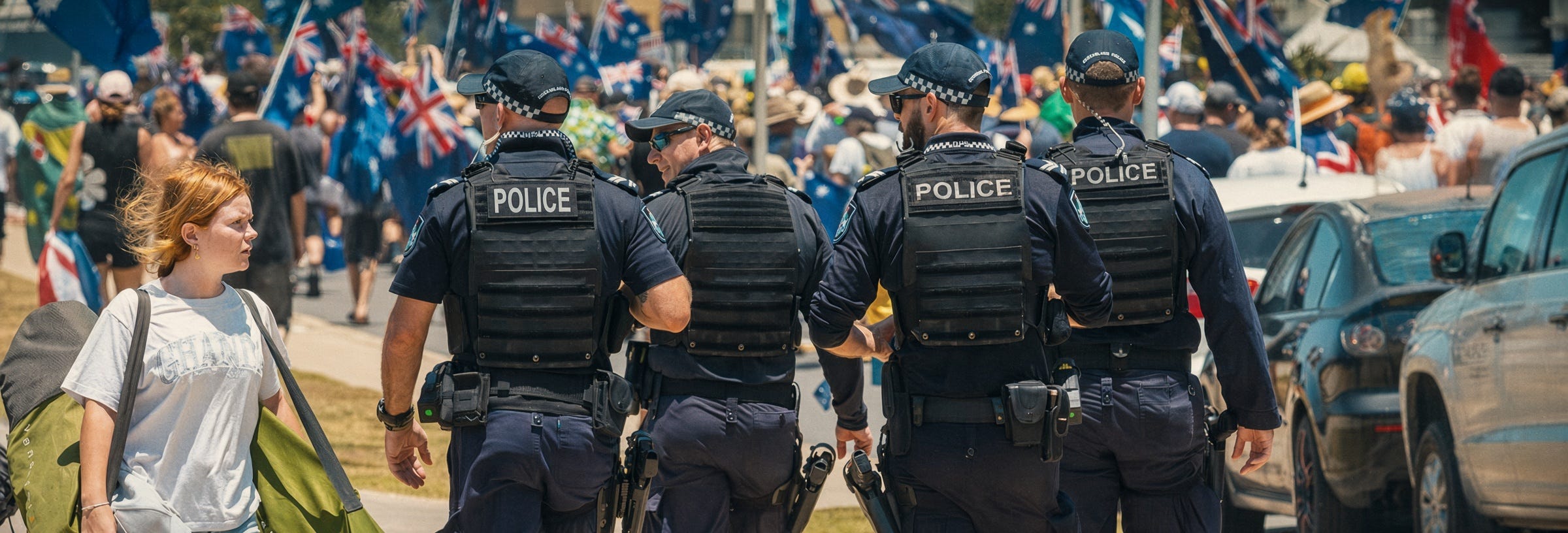
What happens when a police officer is ordered to do something that may be lawful, but which they believe is morally wrong?
It’s a question worth asking, particularly now, when governments are acquiring extraordinary new powers to monitor their citizens, and police are increasingly being asked to enforce laws that touch on freedom of speech, religion and conscience.
Police officers occupy an unusual position in society. They are entrusted with powers ordinary citizens do not possess, including the authority to detain, search and arrest people and, in certain circumstances, use force.
Those powers are necessary for maintaining law and order, but they also carry responsibilities that extend beyond legislation, departmental policy and instructions from senior officers.
For generations, Western ideas about justice and the proper exercise of authority have been shaped, in part, by Christian teachings about conscience, the dignity of the individual and the responsibility of those entrusted with power.
Within that tradition, authority carries a moral obligation. The person exercising it remains accountable for their actions, even when acting on behalf of a government or institution.
The Christian understanding of justice also places considerable importance on mercy, restraint and the treatment of others. It recognises the authority of government while maintaining that obedience to earthly institutions does not absolve individuals of responsibility for their conduct.
Those principles have relevance to modern policing, regardless of an officer’s personal religious beliefs.
Police officers are expected to uphold the law impartially, not impose their own religious or political convictions, but the moral questions surrounding the exercise of state power remain, particularly when an officer is required to make decisions that may profoundly affect another person’s life.
As surveillance technology and artificial intelligence expand the capabilities of law enforcement agencies, those questions are becoming increasingly difficult to ignore.
Former British Parachute Regiment soldier Matt Styler was charged with assaulting an emergency worker following disorder in Southampton on June 2, 2026.
The wider protest became violent, and eleven police officers were injured, with numerous participants being charged. Styler pleaded not guilty to the allegation against him.
Footage from Southampton shows riot police moving against protesters with shields as the confrontation became physical. Images circulated from the incident show Styler, a 50-year-old former soldier, being struck and pushed with police shields.
What is it worth for a former British soldier, who risked his life for his country, only to be beaten by others in authority for doing little more than being present at a protest? In court, the prosecution offered no evidence against the defendant (Styler).
A police officer might spend decades enforcing the law, but eventually that career ends, and at that point, the officer is once again a civilian, dependent upon the same legal protections as everybody else.
If a military veteran can find himself on the receiving end of state force, today’s police officers have no guarantee that they, their children or their grandchildren could never find themselves in a similar position.
The argument is, as it stands, what motivates a group of police officers, or an officer as an individual ‘just following orders,’ making an average of £32,256 to £52,014 for a constable, to beat a retirement-age protester with shields?
Do they not see the irony of it, given it was a former soldier they were beating? That could be them one day.
There’s no argument here that police should abandon their responsibilities or refuse lawful directions because they disagree with them.
Officers are required to enforce laws impartially, including laws they may personally dislike.
But what it does mean is recognising the humanity of the person standing on the other side of the police line, particularly when an officer has discretion over how the law is enforced.
Police deserve to be properly compensated for work that can be difficult, stressful and dangerous. But all careers eventually end, and while the consequences of decisions made during a career can endure for the people affected, that includes the cops themselves.
Politicians and senior officials may make laws and formulate government policy, but it is the police officer on the street who has to put those decisions into practice.
Ministers are not the ones placing people in handcuffs or turning up at the front door to make an arrest.
The individual officer therefore carries a responsibility that cannot be transferred entirely to the institution issuing the direction.
Britain provides an example of why decisions made at street level can matter long before a case reaches a courtroom.
Data obtained by The Times showed police forces in England and Wales made 12,183 arrests in 2023 under section 127 of the Communications Act 2003 and section 1 of the Malicious Communications Act 1988 — equivalent to about 33 arrests each day.
Ministry of Justice figures cited in the same report recorded 1,119 sentencings under those provisions in 2023. There are numerous reasons an arrest may not result in a sentence, including evidentiary difficulties, out-of-court resolutions and circumstances involving other offences.
But an arrest happens before a court determines guilt. A person can be detained, searched, questioned and held in custody while allegations are investigated.
The consequences for the individual can be substantial, even when no conviction follows.
What are these officers thinking when they turn up at the door with the directive to arrest someone over a social media post? Imagine the scenario: it’s 4 am and three officers arrive to arrest an ordinary citizen accused of writing some naughty words on Facebook.
Do the officers wonder if that will be them one day, or if they’ll next be knocking down the door of a relative, or a friend, all for expressing distrust in the state force apparatus? Or confusion as to the current cultural thought crime?
What if the police decided not to follow through with orders they know deep down are immoral, unethical and unprincipled?
What if they decided not to enforce the Orwellian will of the state and lay down arms, to become citizens again?
Would the state hold the same unchecked power? Clearly not.
The Christian moral tradition places particular emphasis on justice, fairness and the protection of people from the arbitrary exercise of power.
Such considerations become especially important where legislation is broad, or officers retain discretion over whether an arrest is necessary.
Another case in Britain raises similar questions about the relationship between individual conscience, religious freedom and the exercise of police authority.
Christian charity volunteer Isabel Vaughan-Spruce appeared before Birmingham Magistrates’ Court on October 7, 2026, where she pleaded not guilty to five charges relating to occasions on which she allegedly stood silently praying within 150 metres of an abortion facility.
Her encounters with police stretch back several years. In February 2023, Vaughan-Spruce was acquitted after prosecutors offered no evidence following her arrest under a local public spaces protection order. She was arrested again weeks later, before receiving a £13,000 settlement from West Midlands Police in August 2024 over the two arrests.
The latest prosecution concerns national legislation introduced in October 2024 to protect people accessing abortion services from interference, intimidation and harassment.
During the October hearing, Judge Tan Ikram questioned the original charge, with Vaughan-Spruce’s legal representatives reporting that he observed that merely standing in a public place was not, by itself, a criminal offence. Prosecutors were subsequently permitted to bring five amended charges.
Vaughan-Spruce’s lawyers argue that her silent prayers did not constitute an attempt to influence or harass anybody and that the prosecution infringes her rights to freedom of thought and religion.
“Standing silently and holding certain beliefs in a public space should never be a crime,” Vaughan-Spruce said.
The Crown Prosecution Service’s own guidance acknowledges that silent prayer does not necessarily constitute an offence, requiring prosecutors to consider the person’s conduct, the surrounding circumstances and evidence of intent or recklessness.
For police officers, this distinction is significant. The responsibility to enforce legislation intended to protect vulnerable people must coexist with an obligation to respect fundamental freedoms. Once again, if the police officers refuse to obey the directive to arrest someone for ‘silent prayer,’ the ludicrous nature of the imaginative force apparatus simply falls away.
From a Christian ethical perspective, the case brings the question of conscience into sharp focus. An officer may have the legal authority to investigate suspected wrongdoing, but must still exercise that authority with fairness, restraint and respect for the individual.
It is precisely in these circumstances, where the boundaries between lawful conduct and criminal behaviour are contested, that professional judgement and moral responsibility become especially important.
Closer to home, NSW farmer John Carter became embroiled in a long-running dispute after cattle he had been grazing on the Jingellic Travelling Stock Reserve were seized by Local Land Services in January 2025. The dispute subsequently resulted in arrests and multiple charges.
Some of the original allegations against Carter, including fraud and animal-cruelty charges, were later withdrawn.
The withdrawal of those charges did not constitute a judicial finding that the original seizure of his cattle was unlawful, nor did it dispose of the remaining proceedings against him. The Carter matter therefore should not be presented as establishing wrongdoing by police.
What the case illustrates is the difficult position officers can occupy when disputes involving government agencies, regulations and individual citizens eventually require police intervention.
Officers frequently have little involvement in the policies or administrative decisions they are required to enforce. Yet they may ultimately be the people exercising coercive powers against the citizen affected by them.
Christian ethical thought has long distinguished between the legitimacy of authority and the moral responsibilities of the individual exercising it. The fact that a direction comes from an institution does not, by itself, settle every question about whether an action is just or appropriate.
That distinction has also been raised by people who have served in law enforcement.
Former Los Angeles Police Department officer and writer Michael C. Ruppert placed considerable importance on the police oath and the personal obligations he believed accompanied it.
During the Occupy movement in 2011, Ruppert spoke about deciding to stand between protesters and police in Santa Rosa after hearing authorities intended to clear an encampment.
His explanation was straightforward: “I took an oath.”
Ruppert said military veterans had independently reached a similar conclusion and were prepared to place themselves between protesters and police if force was used. For him, the oath represented an obligation that survived his career in law enforcement.
NSW police officers also take an oath, or alternatively an affirmation, before exercising the functions of their office.
An officer promises to serve “without favour or affection, malice or ill-will”, to preserve the King’s peace, prevent offences to the best of their ability and discharge their duties “faithfully according to law”.
The oath is not a promise to follow every instruction without question, nor does it authorise officers to replace legislation with their personal religious or political beliefs.
Police are required to act within the law, and professional judgement remains an essential part of fulfilling that obligation.
The Police Act 1990 also establishes a mission for NSW Police that includes placing integrity above all, preserving the rights and freedoms of individuals and exercising authority responsibly.
Those duties are consistent with moral principles that have long been emphasised in Christian teaching: justice, honesty, restraint and accountability for the treatment of others.
An officer deciding whether to arrest somebody, how much force to use or whether discretion is appropriate must make a judgement that cannot always be reduced to a departmental instruction.
Technology is making those decisions more complicated.
Police drones have been operating over Moree in north-west NSW as part of an Australian-first trial, which has now been extended for another two years.
Drones offer clear operational advantages. They can help locate offenders, search large areas quickly and provide officers with information before they enter potentially dangerous situations.
Some Moree residents, legal advocates and the Australian Human Rights Commissioner have raised concerns about privacy, transparency and the safeguards governing their use.
NSW Police has said the drones are being used to prevent, disrupt and respond to criminal activity, while the NSW Government says governance arrangements and operating procedures are in place to ensure their use remains lawful and proportionate.
Australian Human Rights Commissioner Lorraine Finlay has argued that effectiveness is only part of the debate.
“This isn’t just a question about whether the technology works or doesn’t work,” she said.
“It’s a question of what impact that technology is having and how it’s being used by the police in terms of protecting our rights and freedoms.”
Western Australia provides another example of how policing technology is developing.
WA Police has been trialling live facial-recognition technology in public spaces. During the trial, more than 900,000 faces were scanned, producing 209 alerts and 79 arrests. Eight incorrect alerts were recorded.
The trial has prompted questions about privacy, consent, accuracy, possible demographic disparities and transparency surrounding police watch lists.
The implications could become more significant if technologies currently operating separately begin working together, and to be honest, it seems more than probable this will eventually be the case.
There’s no suggestion the Moree drones are conducting live facial recognition, but future systems could potentially identify faces or number plates (think Flock cameras) while artificial intelligence analyses large quantities of online communication and flags individuals for further investigation.
Britain’s experience with communications offences gives some indication of the scale involved when policing intersects with digital information. AI could substantially increase the amount of material capable of being assessed and brought to police attention. So, it’s what happens next that’s key.
Christian ethics places the individual human being at the centre of moral responsibility. Technology may assist in identifying suspects or gathering evidence, but it cannot possess a conscience or accept personal accountability in the way a human officer can.
The responsibility for exercising police powers lawfully and fairly must therefore remain with the people and institutions entrusted with them.
I’m certainly not suggesting officers should become individual arbiters of which democratically enacted laws they will enforce. The rule of law depends on impartiality, and allowing personal convictions to determine enforcement would create its own dangers.
But professional responsibility also requires officers to understand the limits of their powers, question directions they reasonably believe are unlawful and exercise discretion where legislation permits it.
Courts, oversight bodies and legislation should provide safeguards against mistakes and abuses of authority. The judgement of the individual officer remains another important protection.
As I’ve said, police themselves have a personal stake in maintaining those standards.
The civil liberties they uphold while serving are the same liberties they will rely upon when their careers end.
Due process, the presumption of innocence, reasonable use of force, privacy and equality before the law apply to retired officers just as they do to the people they encounter while serving.
For Christians, the principle of treating others as one would wish to be treated offers a straightforward moral test, particularly for those entrusted with power over another person.
It asks the officers to consider whether they are exercising authority with the fairness, restraint and humanity they would expect if their own circumstances were reversed.
Drones, facial recognition and artificial intelligence will continue to give police more powerful tools to prevent crime and protect the public. They will also require governments, police leadership and the community to confront difficult questions about how far those powers should extend.
Whatever technology sits behind an investigation, there will still be occasions when an officer must decide whether the information before them justifies using the authority of the state against another person.
The Christian understanding of conscience offers one framework for considering that responsibility, alongside the legal and professional obligations that bind every police officer regardless of faith.
As policing becomes more technologically sophisticated, the moral character of the people exercising those powers will remain just as important as the laws governing them.
For the officer wearing the uniform, the enduring challenge is to serve the law faithfully without losing sight of the humanity of those upon whom it is enforced.