



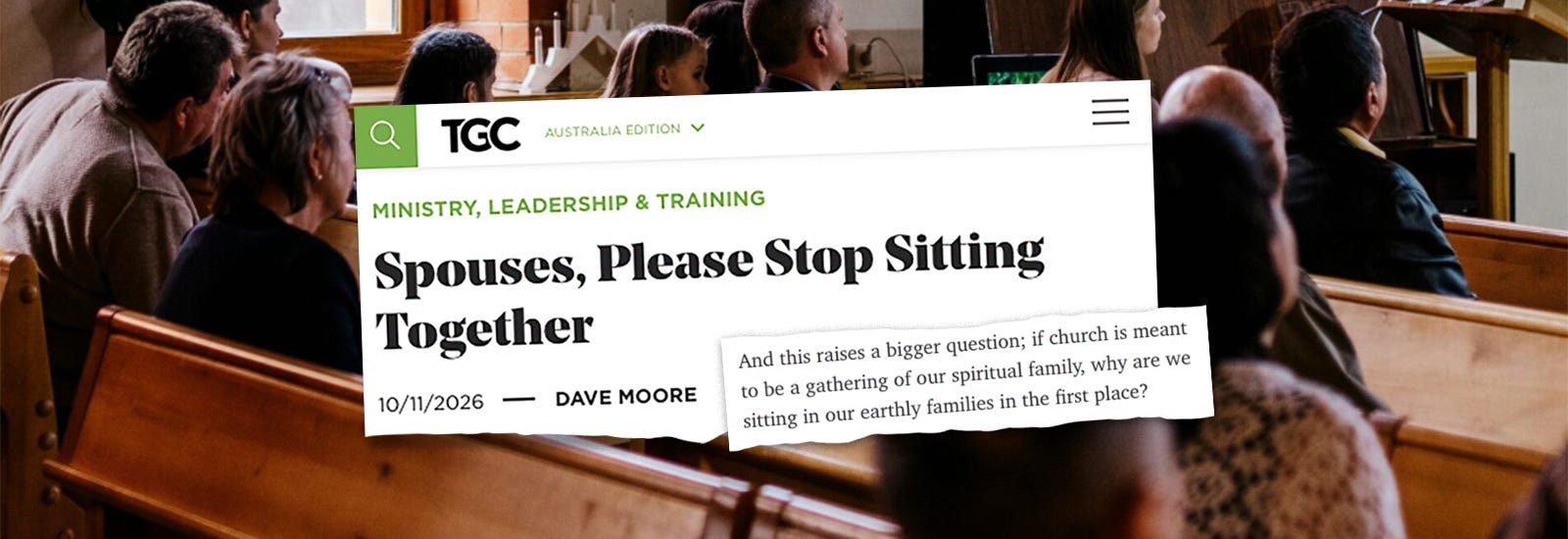
Earlier this week, The Gospel Coalition Australia published an article by Dave Moore titled Spouses, Please Stop Sitting Together, encouraging husbands and wives to sit separately during church services.
Understandably, the article attracted considerable ridicule worldwide and even prompted The Gospel Coalition to publish more than one critique in response.
But that’s not what I want to do here. I’m not going to point out the obvious. You don’t need me to do that. Instead, I want to offer something of a defence of Moore. His conclusion is hardly sensible, but he follows a theological error common in modern evangelicalism to its logical conclusion more consistently than many of his critics do.
Of everything Moore said in his article, this error came through most clearly in a single question he put to his readers:
“And this raises a bigger question; if church is meant to be a gathering of our spiritual family, why are we sitting in our earthly families in the first place?”
Why indeed? That’s not an absurd question to ask, not if we accept the evangelical assumptions of our day.
After all, if our spiritual relationships supersede our earthly relationships, why should Christian husbands prefer their own wives? We belong to God’s family. We are members of the household of God. We have a heavenly Father. We are brothers and sisters in Christ. The Church itself is the Bride of Christ.
What possible significance could our temporal, earthly marriages retain in light of these glorious and eternal, heavenly realities?
Of course, I’m being facetious. But that’s entirely the point.
For years, we’ve heard this same line of reasoning applied beyond the immediate family. It comes up whenever the subject turns to extended family and local community, and especially when we speak of nationhood and our obligations as Christians to our own kin and countrymen.
We are citizens of heaven, we are told. Our kingdom is not of this world. We belong to a spiritual nation that transcends earthly distinctions. One race, the human race. Therefore, earthly nationhood and particular loyalties are supposedly of little Christian significance.
Yet when Moore applies this argument to marriage and immediate family, suddenly everyone loses their minds.
Apparently, heavenly citizenship can relativise earthly nationhood and belonging to the point of insignificance, but heavenly family membership mustn’t do the same to earthly families.
Why not, exactly?
In the end, all Moore has done is take the logic behind evangelicalism’s rejection of Christian nationalism and apply it consistently to Christian marriages.
If belonging to God’s heavenly kingdom dissolves our particular obligations to our earthly nations, why shouldn’t belonging to God’s heavenly household dissolve our particular obligations to our earthly households?
You can’t invoke heavenly realities to erase earthly distinctions selectively, preserving those you personally like while dismissing those you don’t.
The problem here is not that Moore has taken his reasoning too far. It’s that he has inadvertently exposed what happens when spiritual realities are treated as replacements for the natural order.
The historic Christian understanding is that grace does not destroy nature, but perfects it.
Our union with Christ doesn’t abolish marriage. Rather, marriage itself reveals something greater about that heavenly union (Eph. 5:31-32). God’s fatherhood doesn’t abolish earthly fatherhood, but establishes its proper pattern (Eph. 3:14-15). Likewise, our heavenly citizenship doesn’t abolish our earthly obligations.
In fact, the Bible repeatedly employs earthly realities to highlight spiritual truths, precisely because these earthly realities possess genuine significance within God’s purpose.
As such, Christians are not called to escape creation or the natural order, but to see these things redeemed and brought into obedience to Christ.
Moore’s critics are right to reject the idea that belonging to a spiritual family somehow diminishes our earthly family ties. But those who dismiss earthly nationhood on the very same theological grounds only expose how little they’ve thought through their own position when they chide Moore for applying that logic more consistently than they’re willing to do so themselves.
After all, if heavenly realities make earthly loyalties and preferences irrelevant, why stop at nations?
So, perhaps, at this point, Moore deserves less ridicule and more thanks. He’s unwittingly offered modern evangelicalism a remarkably useful reductio ad absurdum of the theology it so often peddles.
What good is rejecting Moore’s conclusion if you still accept the faulty premise that led him to it?