




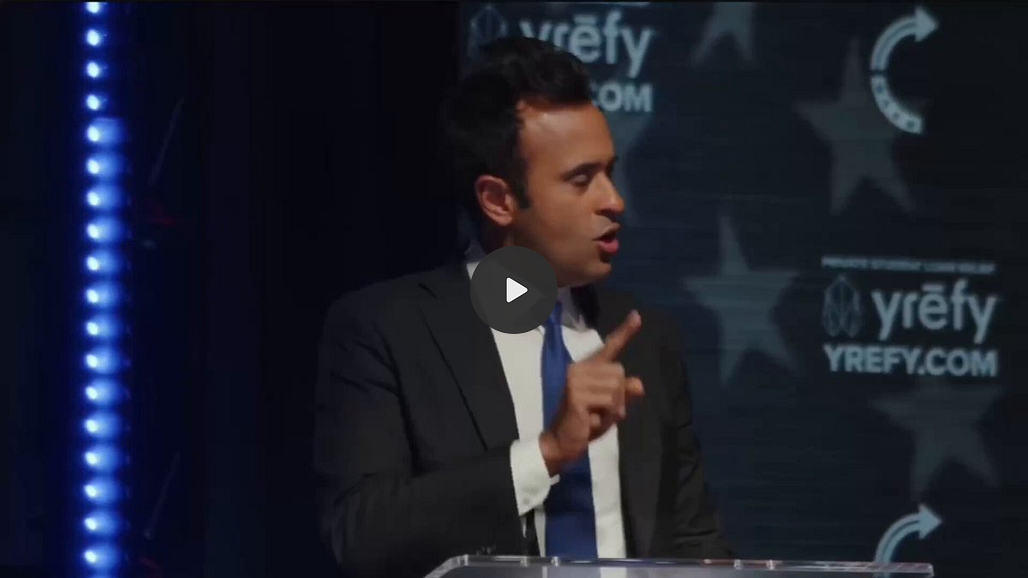
Vivek Ramaswamy is copping a barrage of criticism online after claiming that anyone, from anywhere in the world, can become an “American.” The Republican frontrunner for Ohio Governor was echoing a famous line from Ronald Reagan—but it’s an argument that collapses under the weight of its own contradictions.
In a post on X, Ramaswamy shared a video quoting Reagan, who contrasted the United States with other nations by suggesting that while one may live in France, Germany, or Japan, citizenship can never make a person truly become French, German, or Japanese. America, he argued, is entirely different. Anyone can arrive from anywhere and become fully American.
Ramaswamy doubled down on the idea, insisting that so long as a foreigner works hard, follows the rules, contributes to society, and obtains citizenship, they’re just as “American” as the descendants of the founding families.
He argued:
“You can travel to Italy, but you’ll never be an Italian. You can travel to France, but you’ll never be a Frenchman. You can live in Germany, but you’ll never be a German. You can live in China or Japan, but you’ll never be Chinese or Japanese. Yet you can come to the United States and become an American—so long as you work hard, follow the rules, contribute, wait your turn, pledge allegiance, and obtain citizenship.”

But this notion rests on a basic confusion of terms, exposed by Ramaswamy’s and Reagan’s own words. Citizenship and ethnic identity are not the same thing.
It’s a biblical distinction. The Apostle Paul was a Roman citizen, born in a Roman province, but that did not make him a Roman. Paul identified as an Israelite, because he understood that ‘place of residence’ or even citizenship status could not change the biological realities inherited from his parents.
A person from anywhere may become a citizen of Japan. What they cannot become is ethnically Japanese. The same applies across the world. Legal status doesn’t rewire ancestry, culture, or heritage. Ramaswamy and Reagan both acknowledge this when they insist that foreigners cannot become Italian, French, German, Chinese, or Japanese.
But then, they carve out a supposed exception for the United States without explaining how that exception could possibly work. They’re not unique in doing this. It’s a trend playing out across the Western world, and perhaps nowhere more militantly than the Anglo-Celtic sphere.
Today, terms such as American, Canadian, English, Irish, and Australian have been stretched so broadly that they are now applied to virtually anyone from anywhere who is residing within those countries. In effect, the terms have been stripped of any ethnic meaning. They’re now so inclusive that they cannot refer to any ethnic group in particular.
This is effectively what Ramaswamy is arguing. Either “American” has no real historical, ethnic meaning beyond paperwork, or the claim is that citizenship in America can somehow transform biological identity in a way it clearly cannot. Neither option is coherent. Ramaswamy has rejected the notion that biological sex can be changed by altering a legal document, yet he appears to embrace that same reasoning when it comes to identifying as “American.” Why is that?
The idea that nations founded by the Anglo-Celtic people of the British Isles are uniquely exempt from the normal relationship between people, culture, and nationhood is a relatively modern invention. It gained traction in the post-World War II period, alongside broader efforts to undermine nationalism, and redefined Western nations in purely civic and universal terms.
What this does is dissolve the distinction between a nation, as a particular people, and a geographical, legal jurisdiction. If anyone can become fully “American” in the same sense that no one can become French or Japanese, then “American” ceases to describe a people at all. It becomes a label with no fixed substance. “American” is open to anyone and anchored in nothing, except a geographic location.
What’s more, it reduces a country to the property of the world, belonging to no particular people group, subscribing to no particular religion, and living by no particular culture. When anyone and everyone can become something, that thing is without meaning or limit. And that is, of course, the end goal of the “melting pot” that is Globalism: No nations, only global citizens—people assigned to specific regions, like economic widgets—and nothing more.
Take the recent comments of Australia’s Home Affairs Minister, Tony Burke, who said migrants can become “part of Australia” without even assimilating with Australians. According to the architects of “Modern Australia,” to be “Australian” doesn’t mean much more than living within the country. There’s no longer any shared family, history, culture, customs, or convictions. It is everything in general, and therefore, it is nothing in particular.


Ultimately, Ramaswamy’s claim might sound sentimental and inclusive, but it highlights the fundamental contradiction at the heart of the modern civic-national ideal. It cannot stand unless double standards are selectively applied. It cannot exist without invoking arbitrary exceptions.
Either national identity means something real, grounded in a people, their history, and inheritance, or it is reduced to paperwork and legal formalities. It can’t be both. What remains is not a meaningful definition of what it means to be “American,” but a contradiction that can only be maintained by exception. And you can’t build a coherent nation on that.
Nations as an Extension of the Family

Many anticipate that 2025 will be the year that serious and much-needed debate around immigration takes place in Western countries. Central to this discussion will be a proper understanding of what a “nation” truly is. Is a nation defined by people and place, or does it rest on a shared commitment to ideas, principles, and values? How, then, should we d…