


With Netflix announcing its retelling of C.S. Lewis’ The Chronicles of Narnia, and reports that Aslan, the Great Lion who represents Christ, will be portrayed by a woman, it is worth asking an important question that is often overlooked by Hollywood and its creatives: Why was this story written in the first place?
Why did Lewis create Narnia?
It’s not a mystery. He tells us himself.
He wrote The Chronicles of Narnia to be enjoyed, but not merely enjoyed. There was a deeper purpose behind it all. Lewis was telling two stories at once.
On the surface, he was telling us about a magical land, an evil witch who had taken control, and a talking lion who defeated her. But beneath that story was another—the meaning behind the imagery and what it all was meant to teach us.
Lewis was telling a story about Jesus.
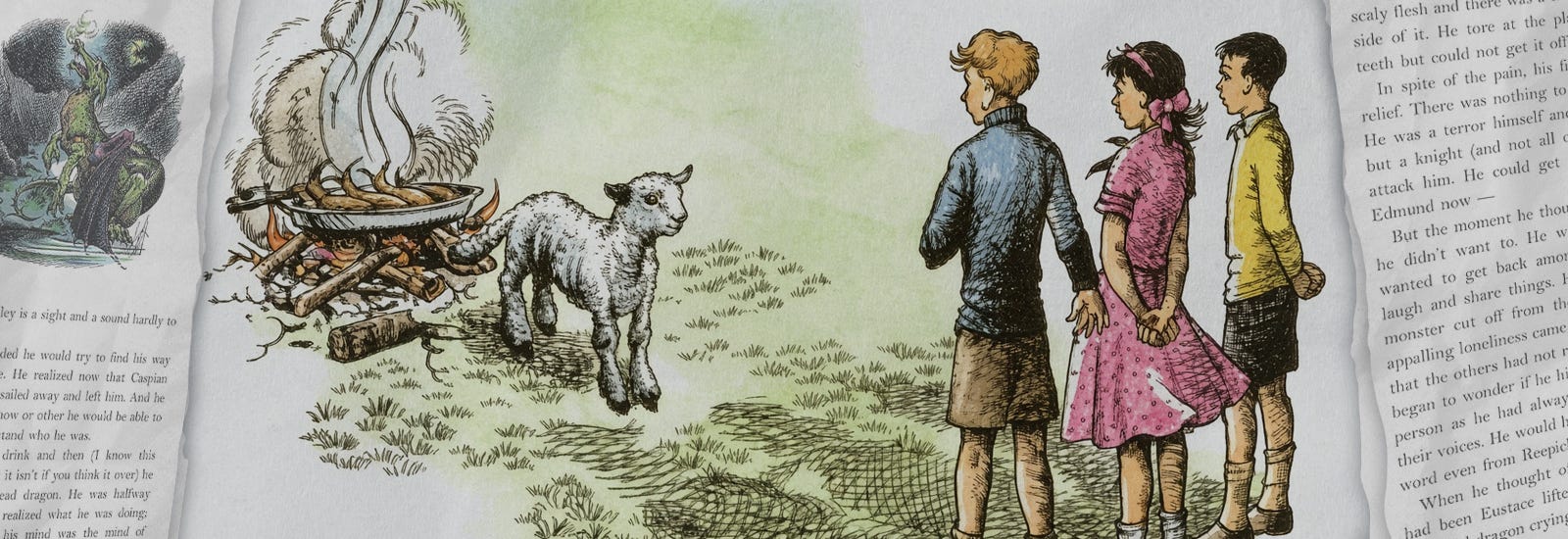
If it wasn’t obvious enough, it becomes explicit in The Voyage of the Dawn Treader. Towards the end of the book, Lucy and Edmund reach the edge of Aslan’s country. There, they have a remarkable encounter with a Lamb:
But between them and the foot of the sky there was something so white on the green grass that even with their eagles’ eyes they could hardly look at it. They came on and saw that it was a Lamb.
“Come and have breakfast,” said the Lamb in its sweet milky voice.
Then they noticed for the first time that there was a fire lit on the grass and fish roasting on it. They sat down and ate the fish, hungry now for the first time for many days. And it was the most delicious food they had ever tasted.
“Please, Lamb,” said Lucy, “is this the way to Aslan’s country?”
“Not for you,” said the Lamb. “For you the door into Aslan’s country is from your own world.”
“What!” said Edmund. “Is there a way into Aslan’s country from our world too?”
“There is a way into my country from all the worlds,” said the Lamb; but as he spoke his snowy white flushed into tawny gold and his size changed and he was Aslan himself, towering above them and scattering light from his mane.
Oh, Aslan,” said Lucy. “Will you tell us how to get into your country from our world?”
“I shall be telling you all the time,” said Aslan. “But I will not tell you how long or short the way will be; only that it lies across a river. But do not fear that, for I am the great Bridge Builder.”
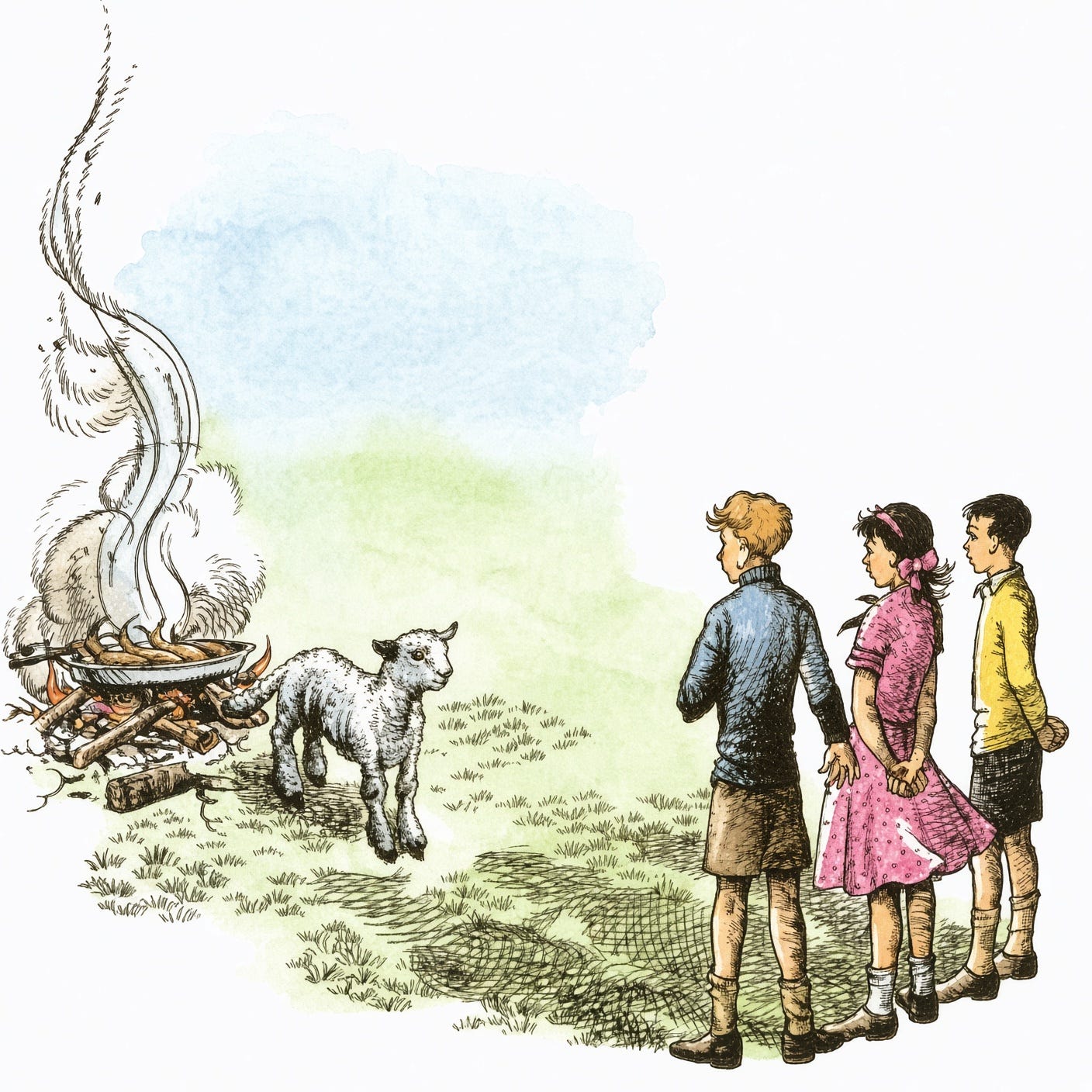
Lewis isn’t subtle. The Lamb is Aslan. Aslan is the Lamb. The Lamb is the one who provides the meal. The way into his country lies across the river, and Aslan calls himself the “Great Bridge Builder.”
But Lewis makes the point here unmistakable.
Lucy is distressed because she has learned that she won’t see Aslan in Narnia again. Aslan, however, assures her that she will, but in another world, and under another name:
“It isn't Narnia, you know," sobbed Lucy. “It's you. We shan't meet you there. And how can we live, never meeting you?”
“But you shall meet me, dear one,” said Aslan.
“Are -are you there too, Sir?” said Edmund.
“I am,” said Aslan. “But there I have another name. You must learn to know me by that name. This was the very reason why you were brought to Narnia, that by knowing me here for a little, you may know me better there.”
“This was the very reason why you were brought to Narnia.”
Lewis could hardly have made his purpose in writing The Chronicles of Narnia clearer. The children were brought into Narnia so that, through knowing Aslan, they might learn to know Christ.
That means the Christian message is not an unnecessary aspect of the story. It’s not merely symbolism that can be disposed of or discarded without altering the entire story.
It’s the very reason the story exists in the first place.
That matters when we’re talking about any adaptation that substantially alters or diminishes the fundamental Christian nature of Lewis’ work. If you remove or change the story’s central meaning, you’ve not simply “modernised” Narnia. You’ve changed what Narnia actually is.
Of course, filmmakers might be free to tell whatever story they wish. But that is not what they are claiming to do. They are claiming to tell Lewis’ story, The Chronicles of Narnia. And that is the problem.
Imagine taking a Christian story, stripping away or altering its Christian symbolism, and using its beloved characters and world to make an entirely different point. That is hijacking Lewis’ beloved characters, his world, and the affection generations of readers have for them, and using what Lewis built as a vehicle for a message Lewis did not intend.
Again, Lewis did not merely sprinkle minor Christian themes throughout Narnia. He built the story around them. As he himself explained, the children were brought to Narnia so that, by knowing Aslan, they might know Christ better.
Strip Christ from Narnia, and you’re not simply tweaking the story; you are gutting it of the very purpose for which Lewis wrote it.