


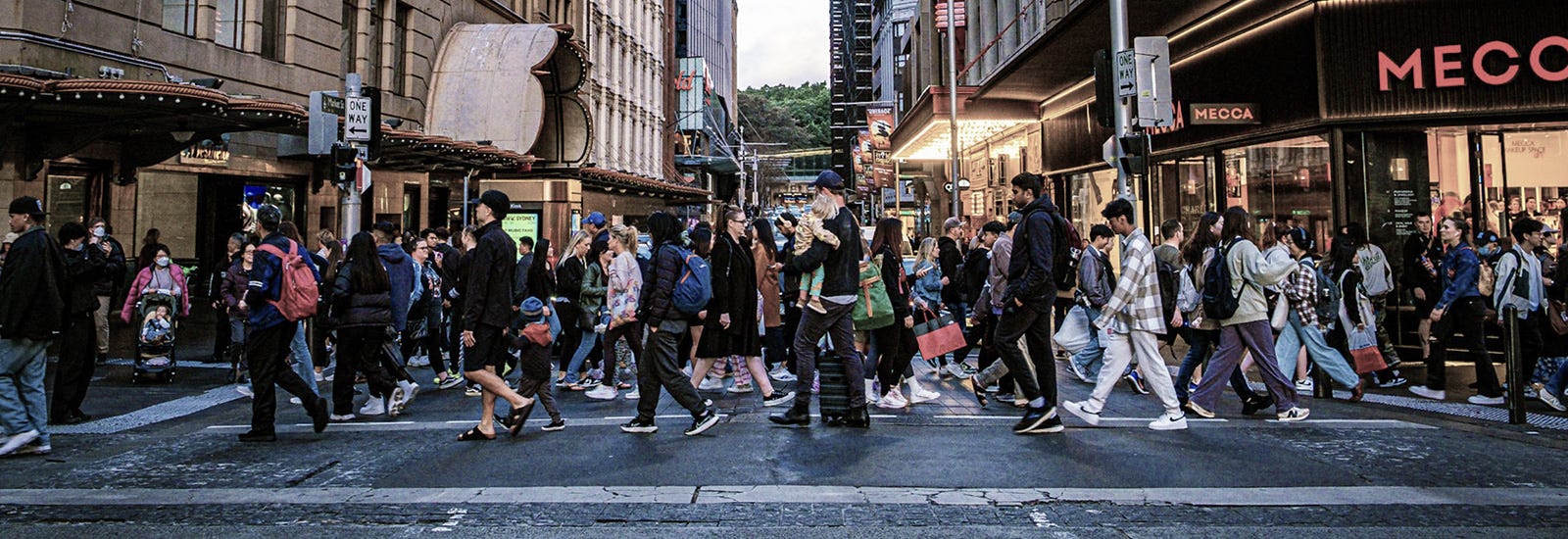
Smith was once the most common surname registered among newborn babies in Victoria. Today, it ranks fourth, behind Singh, Nguyen and Kaur.
According to Victorian birth registration figures reported in March 2025, the five most common surnames among babies born in 2024 were:
Singh (628)
Nguyen (502)
Kaur (452)
Smith (407)
Williams (249)
Smith held first place as recently as 2014. Singh, associated particularly with India’s Sikh community, has held the top position every year since 2019.
The figures concern newborn registrations, not the surnames of Victoria’s entire population. Nevertheless, they illustrate a broader transformation in the composition of Australia’s younger generations.
The same pattern is evident in national migration statistics.
One-third of Australia’s population was born overseas
According to the Australian Bureau of Statistics, 32% of Australia’s population was born overseas in 2025, equivalent to approximately 8.8 million people.
In 2005, the figure was 24.2%.
What’s more, the change is not merely in the number of migrants but in where they originate.
In 2025, India overtook England as Australia’s largest overseas country of birth for the first time on record.
The Indian-born population reached 971,020, compared with 970,950 born in England. Australia’s Chinese-born population numbered approximately 732,000.
Over the preceding decade, the Indian-born population increased by 522,000, while the English-born population declined by approximately 36,000.
Australia’s traditional European migrant populations are ageing, while immigration from Asian and South Asian countries accounts for an increasingly significant share of new arrivals.
The result is a substantial transformation in Australia’s demographic composition, driven by immigration policy rather than natural population growth alone.
Birth rates are collapsing while immigration sustains population growth
The latest ABS birth statistics, released on 6 November 2026, recorded a fertility rate of just 1.497 children per woman in 2025, compared with 1.796 a decade earlier.
The replacement rate is approximately 2.1 children per woman.
Australia’s fertility has remained below replacement level since 1976.
Meanwhile, the ABS reports that Australia’s population increased by 392,700 in the year ending March 2026.
Of that increase:
292,100 came from net overseas migration.
100,600 came from natural increase, meaning births exceeded deaths.
Put simply, 74.4% of Australia’s population growth came from net overseas migration.
But rather than addressing the structural problems discouraging marriage and family formation among Australians, successive governments have relied heavily on immigration to sustain population growth.
The consequence is that Australia’s population continues expanding while its ancestral and ethnic composition changes.
What will Australia look like in 2050 or 2075?
The overseas-born share of Australia’s population increased by 7.8 percentage points between 2005 and 2025.
If that average rate of increase continued, the trajectory would be:
Year - Overseas-born share
2025 - 32.0%
2036 - 36.3%
2046 - 40.2%
2056 - 44.1%
2076 - 51.9%
On this simple extrapolation, overseas-born residents would become a majority around 2072.
Importantly, that calculation excludes second- and subsequent-generation descendants of migrants, who are counted as Australian-born.
It therefore cannot measure the changing proportion of Australians of Anglo-Celtic or broader European ancestry.
The 2021 Census recorded English ancestry among 33% of Australians, Australian ancestry among 29.9%, Irish ancestry among 9.5% and Scottish ancestry among 8.6%. These categories overlap because respondents can nominate multiple ancestries.
Although no reliable “official” projection identifies precisely when Australians of European ancestry might become a minority, the direction of demographic change is clear, as is the decisive role immigration policy plays in determining its pace.
A nation has a right to preserve its inheritance
Australia was not established as an interchangeable economic zone, existing merely to accommodate an indefinitely expanding population or foreigners.
Its national institutions, parliamentary traditions, common law, religion, language and much of its cultural character were inherited from its predominantly British and Irish founders and settlers.
Yet political discussion increasingly treats immigration primarily as a means of addressing labour shortages, economic growth and an ageing population, while giving comparatively little consideration to its cumulative effects on national identity, cultural continuity and social cohesion.
In fact, on Monday, 9 November, NSW Premier Chris Minns condemned One Nation candidate Stuart Bonds as “frankly outrageous and racist” after Bonds warned that Australians were being “demographically replaced inside our own nation” through mass immigration. Minns dismissed the claim as an imported conspiracy theory.


The figures, however, seem to tell a very different story.
In truth, there is nothing “inevitable” about present immigration levels. They are determined by government policy and can be changed. Nor does a declining fertility rate oblige a nation to pursue perpetual population growth through immigration.
A genuinely national government would regard the prosperity, family formation, and generational continuity of its existing population as central political priorities. It would consider the long-term consequences of immigration rather than treating population growth as an unquestionable good.
But here’s the reality we’re faced with: Australia’s fertility rate is below replacement level. Immigration supplies nearly three-quarters of population growth. One-third of residents were born overseas. The sources of immigration have shifted substantially away from the Christian European countries that shaped modern Australia to India and other Asian countries.
These are measurable realities, not speculative predictions.
The question is not whether Australia’s demographic composition is changing. It is whether Australians want that transformation to continue, at what pace, and whether their elected representatives have any intention of preserving the nation’s historical identity for future Australians.
A people who surrender the right to determine the future composition and character of their nation surrender the very principle of national self-government.