




On 18 August, United States gross federal debt passed $40 trillion for the first time. Two days later, the Australian Government Securities passed $1 trillion for the first time.
The standard explanations are mostly just excuses. Washington will point to COVID debt, to the rate cycle, to the tax bill. Canberra will point to the NDIS, to aged care, to hospitals. None explains why every developed democracy is doing the same thing at the same time, under governments on every side of politics, in defiance of what all of them say they believe about fiscal discipline.
Each of these explanations is a distraction from the core issues: runaway consumptive spending, declining spending efficiency, expansion in the very conception of what government should be responsible for and inability to pursue any significant structural reforms.
Here is what drives everything as the underlying foundational demographic challenge: declining generational stake. The marginal voter and the marginal politician in each of these countries hold a shrinking personal stake in what happens after they die. Not zero. Shrinking — and moving in one direction for nearly 200 years.
In exploring questions like these, Prothean Institute looks to the political and philosophical approach of James Madison: not moralistic, just assume people are self-interested and will act to maximise their own outcomes within the incentive structures that exist.
Therefore, it’s not a moral observation. It is an arithmetic one, and it predicts the budget, the policies and the outcomes we are seeing today.
The calculation nobody says out loud
A person with no children, or one child, can protect their line by accumulating personally. Save enough, buy the house, top up the super, and the inheritance divides by one. A deteriorating country is survivable if your sole heir and his wife get the accumulated assets of 4 grandparents. Personal accumulation works.
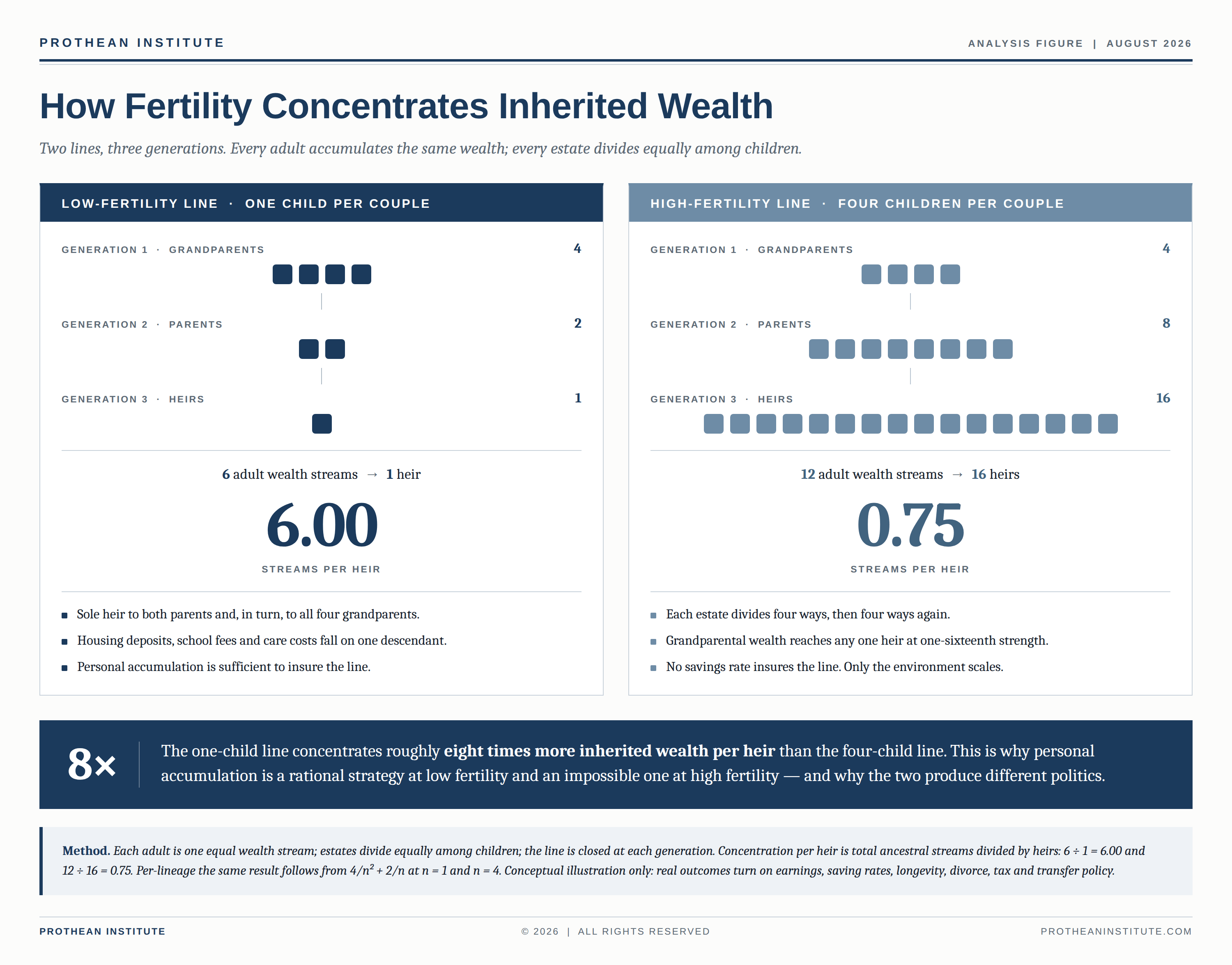
A person with four children cannot do this. The estate divides by four, then by sixteen when grandchildren arrive. And with more than four children, the consequences are exponential. There is no savings rate high enough to ensure a large line of descendants against a shrinking economy.
The only strategy that scales is to create a flourishing country over the long term in which descendants can create their own economic prosperity.
Why low fertility erodes economic performance
What matters here is what it does to fiscal policy and the budget.
Four direct impacts are evident:
First, consumption. For a household that has opted out of children, the rational plan is present enjoyment plus a retirement pot or extraction from government pension plans. There is no inter-generational investment to fund. Politically, that household votes for what makes the present comfortable: transfers, subsidies, cost-of-living relief, protection of asset values and avoidance of significant structural reforms.
It does not vote for anything whose cost is now and payoff arrives in the medium to long term, and will happily borrow money for present consumptive spending.
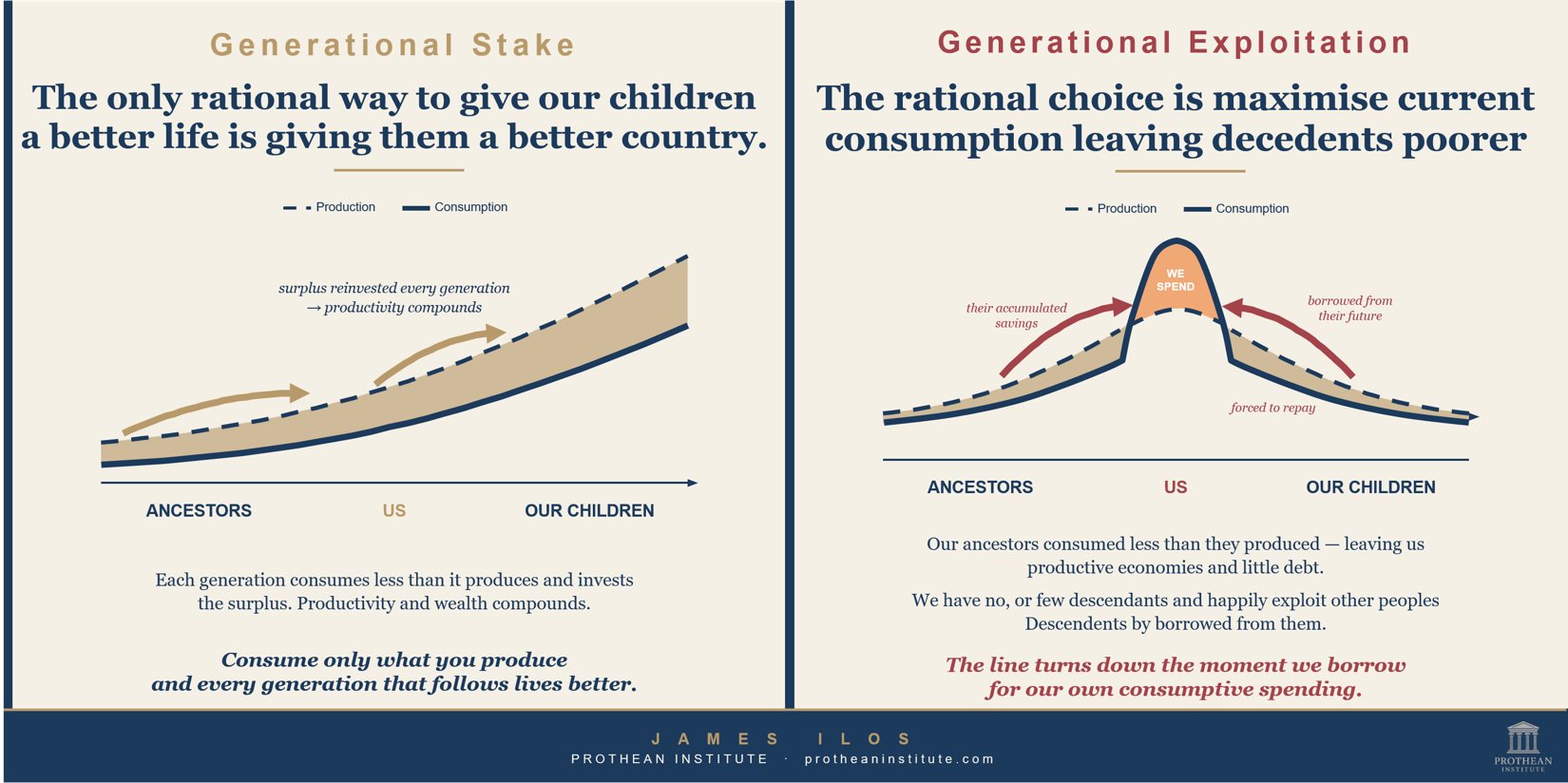
Consumptive spending now accounts for more than the entire government tax revenues in most anglosphere countries, with little federal spending on real intergenerational productive infrastructure.
Second, debt. This is where fertility bites hardest, through a design flaw that low fertility exposed rather than caused. Social Security, the age pension, and every European state pension are pay-as-you-go. Today’s retirees are paid by today’s workers. That is a claim by one cohort on the earnings of another. When the second cohort shrinks, a government has two options: cut the benefit, or borrow from descendants that are likely not even born.
Cutting is possible, but it is politically expensive enough, particularly in a low-fertility environment, that neither Washington, London nor Canberra has seriously attempted it in a generation.
So they borrow from future generations. American net interest is now over $1 trillion per year. In Australia, public debt service costs exceed the budget deficit itself: had Australia lived within its means historically, it could be running budgetary surpluses despite the enormous government spending programs such as NDIS.

Neither country set out to put themselves in these precarious financial situations. It is the compounding cost of incremental decisions and structural reforms consistently deferred.
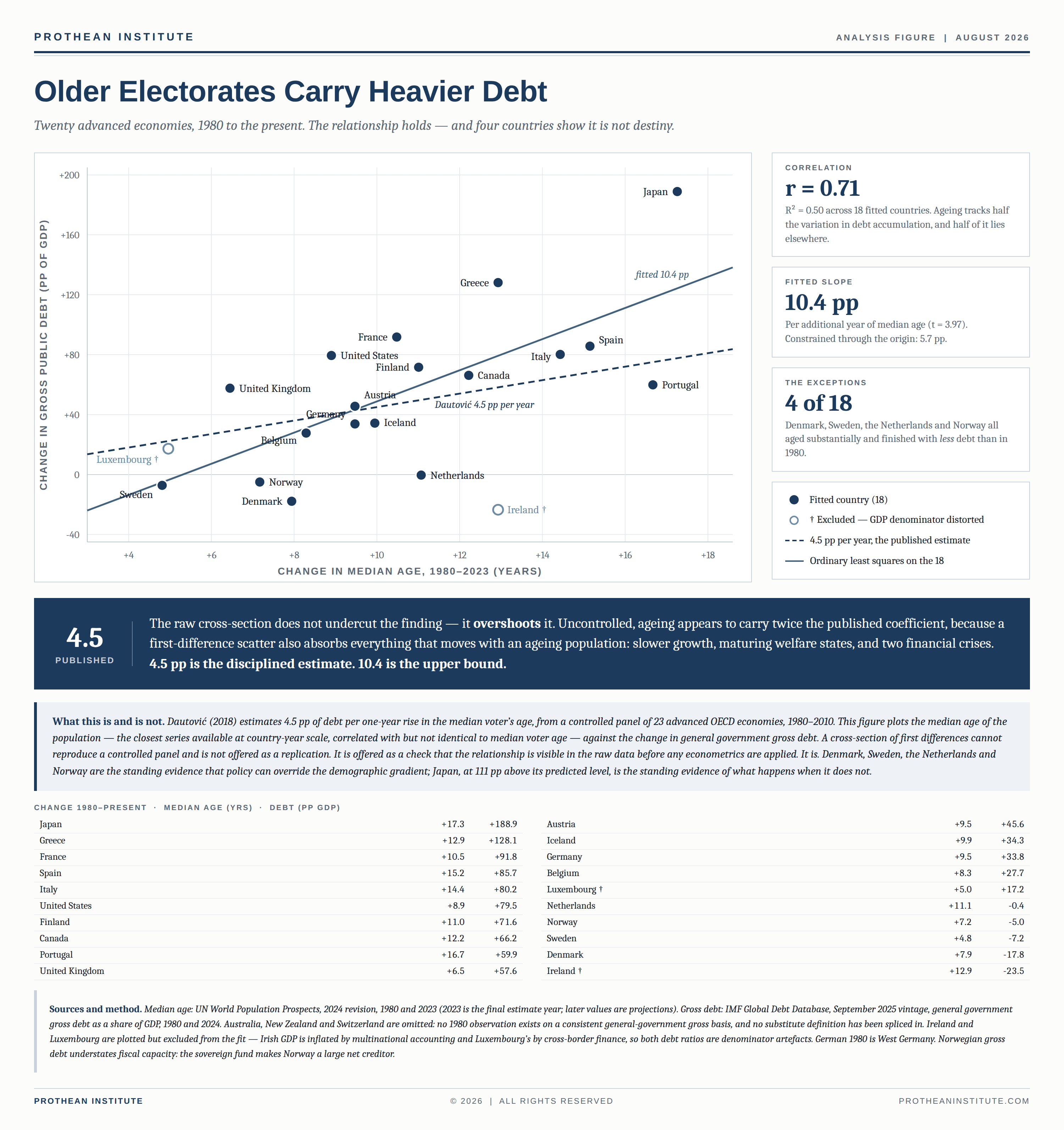
There is a number that gives this mechanism a formula. Across twenty-three advanced OECD economies from 1980 to 2010, every one-year increase in the median voter’s age is associated with a public debt-to-GDP ratio about 4.5 percentage points higher. A study measuring the age of the electorate (rather than the fertility of the people running it) — but it is what the generational stake predicts.
Third, deferral. Work published in February by the Aspen Economic Strategy Group modelled the American budget under continued low fertility and under an immediate return to replacement fertility in 2026. Deficits are unsustainable through 2055 in both cases — and replacement fertility makes the primary deficit worse by 0.2 to 0.5 per cent of GDP a year for the next three decades, because children cost money long before they pay tax. The fiscal payoff arrives around 2075. It’s the very definition of intergenerational investment.
Read that again, because it is the whole problem in one sentence. A politician who fixed the birth rate tomorrow would spend their entire career, and their successors’ careers, paying for it. The same calculus applies to all significant structural or spending reforms that might yield significant benefit in the long term, but require short-term austerity.
The incentive to act on any significant civilisational issue is not merely weak. It is negative at a political level in a low-generational-stakes political environment.
Fourth, immigration as a ‘cheap’ substitute for children. Once fertility repair or structural reforms to improve productivity are written off as too hard or uneconomical, the rational policy is to substitute population and economic growth with migration, and the low long-term consequences of these policies are not considered relevant to a low-generational-stakes electorate.
In Australia, net overseas migration accounted for 73 per cent of population growth in the year to December 2025. Migration levels have been fought over at recent elections in all Anglosphere countries. What has never been put to a vote is migration as a demographic replacement strategy — the quiet substitution of imported adults for domestic births. It arrived because it is the only lever that shows results inside an electoral cycle.
That is what managed decline is. Not a plan. A sequence of individually rational decisions by people whose personal calculation is satisfied either way.
The biggest problem of our time
Apply the inheritance calculation to the people currently in office, and it makes an awkward prediction.

The senior figures of the American executive have unusually high fertility: Trump (five children), Vance (four), Hegseth (seven), and RFK Jr. (six). Between them they have twenty-two children — an average of 5.5.
Set against the recent leaders of other major Western democracies — Macron (none), Scholz (none), Merkel (none), Albanese (one), Sunak (two), Starmer (two), Trudeau (three) — the average falls to roughly 1.14. The gap is striking.
Yet the high-fertility group is also running one of the largest structural deficits in the developed world.
Elon Musk is the cleanest illustration of the problem. A man with more than ten children entered government specifically to attack the long-horizon fiscal problem, at considerable personal cost to his companies and his public standing. What happened next is an informative bit. The effort achieved a fraction of what it claimed, ran into an entrenched appropriations structure that no executive could break through, and wound down. A high-stakes individual attacked the problem directly, and the low-generational-stakes incentives won. If that does not settle the question of whether personnel can substitute for institutional design, nothing will.
We will not pretend this away. On the most visible short-term test available, the mechanism appears to get the wrong answer.
There are two compounding explanations:
The inheritance calculation is a claim about long-horizon incentives, not about the next budget cycle. The same administration has pursued (with mixed success) spending restraint (in particular Musk), reshoring, energy expansion, and family-formation measures — projects whose payoffs, if any, arrive well beyond the current electoral window.
Perhaps more important for the argument of this piece: a high-fertility executive still faces low-fertility voter preferences and the same institutional incentives that produced the deficits in the first place. Personnel alone does not rewrite the incentive structure across a population.
Which is, in the end, the point. The deficit is downstream of what the median voter demands and what the institutional design rewards. Changing the people at the top, even when those people have strong personal generational stake, does not automatically change the outcome.
The clearer tests of the underlying mechanism are the structural cases of Singapore and Israel.
The Israeli exception
Israel is the only country in the OECD with fertility above replacement — 2.87 in 2024. If the generational stake operates at population scale rather than only through individual leaders, this is where it should show.
It does. Israel cut general government gross debt from 269.8 per cent of GDP in 1984 to 59.3 per cent in 2019, and ran a budget surplus in 2022.
No other developed country has managed anything close. Over the same thirty-five years, every low-fertility peer moved the other way.
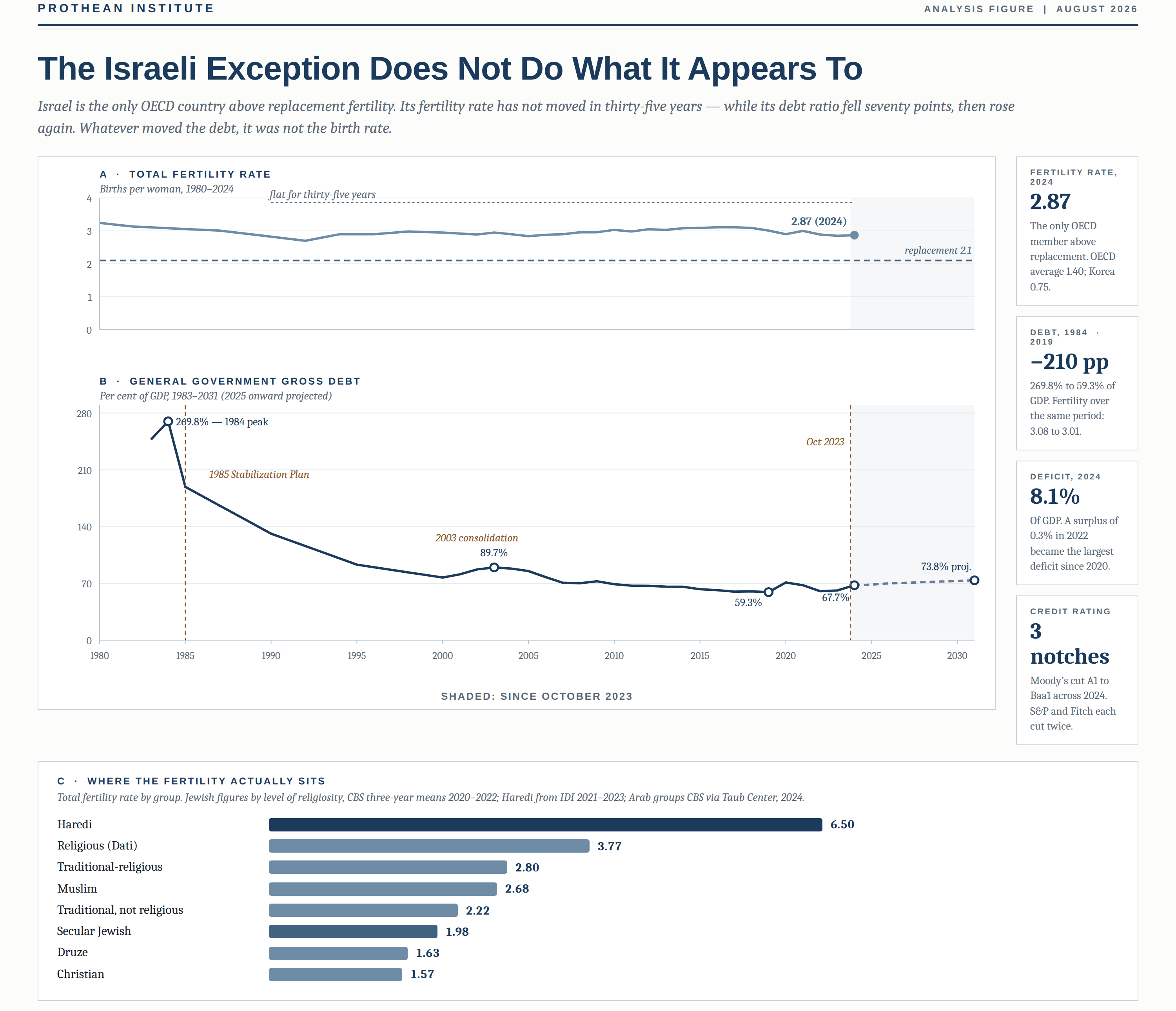
Israeli fertility did not rise during the deleveraging — it sat between 2.8 and 3.1 the whole time. That is the point: the generational stake is not a switch that gets flipped; it is a standing condition that biases policy toward long-term investment. Israel held it continuously and deleveraged continuously. The Anglosphere and Europe held the opposite continuously and did the opposite.
The war since October 2023 has added roughly ten points to Israel’s debt ratio. But borrowing to resolve a problem permanently rather than manage it indefinitely moves cost into the present so that the future inherits a solved problem instead of a costly running one.
Israel did not choose 7 October. What it chose afterwards was to prosecute the problem to a resolution rather than return to managing it — at eight per cent of GDP, three credit downgrades, and sustained international diplomatic cost.
A low-stakes political class facing the same attack has an obvious alternative available: absorb it, restore the prior equilibrium, defer the underlying problem, and protect the status quo. And that is what the west has chosen repeatedly to for its significant challenges.
The Singapore objection
The other obvious rebuttal is Singapore. A fertility rate of 0.87, among the lowest in the world. Yet a budget surplus, a AAA rating, and a net asset position. If low fertility drives debt, Singapore should be a wreck.
Prime Minister Lee Kuan Yew had three children, together with a near-dynastic attitude toward generational stake, and he built its institutions, economy and government with this long-term vision. He made sure Singapore voters had little influence for half a century.
He built its retirement system to require workers to contribute to their own retirement over their productive lifespans, rather than draw on the next cohort’s payroll. Half the long-term real return on the national reserves must by law be reinvested rather than spent. Intergenerational investment is built into its economy.
None of that requires virtuous politicians. It is Madisonian design in the strict sense: long-horizon outcomes out of ordinary self-interested people. The recent history of Singapore is also instructive on two points:
Voter power growing - As Lee Kuan Yew stepped back progressively from leadership, and the voter influence grew from around 2000, we see the emergence of the very consumptive spending trends evident in other Western democracies.
The primary balance — budget excluding investment returns — went negative this year for the first time since the pandemic. The system is now funding current spending from the yield on inherited capital, exactly as the West does
Singapore has not solved low fertility. It bought several decades of insulation from the fiscal consequences with its capital accumulation, and it is now spending the yield.
What follows
Asking the political class to think longer term is wasted breath, and it does not much matter how many children they have.
A voting public that rewards consumption, debt and reform deferral will produce consumption, debt and reform deferral.
Moral exhortation asks people to act against their interest, and Madison’s entire point was that durable institutions never require that, and those that do, fail.
And read the debt figures and intergenerational theft as the cost of failed institutional design.
Forty trillion and one trillion are not the problem; they are the reckoning — addressed to the grandchildren of the people who still have a generational stake.
The corrective is structural, or it is nothing.
The Prothean Institute is an independent strategic research organisation dedicated to understanding, preserving, and renewing the foundations of thriving societies. All policy recommendations and strategic analyses are grounded in strict epistemic rigour and the reality of real-world conditions and human nature. We reject abstractions untethered from reality and seek to equip leaders with tools that work in the world as it is — not as we might wish it to be.
Notes and References
US Department of the Treasury, Debt to the Penny. Total public debt outstanding was $39,986,657,878,071.92 on 17 August 2026 and $40,047,425,768,420.22 on 18 August 2026. https://fiscaldata.treasury.gov/datasets/debt-to-the-penny/
The $1 trillion figure derives from the Australian Office of Financial Management’s issuance schedule as calculated and released by Shadow Treasurer Tim Wilson, 20 August 2026, which puts AGS on issue at $1,000.8 billion on 20 August and $994.8 billion on 21 August following $6 billion of maturities. AOFM’s own last published stock figure was $983.7 billion as at 14 August. Commonwealth of Australia, Budget 2026–27, Budget Paper No. 1, Table 7.1 projects AGS on issue of $982.0 billion in 2025-26 and $1,051.0 billion in 2026-27. https://www.miragenews.com/australia-hits-1-trillion-of-commonwealth-debt-1730112/ | https://www.aofm.gov.au/
Prothean Institute, The Generational Stake: Why Different Fertility Patterns Produce Different Incentive Structures — and What That Predicts About Political Behaviour, Policy Brief, May 2026 (Paper 3, The Divergent Societies series).
Congressional Budget Office, The Budget and Economic Outlook: 2026 to 2036, February 2026. Mandatory outlays $4,529 billion of $7,449 billion total in FY2026 (60.8%); $7,028 billion of $11,416 billion in 2036 (61.6%). https://www.cbo.gov/publication/61882
Commonwealth of Australia, Budget 2026–27, Budget Paper No. 1, Statement 3, Table 3.1 (payments 26.6% of GDP in 2025-26, 26.8% in 2026-27) and Statement 11 historical series (1986-87: 26.9%). These are budget estimates, not outcomes. https://budget.gov.au/content/bp1/download/bp1_bs-11.pdf
Congressional Budget Office, Monthly Budget Review: July 2026, August 2026. Fiscal year to date: Social Security $1,373 billion; net interest $963 billion; Medicare $952 billion; Department of Defense (military) $763 billion. https://www.cbo.gov/publication/61983
Commonwealth of Australia, Budget 2026–27, Budget Paper No. 1, Statement 7, Table 7.9 (AGS interest $27,690 million in 2026-27 rising to $40,425 million in 2029-30, +46.0%) and Statement 3 (public debt interest averaging 8.8% annual growth over the projection period, against hospitals 7.3%, defence 6.4%, aged care 5.4%). https://budget.gov.au/content/bp1/download/bp1_bs-7.pdf
Ernest Dautović, ‘The weight of the median voter ageing on public debt’, Constitutional Political Economy, vol. 29 no. 1, 2018, pp. 69–92. Panel of 23 advanced OECD economies, 1980–2010. https://link.springer.com/article/10.1007/s10602-017-9248-8
Social Security and Medicare Boards of Trustees, 2026 Annual Reports, 9 June 2026. OASI depletion fourth quarter 2032 (78 per cent payable); Medicare HI depletion second quarter 2033 (89 per cent payable); seventy-five-year OASDI actuarial deficit 4.42 per cent of taxable payroll, widened from 3.82 per cent, of which approximately 0.33 points is attributed to lower fertility, 0.18 to reduced immigration, and 0.16 to the One Big Beautiful Bill Act. https://www.ssa.gov/oact/TR/2026/
Lisa Dettling and Luke Pardue, Low Fertility and Fiscal Sustainability: The Effects of Past and Future Fertility Rates on the US Federal Budget Outlook, Aspen Economic Strategy Group, 24 February 2026. https://www.economicstrategygroup.org/publication/pardue-dettling-budget/
Australian Bureau of Statistics, National, state and territory population, December quarter 2025, released 18 June 2026. Total population growth 412,500; net overseas migration 301,000; natural increase 111,500. Australia’s total fertility rate was 1.481 in 2024, a record low: ABS, Births, Australia, 15 October 2025.
Statistics Canada, ‘Canada’s total fertility rate reaches new low’, 22 April 2026. https://www.statcan.gc.ca/o1/en/plus/9140-canadas-total-fertility-rate-reaches-new-low-2024
Committee for a Responsible Federal Budget, ‘OBBBA Dynamic Score Comes In At $4.7 Trillion’, on CBO’s dynamic estimate including debt service, FY2026–2035. The conventional provision-only score is $3.4 trillion. https://www.crfb.org/blogs/obbba-dynamic-score-comes-47-trillion
Israeli Government Israel Economy Recent Trends 2026 economic update:
https://www.gov.il/BlobFolder/reports/israel-economy-recent-trends/en/Files_eng_israel-economy-recent-trends.pdf
Singapore Department of Statistics, Total Fertility Rate 2025, 26 February 2026 (preliminary resident TFR 0.87, from 0.97 in 2024); Speech by Deputy Prime Minister Gan Kim Yong, Committee of Supply Debate 2026. South Korea’s 2025 provisional TFR was approximately 0.80. https://www.singstat.gov.sg/news/total-fertility-rate-2025
Singapore Ministry of Finance, Analysis of Revenue and Expenditure, Financial Year 2026. Net Investment Returns Contribution S$28.48 billion, 17.4 per cent of total revenue (21.1 per cent of operating revenue); primary balance −S$2.57 billion in FY2026 against +S$6.40 billion in FY2025. https://isomer-user-content.by.gov.sg/153/b25a4bb9-db1b-428d-ab48-4528e0ee0d37/fy2026_analysis_of_revenue_and_expenditure_2026.pdf