


J.R.R. Tolkien, author of The Lord of the Rings and The Hobbit, didn’t just write fantasy for fantasy’s sake; he believed that when humans tell stories filled with beauty, sacrifice, and hope, they reflect the image of the Creator Himself.
It’s a vision that gives weight and meaning to all great art, and especially to the kind of “eucatastrophe” that he saw as central to the Gospel. Tolkien coined the term eucatastrophe by combining the word eu (good) with catastrophe (sudden turn), to describe a sudden, unexpected, and joyous turn of events in a story.
According to Tolkien, the true purpose of fairy tales is to bring consolation through a joyful ending, not merely a “happily ever after,” but a sudden and uplifting turn of events that brings awe-inspiring hope out of despair. This moment of unexpected joy, this eucatastrophe, he believed, is one of the most powerful effects fairy tales can have.
For Tolkien, the eucatastrophe offers a brief, shining glimpse of ultimate joy—a joy that transcends the world and touches on something deeper, even spiritual. It is like a moment of grace, a taste of something eternal, “joy beyond the walls of the world, poignant as grief.” In other words, it offers us a small glimpse at Christ.
In his essay On Fairy-Stories, Tolkien explains:
“The Gospels contain a story of a larger kind which embraces all the essence of fairy-stories… But this story has entered History and the primary world; the desire and aspiration of sub-creation has been raised to the fulfilment of Creation. The birth of Christ is the eucatastrophe of Man’s history. The Resurrection is the eucatastrophe of the story of the Incarnation. This story begins and ends in joy.”
J.R.R. Tolkien, On Fairy-Stories, 1939
In fact, Tolkien saw the Resurrection as the ultimate eucatastrophe—the most joyful turning point in the greatest of all Stories. The Gospel story evokes a unique joy, he said, that is so profound that it brings tears, not because it is sorrowful, but because it touches that deep place where joy and sorrow meet, where opposites are reconciled, and love swallows both selfishness and selflessness alike.
Tolkien believed that all meaningful stories, at their best, echo this Great Story—the one where light overcomes darkness, where the unexpected turn is the deepest truth breaking through. That’s what makes his works feel so timeless, soul-stirring, and even spiritual. They touch on something we cannot possibly put into words. They aren’t merely “escapism,” they’re a reminder of what’s real.
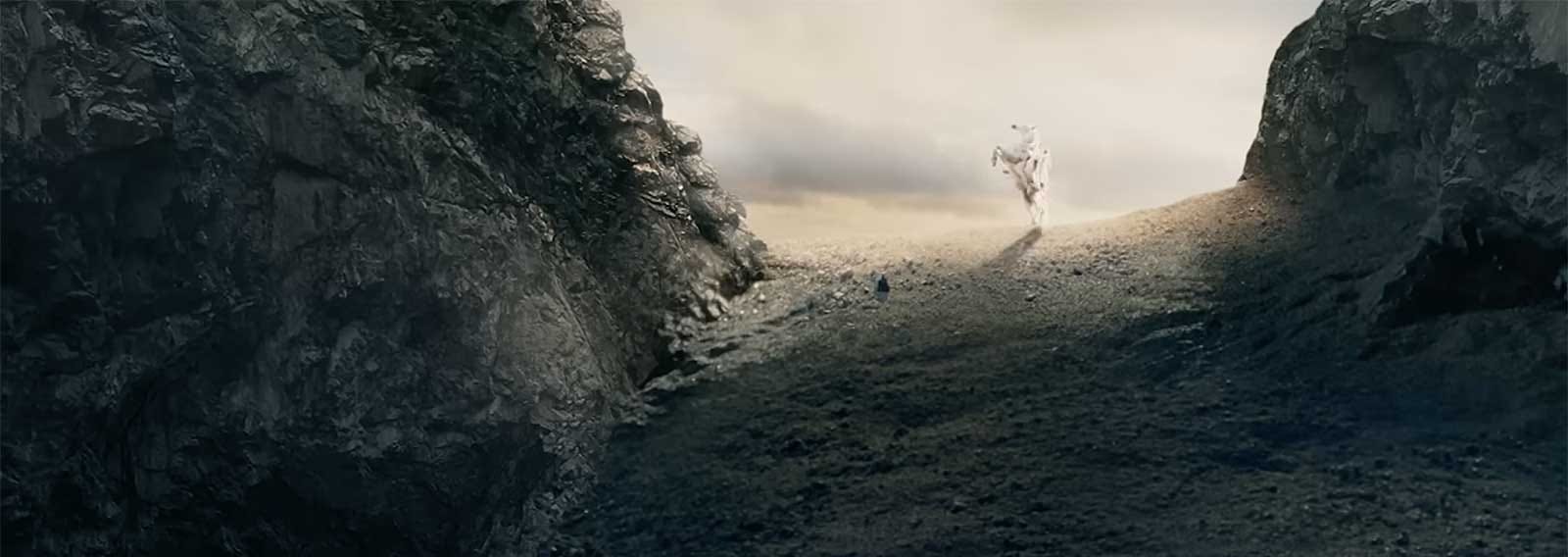
Reflecting on Tolkien’s concept of eucatastrophe, John Piper highlights a particularly poignant scene from Peter Jackson’s The Lord of the Rings film adaptation. He writes:
“Why do people go to see The Lord of the Rings by the millions? My wife and I made a three-year anniversary date in December out of going to see every one of these. Why? What is it about those huge boulders quashing all those bad guys? What is it about the magnificence of this army and Gandalf riding this white horse in just at the right time, and everything like a sea dividing before him? What draws us to that?
He continues: “This is not evil that we are drawn to things like that. Written on our hearts is: ‘You are not made for mirrors; you are made for God.’ It’s Christ. It’s all about images of Jesus. Of course, we don’t know what Jesus looked like, and we have to invent stories and parables and great cinematic phenomena so that we would just taste a little bit of what it will be like when John 17:24 comes true… everything you ever were moved by in the theater will become a tiny pointer to the reality. Therefore, you were made for Jesus and the satisfaction of your soul will be found in him…”
John Piper, The Blazing Center
Piper is right—each of us has, at some point, experienced this sense of awe. Many felt it, to some degree or another, as Gandalf and the Rohirrim ride to the king’s aid. If you cannot remember the scene, you can watch it below.
The awe you sense at Gandalf’s timely arrival is, as Tolkien put it, the eucatastrophe—the sudden, unexpected, and joyous turn of events. It is a very real echo of Christ’s unexpected and joyous triumph.
WATCH: