




Earlier this year, Australia’s eSafety net nanny took on the “manosphere” by waging war on emojis.
Chances are you missed it. So, here’s a quick rundown.
eSafety defined the sphere as more than “just a fringe online subculture.”
In the post, dated 12 March, the commission said, “Its harmful messages are filtering into online humour, memes, self-improvement content and recommender feeds. The content might seem harmless at first. Then the tone shifts.”
It’s complex, they added, stating that the online environment is being used to exploit what the commission called the natural insecurities that come with adolescence.
These, they said, “can pull young men towards more hostile and harmful ideas that portray girls and women as inferior.”
As for what constitutes the so-called “manosphere”, eSafety said, “it’s a space that frequently advocates narrow and rigid ideas about what it means to be a ‘real man’.”
This includes any signalling towards physical appearance, wealth, and dominance, especially over women.
“Another common (but false) narrative,” they said, “is that feminism and gender equality have come at the expense of men’s rights.”
eSafety’s five-alarm fire about ‘toxic masculinity’ went as far as to argue that content about men which uses this tone wasn’t about helping men; it was about farming the algorithm by fuelling outrage.
They said, “While young men might start out searching for relatable topics – like fitness or self-improvement – they can be propelled by these combined forces, step by step, into blame, resentment and hate, often aimed at women and the LGBTIQ+ community.”
For the eSafety net, nannies, parents and carers need to watch out for content about self-improvement, financial or dating advice, fitness tips, confidence talk, ‘discipline,’ rigid gender roles and harmful messages about women and girls.
Alongside fitness, humour is also a suspect door towards masculine radicalisation.
The Commission asserted that memes can “carry coded messages, shift meaning over time, or be used to smuggle hateful ideas through dark humour.”
To this, eSafety added, “some groups use shorthand to signal membership. Even emojis can be used in coded ways. The key point is context: a symbol can be harmless in one chat and a red flag in another.”
As for what emojis are the weapons of choice for “manosphere” manipulators, eSafety shared five examples.
Exhibit A:
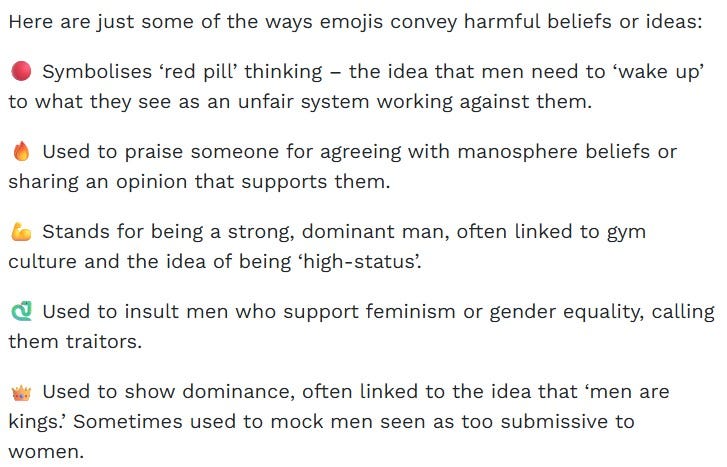
Other “manosphere” landmines to look out for, eSafety’s guide says, are terms like ‘incel’ (involuntarily celibate), ‘red pill’, ‘Chad/Stacey’ (stereotypes about attractive, successful men and women) and ‘normie’.
This online environment and its language have raised concerns; the eSafety information piece said that “a small number of individuals can move from online hate into offline harm, especially when online communities reward extreme talk.”
It’s not all bad. The eSafety concluded their —‘emojis are telling you bad things’ — takedown of “toxic” masculinity with a helpful guide for parents.
Sure, it’s wordy, but you do get some useful take-home points for the tax dollars they spent on it.
For example, the guide advises building rock-solid relationships with our kids, stating, “You don’t need to know every acronym or meme. What matters is connection, conversations and ongoing support.
“Stay close even when they push back. Strong relationships offer protection. Young people who feel anchored offline are less likely to rely on online validation.”
Their four tips? Talk in low-pressure moments, show interest in what kids are doing online, keep calm, and pause before reacting.
These could have easily been lifted straight from James 1:19: “Be quick to listen, slow to speak and slow to become angry.”
More so when the eSafety guide talks up critical thinking and states, “When parents panic, young people often shut down. Be curious, not critical. Focus on respect and values, rather than giving them a list of people they can’t engage with online.”
That’s good advice.
I can’t say that much for the rest of it.
The word harmful is deployed 11 times. “Manosphere” appears 17 times, violence appears 6 times, and masculinity appears 5 times.
As I’ve argued before, those who preach about “toxic” masculinity often have a toxic view of masculinity.
It says a lot about the eSafety Commission when they’ll obsess over emojis, fitness and what it regards as “toxic” masculinity, yet not even mention pornography or abortion.