



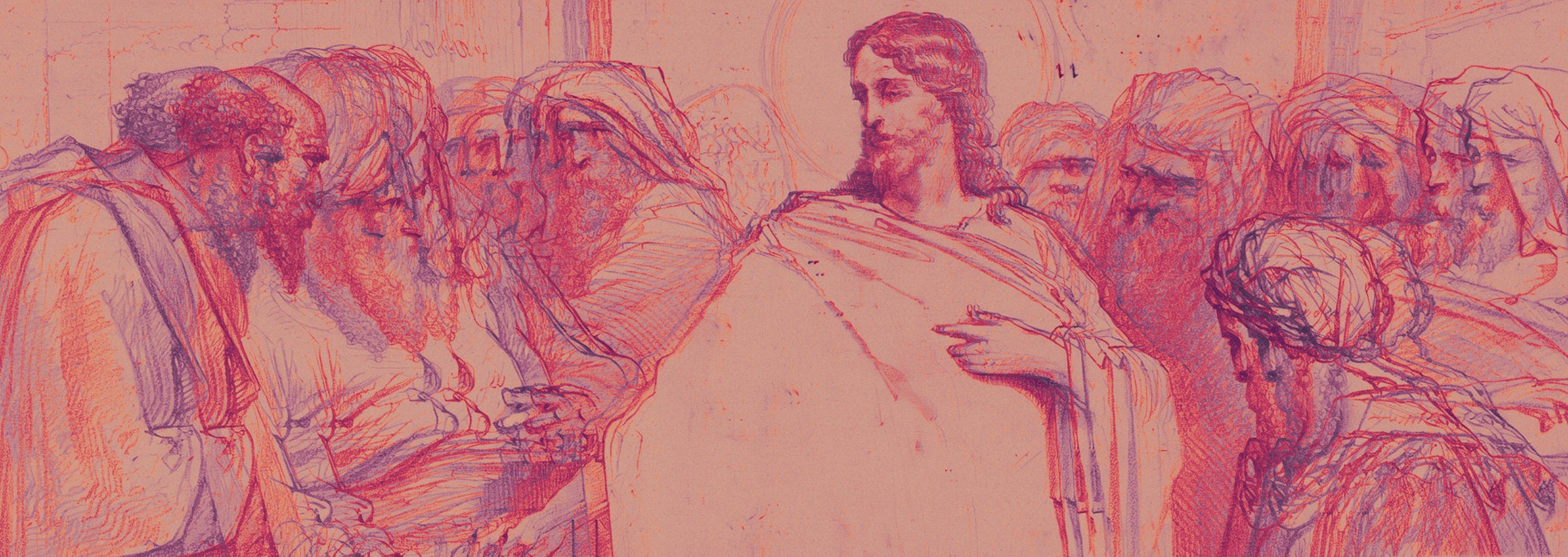
For the Christian, nothing is more vital than rightly understanding Jesus—what he believed, how he interpreted the Scriptures, and what form of religion he actually observed during his earthly life and ministry.
Many people remain convinced that Judaism is simply the religion of the Old Testament—and therefore the religion Jesus Himself practised. The problem with this assumption, however, is that it overlooks the complexity of Judaism in the first century. In Jesus’ day, there was no single, unified expression of Judaism, but a range of competing traditions, each claiming to represent the true interpretation of the Scriptures.
Without question, Jesus faithfully followed the religion revealed in the Old Testament. This point must be emphasised and underlined twice, because some may assume that when we speak of “Judaism” here, we are referring simply to the observance of the Old Testament law. We affirm that Jesus obeyed the law of God perfectly.
The question is not whether Jesus upheld the Scriptures—He clearly did—but whether Jesus believed the “Judaism” of His time faithfully represented those Scriptures—and, if so, which version of Judaism. After all, first-century Judaism was not monolithic. It was divided into several rival and contradictory sects.
So, when someone insists that Jesus subscribed to “Judaism,” they must first answer an obvious question: which Judaism, exactly? The label itself is far from self-explanatory.
The Origins of Judaism
The term “Judaism” ultimately derives from the name “Judah.” Judah (Hebrew: Yehudah) was one of the twelve sons of Jacob. His descendants formed the tribe of Judah, and later the southern Kingdom of Judah. After the Babylonian exile, many of those who returned were from this region, and they came to be known as Yehudim—that is, “Judeans,” or “Jews.”
Originally, the term referred primarily to a people or regional identity—those associated with the tribe of Judah. Over time, especially in the Greek period (when the term Ioudaismos appears), it developed into a broader designation for their religion, encompassing beliefs, practices, and ways of life that distinguished them from surrounding cultures.
In that sense, figures such as Abraham, Moses, David, and even Judah would not have described their faith as “Judaism,” since the term arose much later and reflects a historically and theologically developed identity—one that, by the Second Temple period (516 BC-AD 70), had come to include a variety of sects, interpretations, and recognised competing authorities.
The Diversity of First-Century Judaism
So, the question remains: If Jesus practised Judaism, which sect of Judaism did he belong to? Was Jesus a Pharisee, a Sadducee, an Essene, a Zealot, or was he part of the Hellenistic Jewish tradition? Did he side with the Sicarii, the Herodians, or even the Samaritans? Each of these groups had its own interpretation of Scripture, its own authorities, and its own vision of what faithfulness to the God of Israel looked like.
Scholars suggest that Jesus was theologically closest to the Pharisees. After all, the Pharisees believed in the resurrection and accepted the full Old Testament canon. By contrast, the Sadducees denied the resurrection and recognised only the Torah (the first five books of the Bible), while the Essenes maintained additional writings.
The Zealots, Hellenists, Sicarii, and Herodians, on the other hand, were largely driven by political and cultural concerns. The Samaritans had their own version of the Torah that reflected a rival tradition of Israelite worship that centred on Mount Gerizim rather than Jerusalem.
When someone insists that Jesus subscribed to “Judaism,” they must first answer an obvious question: which Judaism exactly?
Jesus Against the Pharisees
Yet the Gospels make clear that Jesus did not fit neatly into any of these groups—not even the Pharisees. On the contrary, the Gospels portray Jesus as reserving his harshest criticism for the sect of the Pharisees. In fact, he openly challenged and, at times, rejected key aspects of their teaching and practice. As such, Jesus cannot, in any meaningful sense, be regarded as a Pharisee.
For one thing, Jesus had not been formally trained in their schools (Jn. 7:15). More importantly, He rejected the authority of their oral traditions, which He described as “the tradition of the elders” (Mk. 7:6-9, 13). Rather than aligning Himself with the Pharisees, He repeatedly denounced them and publicly distanced Himself from their teaching (Matt. 23).
The Gospels never identify Jesus as a Pharisee. On the contrary, His teaching undermined their authority. The crowds recognised that Jesus Himself spoke, “as one who had authority, and not as their scribes” (Matt. 7:28-29). His influence also threatened their power and influence, which is why they quickly began plotting against Him (Mk. 3:6).
Jesus also associated freely with people the Pharisees avoided, including tax collectors, sinners, and social outcasts (Lk. 5:30-32). He repeatedly violated their interpretations of the law, particularly regarding the Sabbath (Matt. 12:1-8; Lk. 14:1-6).
Most fundamentally, His teaching on righteousness and justification directly contradicted their bloodline, works-based system (Matt. 5:20). Even His disciples were not products of the Pharisaic scholarly tradition; they were described as “uneducated, common men” (Acts 4:13).
“And beginning with Moses and all the Prophets, [Jesus] interpreted to them in all the Scriptures the things concerning himself.” (Luke 24:27)
Jesus: A New Teaching?
For these reasons, it is impossible to classify Jesus within any existing sect of Judaism of His day. His teaching stood apart from all of them. The people themselves recognised this, often describing His message as a “new teaching” (Mk. 1:27). For many, the religion Jesus proclaimed was unprecedented in character, power, and authority—so much so that his hearers were repeatedly left amazed and astounded (Matt. 7:28; 13:54; Mk. 1:22).
But while Jesus’ teaching was new to the ears of his hearers, Jesus was not introducing a new religion. He was proclaiming the true and original meaning of the Law and the Prophets—a message that the religious leaders of His day had obscured and distorted beyond recognition (Mk. 7:9-13). It sounded new to the people only because it was no longer being faithfully taught by any of the various sects of “Judaism.”
This is especially clear in the Sermon on the Mount. Jesus was not abolishing the Law of Moses; He was restoring its true meaning. Again and again, He contrasted His teaching with the prevailing interpretations of the religious authorities: “You have heard that it was said… but I say to you.” Jesus was not replacing the Law; instead, he was correcting prevailing Rabbinic interpretations. He was expounding the Law as it was originally intended.
Jesus’ teachings contrasted the Pharisaic emphasis on external observance with true righteousness of the heart (Matt. 23:25-28, Rom. 10:4). He restored the original intent of the Law, fulfilling the typology of Abraham, Moses, and the prophets, showing that Christianity is the continuation and completion of Old Testament faith.
That is precisely why Jesus could say that if the religious Jews of His day had truly believed the Torah, they would have believed Him as well (Jn. 5:46). Moses pointed forward to Christ. And according to Jesus, the rejection of Christ was evidence of a rejection of Moses, and the rejection of Moses was a rejection of the faith of the Old Testament.
Jesus said, “For if you believed Moses, you would believe me; for he wrote of me.” (John 5:46)
The Testimony of Paul
The Apostle Paul later reached the same conclusion. Far from abandoning the Old Testament faith, Paul embraced Christianity because he recognised it as the fulfilment of that faith. Hence, it was necessary for Paul to convert from Judaism to Christianity (Gal. 1:13-16; Phil. 3:4-7).
If Judaism were the religion of Jesus, then Paul would not need to convert away from it to another system. If the religious systems of Judaism had truly preserved the teachings of Moses, they would have led their followers to Jesus. Instead, the majority rejected Him.
In fact, Jesus was so fundamentally at odds with the religious authorities of His day that the Pharisees, the Sadducees, and the priestly leadership all conspired together to put Him to death (Jn. 11:47-53; Acts 5:17).
Jesus did not align Himself with any of the religious systems of first-century Judaism. He confronted them. He exposed their errors. And ultimately, He was crucified for doing so.
The truth is that Jesus was not the representative of any particular Jewish sect. He was the fulfilment of the Law and the Prophets themselves. No sect of Judaism fully reflected that reality.
“All things must be fulfilled, which were written about me in the law of Moses, and in the prophets, and in the psalms” (Luke 24:44).
So, What Do We Call It?
It’s natural to want to put a name to things—to label systems, beliefs, and religious practices. It is almost as if something does not truly exist until it has a label. Yet the faith of the Old Testament rarely had a simple designation.
At times, it was called “the way of the LORD” (Gen. 18:19; cf. Ex. 18:20; Ps. 27:11;), which was less a formal religious label and more a description of covenantal life—following God’s commandments, walking in obedience, and trusting in Him.
This explains why the first Christians were called “followers of the Way” (Acts 9:2; 19:9, 23; 22:4). They understood themselves as continuing and fulfilling the covenantal faith of Israel—the very “way of the LORD” that Abraham and Moses exemplified.
The One Faith
The religion of the Old Testament is the religion of the New. Thus, Jesus was not a representative of any particular Jewish sect. He was, as he stated, the fulfilment of the Law and the Prophets, the ultimate interpreter of God’s Word, and the embodiment of the one true faith—the faith of Abraham, Isaac, Jacob, and Moses. He is the fulfilment of the Old Testament—He is the reality of the shadows cast throughout its pages.
Jesus replaces the Temple with His own body (John 2:19-21; Rev. 21:22) and the Levitical priesthood with His eternal priesthood (Heb. 7:11-28). He fulfils the sacrificial system by offering Himself once for all (Heb. 10:1-14; John 1:29) and transforms the altar into the cross (Heb. 13:10-12; Gal. 6:14).
He replaces the Holy of Holies with His presence (Heb. 9:11-12; John 14:6), the Passover lamb with Himself (1 Cor. 5:7; Luke 22:19-20), and the veil with His flesh (Heb. 10:19-20; Matt. 27:51).
Jesus inaugurates the New Covenant, fulfilling and surpassing the covenant of Moses (Jer. 31:31-34; Luke 22:20; Heb. 8:6-13), and replaces the earthly Jerusalem with the heavenly Zion (Heb. 12:22-24; Gal. 4:26; Rev. 21:2).
He is the true bread from heaven, replacing the manna (John 6:32-35, 48-51), and His crucifixion fulfils the typology of the bronze serpent (John 3:14-15).
Jesus invites all into rest, replacing the Sabbath with Himself (Matt. 11:28-30; Heb. 4:8-10), and ushers in the new creation (2 Cor. 5:17; Rev. 21:5).
He replaces fleshly circumcision with the circumcision of the heart by the Spirit (Rom. 2:28-29; Col. 2:11-12) and earthly priestly intercession with His eternal intercession (Heb. 7:25; Rom. 8:34).
He fulfils Mount Sinai through the heavenly Mount Zion (Heb. 12:18-24), the throne of David through His eternal kingship (Luke 1:32-33; Acts 2:30-36), and Israel itself as the promised heir, the true vine and covenant people (Hos. 11:1; Matt. 2:15; Gal. 3:16; John 15:1; Isa. 49:3-6).
In all these ways, Jesus is the ultimate fulfilment of the Law and the Prophets, revealing the reality behind the types, shadows, and promises of the Old Testament.
Christianity is not a departure from the Old Testament; it is the completion and restoration of the faith revealed from Abraham through Moses. By understanding Jesus rightly, we see that the true religion is not defined by sectarian labels or human traditions but by fidelity to God’s covenant, as fully revealed in the One who said, “If you believed Moses, you would believe me; for he wrote about me.” (John 5:46)