



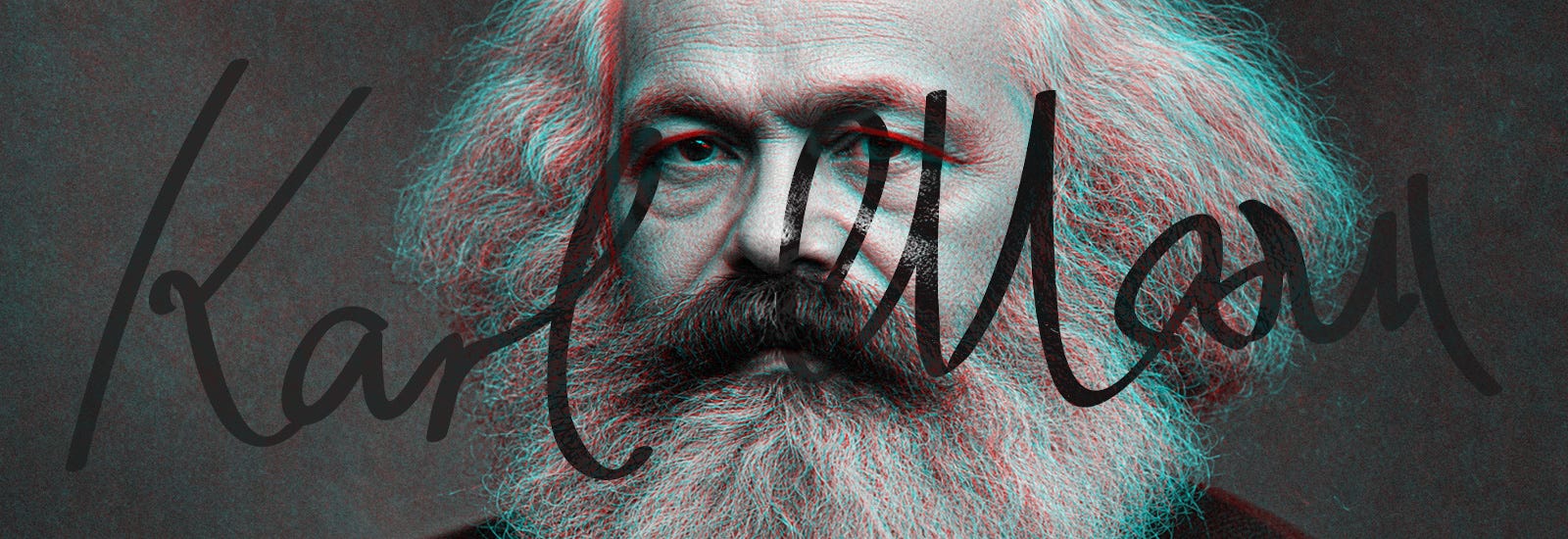
Marxism is intellectual terrorism. It negates everything human.
So wrote ex-Communist Jacques Ellul in Jesus and Marx.
The 1979 work functions in part as a criticism of the French leftist elite who were reading everything through the Marxist lens.
For the disciples of the dead Das Kapital author, his model of decoding history through the dichotomy of oppressor vs. oppressed is a religion.
As Simone Weil wrote, Marx’s obsession with what he called historical materialism created a badly constructed one at that.
At the time, Ellul noted that Marxism is “the only terrorist line of thought in Western intellectual circles.”
This terrorist position, he argued, consists of situating everything with respect to Marxist ideology.
For Ellul, the banal acceptance of this has led to the brutalisation of Christianity, where the Gospels are prostituted out like modern-day call girls.
That outcome was inevitable because Christianity cannot be reinterpreted through Marxism and vice versa.
Like abortion “care”, the term Christian Marxist is essentially an oxymoron. They’re both as far away from “care” as Zyklon-B is from a shower.
“Christians,” Ellul stated, “have every reason for not being Communists. They have almost no reason for being Communists.”
Ellul wrote that it was Marx’s ideas, not Jesus Christ’s, that gave birth “to the world’s worst sort of dictatorships, and strictly totalitarian dictatorships (including China and Vietnam).”
He also argued that forcing Marx into the same Messianic light as Christ was deliberate. For example, the term “religious right” was created by the Left to undermine conservative Christian theological legitimacy.
‘Jesus and Marx’ largely answers Daisy Mai Inglese’s question on Ayaan Hirsi Ali’s Restoring the West: Is Liberation theology costing the Catholic Church in Brazil?
Ellul does so with a big fat ‘Yes’.
Inglese holds that Brazilians are turning away from Catholicism towards Evangelicalism, and says that its likely cause is the left-wing takeover of the church.
She writes that “Liberation theology took hold in Brazil in the 1960s, as millions still lived in poverty despite the country’s rapid modernisation.
“Catholic Action, and later Vatican II, had rightly been encouraging priests and lay Catholics to work more closely among the poor.
“Yet their desire to understand why families remained trapped in poverty misled many towards a theology misguided by Marxism, with a language shaped by class and oppression.
“As politics assumed a greater place in the Church, less attention went to passing on fundamental truths: radical life in Christ, the impact of sin on our eternal salvation, and how we are to live a truly moral Christian life.”
That Marxist fusion, Inglese correctly states, tried to pack Christianity into an ideology that promised liberation through political programs instead of the transformative power of the Cross.
The church displacing Christ has put Marx’s irreconcilable dialectical and divisive paranoia about power on the throne.
Marx is no saviour, victim or hero. Jesus is all three.
Christ is King.
Marxism should be read in the light of the Gulags, not squeezed into the Gospels.
Put simply: Liberation theology is not a theology of Christian liberation.