


A decade ago, Peter Hitchens warned that the atheist campaign to expel Christianity from Western public life would not produce a neutral, secular vacuum—but would instead open the door to something else entirely.
In an interview on Conversations, he observed:
“When they drive Christianity out of Europe, as they’re rapidly succeeding in doing, they will not create an atheist paradise. They will leave a space for Islam.”
His point was not that Islam advances by force of argument alone, but that civilisations cannot remain religiously empty. The attempt to force Christianity from public life—education, law, and government—does not produce neutrality. It produces a religious vacancy. And that vacancy, Hitchens warned, will inevitably be filled.
“Those people who now campaign for Christianity to be driven, more or less, out of public life… may be very unpleasantly surprised when, having succeeded in doing that, they simply cleared a space for Islam to take over.”
When Christianity is driven from the public square, it is not instantly replaced by another historic faith. Instead, the state expands to fill the void. It claims neutrality, but in practice it begins to function as a god: defining morality, adjudicating truth, shaping identity, and demanding allegiance. In predominantly Christian nations, this expansion is directed first and foremost against Christianity itself, because Christianity represents a rival source of ultimate authority.
Statism, then, is not the final destination. It is a clearing mechanism. It works to level the religious landscape—to privatise, marginalise, and relativise all competing faiths, but especially the one that once defined the civilisation. In doing so, it creates a managed, flattened public square in which no transcendent authority is allowed to stand above the state.
Yet this arrangement is inherently unstable. A society cannot live indefinitely on procedural neutrality or bureaucratic authority alone. The state can suppress and regulate religion, but it cannot replace the need for a coherent, lived faith. And so, over time, the space it has cleared becomes available for a more substantive religious system to take root.
Fast-forward to 2026, and this trajectory is becoming visible in the United Kingdom.
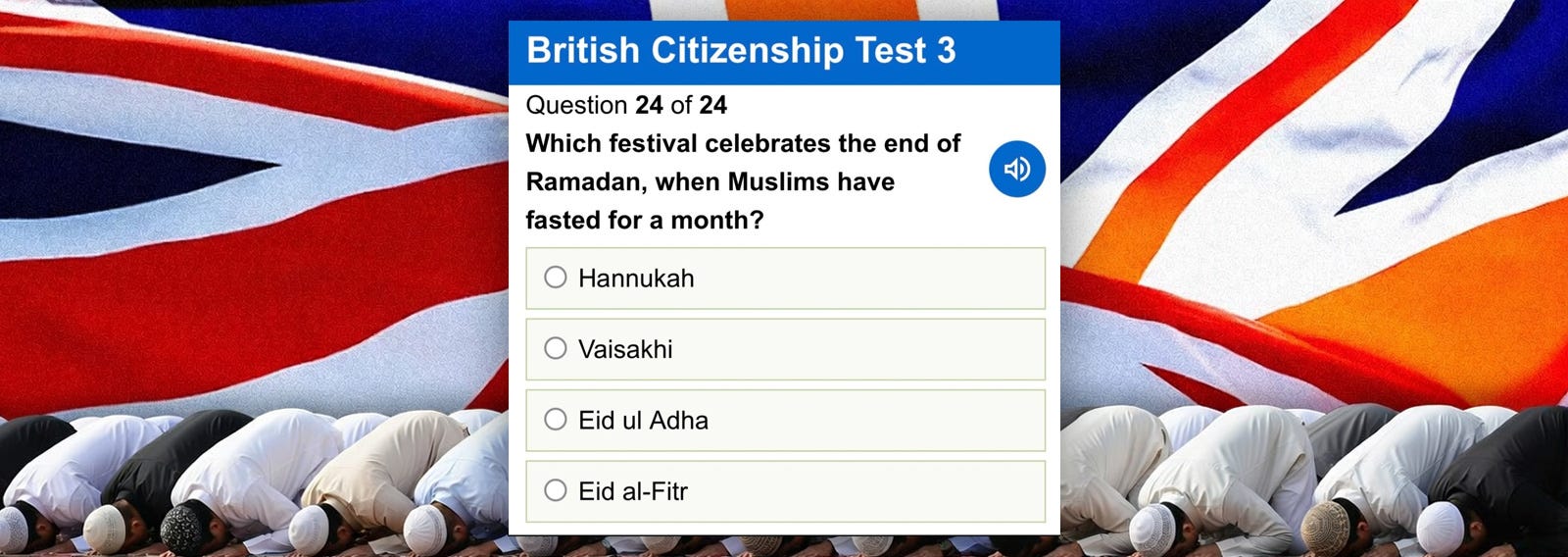
The British citizenship test now requires applicants to distinguish between Islamic festivals such as Eid al-Fitr and Eid al-Adha—asking which festival marks the end of Ramadan, the month of fasting. Eid al-Fitr is the festival of breaking the fast, while Eid al-Adha is associated with the culmination of the Hajj pilgrimage and the theme of sacrifice.
On the surface, it may simply appear to be civic literacy. But it also signals something deeper. The state, having distanced itself from its own Christian foundations, now takes on the role of mediator between competing religions, transmitting their basic forms as part of civic identity.
The issue is not merely that citizenship now includes knowledge of another religion’s festivals. It is that a civilisation once shaped by Christianity now finds itself instructing citizens in the internal practices of a different faith, not as outsiders looking in, but as participants in a shared public order.
Historically, Britain and the wider Western world were not constructed on the assumption of religious neutrality. Their legal and political imagination developed within a Christian moral framework. Law was understood to be grounded in a transcendent order, not created ex nihilo by the state. Authority was accountable to God, not self-authorising.
When that foundation is removed, the structure does not remain intact. And when Christianity ceases to function as the public confession of a people, it is not replaced by neutrality. It is first replaced by the sovereignty of the state—and then, in time, that state-made vacuum becomes fertile ground for another religion.
Statism clears the space. It does not keep it.
In such a setting, it is unsurprising that citizenship education begins to reflect the presence of a rising alternative. The state, having weakened its own foundations, now inadvertently prepares the ground for something else to take root in its place.
In truth, no nation is religiously neutral. Every civil order rests upon a theological foundation. Laws always reflect ultimate commitments. And as the confession of a society changes, so too does its moral and political architecture.
Britain today is therefore not merely rearranging the furniture of its civil life. It is passing through a transition—from a Christian order, through a statist one, toward Islam.
The real question is not whether citizens can distinguish Eid al-Fitr from Eid al-Adha, but what comes after the state has finished clearing the ground—and which faith will ultimately claim it.
England as we know it is lost.
The other problem is that Christianity has become so toxic that it’s opened the door to other toxic religious practice. People wouldn’t be so against Christianity if it was still about helping the poor and disadvantaged.