


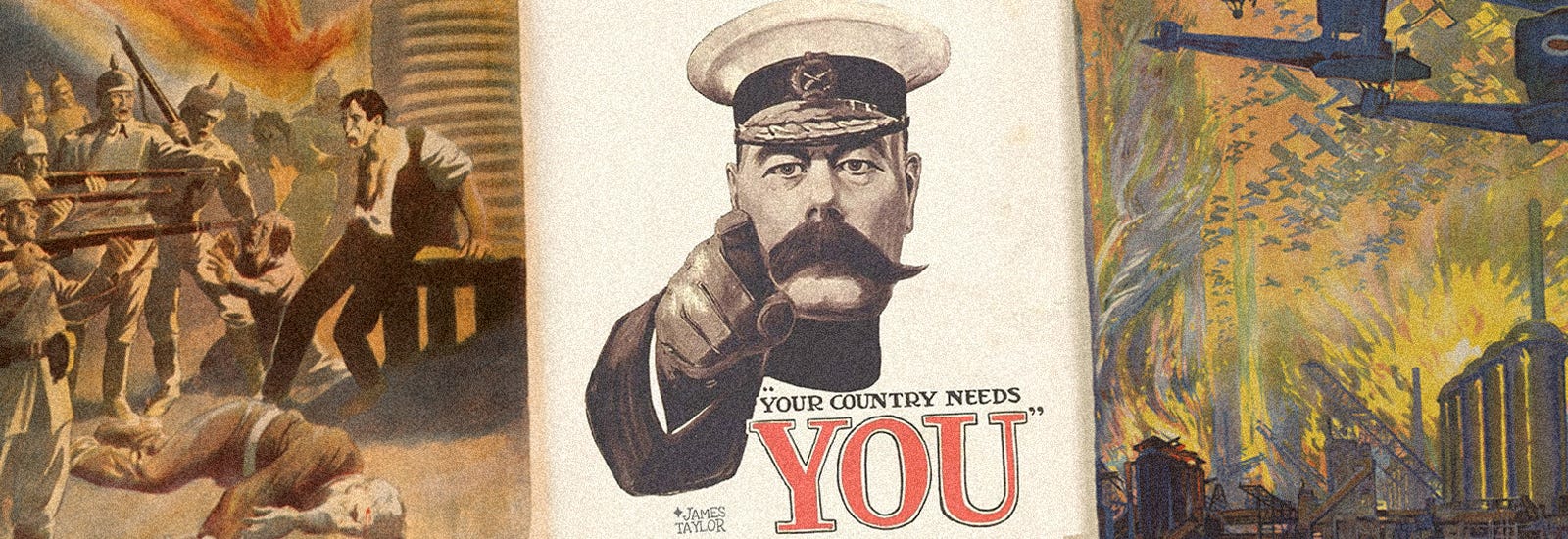
Britain’s military leaders, with the help of the mainstream media, are preparing the public for the possibility of war with Russia.
On Friday, General Sir Roly Walker, head of the British Army, warned that political leaders would soon need to have a frank conversation with the public about the sacrifices required to defend the nation.
Every citizen, he suggested, would have a part to play.
But before asking another generation of young men to fight and die in the never-ending wars of the globalist elites, there’s a question the political establishment needs to answer:
Why should British men be expected to fight for a country whose political leadership appears embarrassed by and increasingly hostile to their national identity?
For decades, Britons concerned about immigration, demographic transformation, cultural displacement, and the erosion of their national inheritance have been branded racists, far-right extremists, and even Nazis by the political establishment.
They have been told to celebrate diversity, while their own desire for cultural continuity has been met with accusation and condemnation. They have been told that Britain belongs to the world, that their homeland is everyone’s homeland, and that their national identity is available to anyone who wishes to claim it.
When the British people seek to preserve their own distinct identity, culture, and inheritance for future generations, their efforts are increasingly treated not merely as objectionable, but potentially criminal.
And now, after decades of promoting a conception of Britain in which national identity is increasingly detached from ancestry, history, and inherited culture, the establishment wants its sons to prepare for war.
But men do not fight for abstract notions of nationhood. They do not die to protect global economic zones. Men fight for what’s behind them. They die for the people they love—the people the establishment told them they ought to apologise for, the people they were told have no right to any power or place of their own.
Their wives. Their children. Their families. Their communities. The churches their ancestors built for them. The countryside they grew up in. The nation they inherited from their own people. They fight, and they die to ensure the inheritance they received from their fathers can be passed on securely to their children.
A homeland is not merely a geographic location, nor is it simply a collection of random individuals temporarily occupying the same territory.
It’s a people and their inheritance, sustained across generations by common loyalties, traditions, institutions, and obligations.
The Bible itself recognises the significance and goodness of nations. According to the Apostle Paul, their boundaries and their appointed places are established by God’s providential hand (Acts 17:26). As such, we are not to regard the existence of distinct peoples and nations as an obstacle to human progress. Nations are good, natural, and inevitable.
And yet, much of modern political discourse treats national attachment and patriotism as something potentially dangerous, particularly when expressed by the British people themselves.
This is a little more than ironic, considering the government is now asking those same men to be prepared to sacrifice themselves on behalf of the nation they weren’t allowed to express any degree of pride in.
Apparently, loving your country is dangerous, until the government needs you to die for it.
But you cannot spend decades weakening a people’s attachment to their homeland and then expect that same attachment to inspire them to die for it. Nor can political leaders spend years demonising patriotism, only to suddenly appeal to it when they need another generation of young white men willing to sacrifice their lives for the very government that was condemning their national loyalties just five minutes earlier.
Of course, defending Britain is not necessarily the same thing as defending its government. A man may have every reason to despise the decisions of his rulers while remaining fiercely devoted to his homeland.
But if Britain is worth defending against so-called foreign aggression, then surely its national inheritance is worth preserving at home. If its people are worth dying for in wartime, surely their interests, identity, and continuity are worth defending in peacetime.
Patriotism is an indispensable virtue in wartime, and Britain's political leaders understand its importance. That’s why you’ll only see British men calling British men to sign up, fight, and die for Britain. That’s why wartime military recruiting advertisements almost exclusively feature White people. Suddenly, their beloved diversity quotas and racial representation don’t matter.
But if patriotism is an indispensable virtue in wartime, why should it be treated with suspicion during peacetime?
Britain’s leaders are increasingly concerned about whether the country possesses the military strength to withstand a foreign enemy. But they should also consider whether they have preserved the national solidarity necessary to inspire its defence.
A government cannot reasonably expect men to sacrifice everything for a homeland while treating their desire to preserve that homeland as something shameful.
Before asking British men what they are prepared to die for, Britain’s rulers ought to ask themselves what they have allowed those men to live for.