


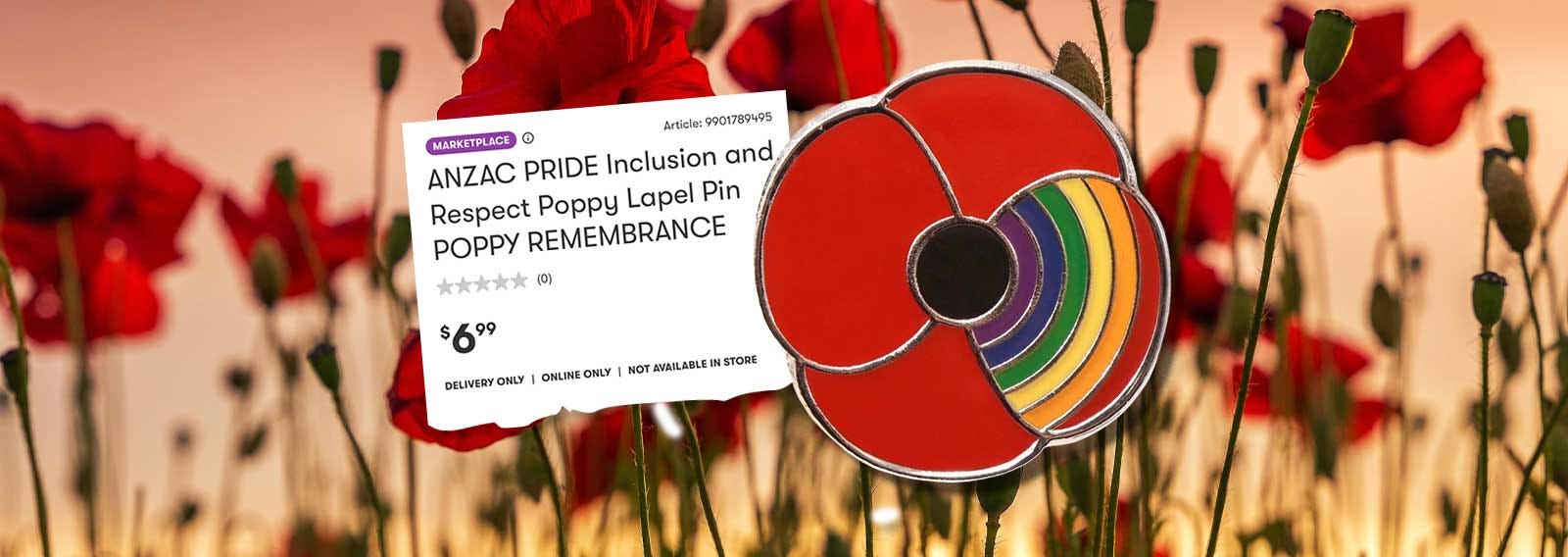
Australian retailer BIG W appears to have removed an LGBTQ-themed ANZAC poppy product from its website following online backlash.
The item, listed by a third-party seller, was described as an “ANZAC Pride Inclusion and Respect Poppy” lapel pin. The design featured a traditional red poppy combined with a rainbow-coloured petal, and was described on the website as a symbol of “inclusivity and diversity.”
However, the supermarket giant faced a wave of criticism online from those who argued that the symbol of remembrance for fallen soldiers was being hijacked to convey ideological messaging related to homosexuality and transgenderism.
Former member of the Australian Parliament, Craig Kelly, flagged the product, vowing never to shop at Big W again.
“I thought it had to be AI,” he said in a post on X. “That’s it, I’m done with BIG W. They won’t ever get another cent of my money.”
Kelly went on to say that Anzac Day is “not a promotion platform for the rainbow crowd to push their agenda.”


Kelly applauded the product’s removal, calling it a “perfect example of how social media backlash can actually force change.”
The red poppy is recognised as a symbol of remembrance for soldiers who died in war, particularly those of World War I. Its association with remembrance is said to come from the appearance of poppies on battlefields in regions such as Flanders.
The symbolism was popularised by the 1915 poem In Flanders Fields, written by Canadian physician John McCrae. The poem reads:
In Flanders fields the poppies blow
Between the crosses, row on row,
That mark our place; and in the sky
The larks, still bravely singing, fly
Scarce heard amid the guns below.We are the Dead. Short days ago
We lived, felt dawn, saw sunset glow,
Loved and were loved, and now we lie,
In Flanders fields.Take up our quarrel with the foe:
To you from failing hands we throw
The torch; be yours to hold it high.
If ye break faith with us who die
We shall not sleep, though poppies grow
In Flanders fields.
Following the war, the poppy was adopted as a symbol of remembrance, and its symbolism spread throughout Commonwealth countries. In Australia, poppies are usually worn in the lead-up to Remembrance Day on November 11.
An insult to ANZACS, as well as poppies. An insult to everyone actually. Note to self- never shop anywhere I see that gross fascist flag.