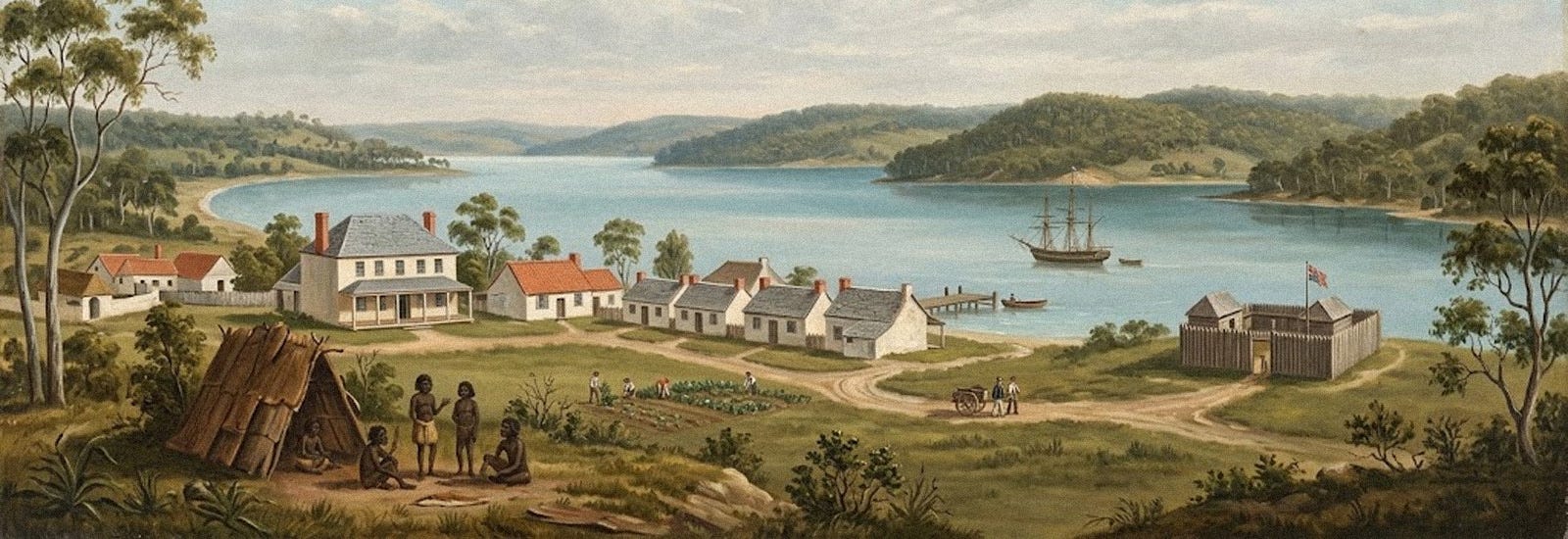
New South Wales MLC John Ruddick has a message for Australians debating immigration: before we argue about how many people Australia should admit today, we should remember who built the country in the first place.
Speaking in Parliament last month, Ruddick took aim at South Australian Premier Peter Malinauskas, who recently argued that migrants built Australia.
Ruddick called the claim a “historical absurdity,” and said the foundations of Australian civilisation were laid long before the era of mass post-war migration.
“Australia was built by settlers,” Ruddick argued, particularly British settlers who arrived in a remote and largely undeveloped land and set about establishing farms, roads, bridges, factories, towns, cities and institutions.
That distinction matters, he said. A migrant arriving in an established country is entering an existing civilisation. A settler arriving in a wilderness is attempting to build one.
And the decision to establish a permanent British colony on the other side of the world was hardly an undertaking for the faint-hearted.
The First Fleet arrived in 1788. The colony that followed faced isolation, shortages, disease, enormous distances and the constant possibility of failure. Even while Britain was facing the threat of revolutionary France and Napoleon, the experiment at New South Wales continued.
Over the course of the nineteenth century, millions of people from the British Isles came to Australia. They cleared land, established farms and businesses, built infrastructure and founded the communities that would eventually become the Australian nation.
Ruddick argues that modern Australians should recognise the magnitude of that achievement.
And he extends the argument to immigration itself.
Why, he asks, do migrants fleeing poverty, instability or authoritarianism so often seek out English-speaking countries?
Because they are not merely seeking geography.
They are seeking the institutions and inheritance that make those countries prosperous and peaceful: the English language, the common law, representative government, private property, stable institutions and a culture shaped by centuries of British political and legal development.
Australia’s prosperity did not appear from nowhere.
It was inherited.
That doesn’t mean immigrants don’t contribute to it. It means they contribute to something that already exists.
And Ruddick argues that this should produce something increasingly rare in public debate: gratitude.
A person who arrives in Australia and receives citizenship has been given access to a country whose institutions and prosperity were built over generations.
That citizen should be welcomed as an equal Australian.
But equality before the law doesn’t require historical amnesia.
Australians whose families arrived seven generations ago and Australians who became citizens yesterday should be treated exactly the same under Australian law.
But both, Ruddick argues, should be capable of recognising the extraordinary achievement of those who came before them.
The evidence of that inheritance is written across Sydney itself.
Macquarie Street.
Phillip Street.
Hunter Street.
George Street.
Pitt Street.
Castlereagh Street.
And Sydney itself.
These names are reminders of the people who established the institutions and communities upon which modern Australia was built.
Australia can treat every citizen equally while still remembering the people who laid its foundations.
And Ruddick believes that remembering those foundations should inform how Australia approaches immigration today. As such, he is calling for a five-year pause on immigration.
And that would be entirely consistent with the growing consensus among Australians—though some would argue that five years is nowhere near long enough.
Last month, 7NEWS reported on a Newspoll survey finding that 66 per cent of Australians want fewer migrants allowed into the country—a notably high proportion given that around one-third of Australia’s population was born overseas.
WATCH: