


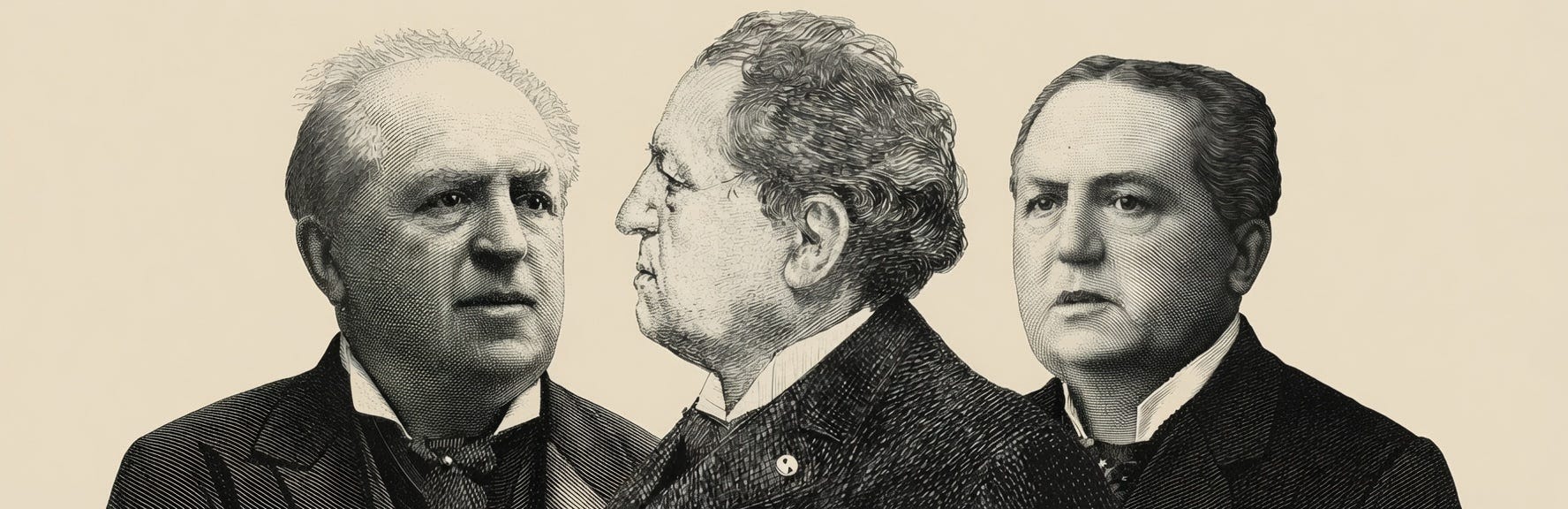
Abraham Kuyper (1837-1920) was a Dutch theologian, journalist, and statesman who served as Prime Minister of the Netherlands from 1901 to 1905.
Kuyper famously rejected any separation between faith and public life, insisting instead that his Christian faith shaped every aspect of his existence. One of his most memorable quotes captures this conviction perfectly:
“There is not a square inch in the whole domain of our human existence over which Christ, who is Sovereign over all, does not cry, ‘Mine!’”
This belief shaped Kuyper’s approach to every sphere of life. He believed Christianity had something to say about every area of human existence, whether it’s acknowledged or not.
As a result, he became one of the most prolific institution builders of the modern era. He founded a political party, established a daily newspaper and a university, led major reforms within the church, and eventually served as Prime Minister of the Netherlands.
If you're not familiar with Kuyper's work, it's well worth becoming acquainted with. Although he lived more than a century ago, his writings continue to speak to many of the issues confronting the West today. Among the most pressing are what many regard as the deliberate dismantling of once-Christian nations through sustained mass migration, compounded by persistently low birth rates among their historic populations.
Kuyper was both a committed Christian and a devoted patriot. His love for Christ and his longing for heaven did not diminish his affection for his own people or his earthly homeland. On the contrary, he saw these loves as complementary rather than competing. Love of God, in Kuyper’s view, rightly ordered and strengthened love of neighbour, family, and nation.
That conviction is especially evident in a speech he delivered in 1888, titled Twofold Fatherland. There, Kuyper argued that attachment to one’s own people and country is not contrary to the Christian faith but part of the natural order established by God.
Kuyper stated:
No flower exudes a fragrance other than that of its own kind, whether it is a rose, a daisy, or a lily; and no precious stone sparkles except in accordance with the special name it bears, whether a diamond, a ruby, or a jasper.
So also no human beings live under the sun without belonging to their own country and their own people, be it Russian, Spanish, Belgian, or whatever other nation you might name. It is no different with us.
We too are not just human beings, but come from the province of Zeeland, Friesland, or North or South Holland. But together we are people of the Netherlands, and as such, we are proud of our country and thank our God that the love of our native soil dwells innately in our lives.
We also love the House of Orange-Nassau, and we continue to grow in our national history.
No blow would destroy our national conscience more than if our existence as a people were destroyed and the Netherlands were to disappear from the ensemble of free European states.
The sentiment is somewhat reminiscent of that expressed by theologian J.C. Ryle a decade earlier in his work, Practical Religion. Commenting on man’s natural affections towards one’s own kinsmen, Ryle wrote:
Next to the grace of God, I see no principle which unites people so much in this sinful world as family sentiments. Community of blood is a most powerful tie.
It was a fine saying of an American naval officer, when his men insisted on helping the English sailors in fighting the Taku forts in China, ‘I cannot help it: blood is thicker than water.’
I have often observed that people will stand up for their relatives, merely because they are their relatives, and refuse to hear a word against them, even when they have no sympathy with their tastes and ways.
Anything which helps to keep up the family sentiment ought to be commended.
Charles Spurgeon, in his 1864 sermon entitled, A Solemn Enquiry Concerning our Families, the Prince of Preachers observed:
Unless we have lost manhood, we love our kindred and desire their good. We have not yet become like ostriches in the wilderness, which care not for their young. Our flesh has not congealed into marble, nor are our hearts become like millstones; we have a very tender concern for those united to us by ties of nature, and esteem them as parts of ourselves.
Commenting on Abraham sending for a wife for Isaac from among his own kindred in Genesis 24, theologian and Bible commentator Matthew Henry makes a similar statement, arguing:
“The highest degree of divine affection must not divest us of natural affection.”
At a time when the heirs of Christendom are increasingly condemned simply for expressing a particular love for their own people or a desire to preserve their own nations, we need to be reminded that these are not sinful affections, but natural and God-given ones.
We are finite creatures with limited resources, and as such, our loves must be ordered and prioritised correctly. This, theologians have called the Ordo Amoris, the Order of Affections. That order, as generally agreed, is as follows: God, Spouse, Children, Extended Family, Community, Nation, and then the World. When that order is confused, there is disorder and pain.
Scripture itself recognises the legitimacy of such ordered loves. Even the Apostle Paul declared that he could wish himself "accursed and cut off from Christ" for the sake of his “brothers, [his] kinsmen according to the flesh” (Rom. 9:3). Love for one's own people is not opposed to Christianity; rightly ordered, it is entirely consistent with it.
Let us pray that the Western world remembers this truth before it is too late. As Kuyper warned of the Netherlands, so it may one day be said of the civilisation that Christianity built in the West: no greater blow could be dealt to our national conscience than the disappearance of our historic peoples and nations.
A civilisation cannot endure if the people who created it cease to exist.