



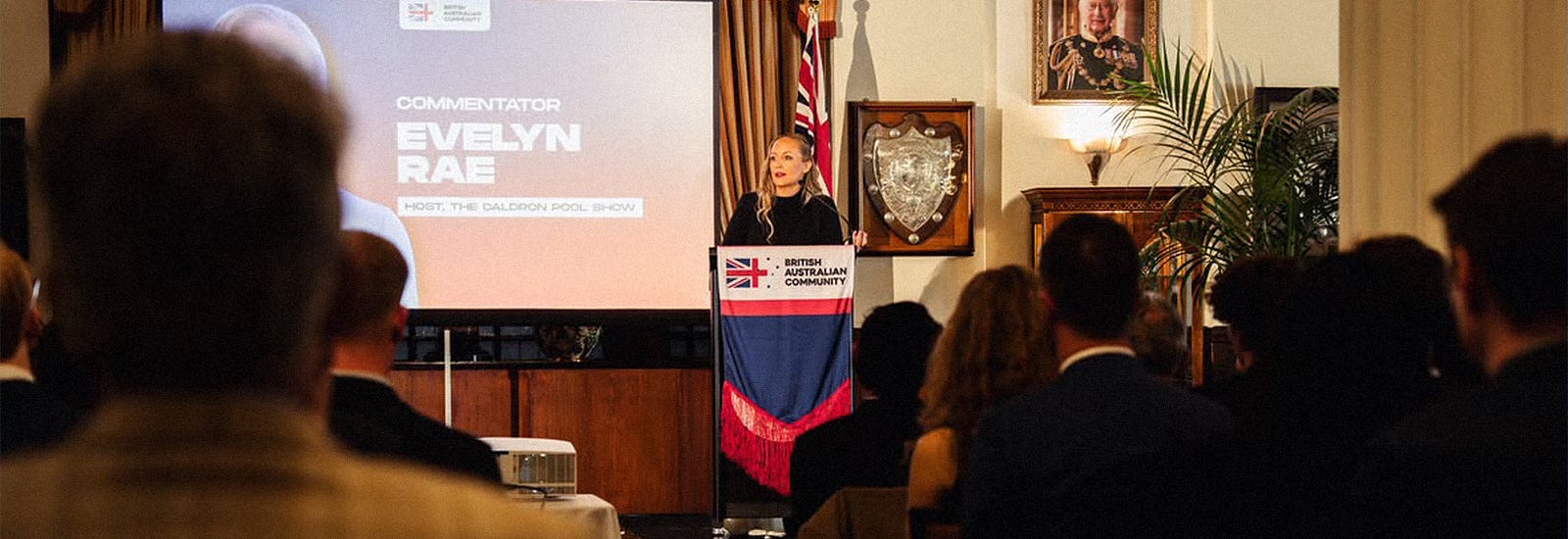
The following speech was delivered by Evelyn Rae on October 17, 2026, at BACPAC 2026, hosted by the British Australian Community.
I don’t think I have to convince anyone in this room that we have a problem. Not just Australia, but the Anglo-world. And not just the Anglo-world, but the European people as a whole and the civilisation we have collectively inherited.
It’s a problem that has impacted virtually every Western nation. It’s both a disease and a wickedness. It’s a disease because it’s highly infectious. The problem has spread through our nations, our institutions, our churches, and our schools. It has taken over the minds of many of our own people.
It’s wickedness because, in many respects, the disease is self-inflicted—to our own hurt, to our own harm, and worse: to the destruction of our own children. What am I referring to? It’s the suicidal notion that there is something uniquely evil about being “White.” We are told that our ancestors are guilty of crimes so heinous, so abhorrent that a lifetime of grovelling, and the total forfeiting of our own homelands cannot come close to atoning for the sins that we inherited from them.
It’s the suicidal ideation that says there is something immoral about meetings like this, because a collective of “Whites” is a dangerous problem in need of fixing. We heard it last year, and there’s no doubt, we’ll hear it again this year. Through never-ending racial quotas and DEI programs, we are relentlessly told that the workplace, the community, the nation, indeed, the world is a better place when White people are diluted, when their power is limited, when their voice is drowned out—and increasingly, when they’re not visibly present at all. Some are already stating it openly: Fewer Whites is the goal today. No Whites is the goal tomorrow.
Of course, the irony here is that this is the only sense in which we are permitted to think of ourselves as a collective. Our ancestors are ours, and we are the inheritors of their actions, but only when their actions are sinful. Their achievements belong to the world, and everyone from everywhere has a right to the civilisation they built—but their supposed crimes, they alone belong to us. So, we are told, the only thing we inherit from our ancestors is the guilt, the shame, and the debt.
And so, as a result, we are told to step aside, to stay silent, and to not question the narrative—even if it’s obviously rigged against us. And it is rigged against us. On a national level, we’re told our identity doesn’t matter because we have to prioritise the voices of ethnic minorities. On a global level, we’re told our identity doesn’t matter because we have to prioritise the voices of so-called “global majorities.”
Wherever we are, we are told that we don’t matter, we need to be silent, we need to be diluted, we need to be watered down and marginalised—and the remarkable thing is that those who openly discriminate in this sense are wholeheartedly convinced they’re morally virtuous in doing so—why? Because they have been convinced that all of the world’s problems can be traced back to White men, and especially White men in positions of power and influence.
In their minds, this is now the great evil that needs to be conquered. And so, every White man striving for power is “literally Hitler”, and any collective of White men who support that are demonised as “literal Nazis. If you want a disturbing glimpse at how widespread this dangerous mindset is, simply take a look at how people reacted to the public murder of Charlie Kirk.
But recognising the symptoms of this problem is not enough. You might know you’re sick, you might even know why you’re sick, but unless you understand the cause, unless you understand the remedy, the diagnosis itself is not enough to save you.
We’re here today to discuss our pathway to victory. But that discussion will be meaningless unless we first identify what we are trying to preserve—and why it’s worth preserving.
Now, many will agree that there is something very wrong with the current state of our nation. An increasing number of Australians believe the country is on the wrong track, and they will even admit that this is largely due to the government’s immigration policies. They’ll acknowledge multiculturalism has divided our communities into nations within nations, that diversity has undermined national unity, and that the Australia we all know and love is at risk of being lost for good.
But when it comes to offering a solution to that very visible problem, all we are given are meaningless platitudes and a lot of talk about some vague and arbitrary concept of “Aussie values.” Today we have just about everyone on the right of Labor talking tough about immigration reforms, but whenever they’re asked what they mean and what it will look like, it always comes back to a “values” test.
Now, aside from the fact that no one is really able to define what these “Aussie values” are, or where these “values” originate, what we are effectively being told through their imagined “solution” is that the Anglo-Celtic people of Australia are inconsequential. We are being told that the descendants of Australia’s founding stock are unnecessary—that it doesn’t matter who inherits the house, provided they like Rugby, barbecues, and waving the Aussie flag. That is to say, we’re being told that Anglo-Celtic Australians are interchangeable.
In other words, what they are saying is that if every Anglo-Celtic Australian were to be replaced by foreigners, the nation itself would remain the same, provided the new imports subscribed to “Aussie values.”
Of course, this is an absurd assertion, and its implications are untenable. Follow it to its logical conclusion, and you arrive at a definition of “Australian” in which foreigners living in foreign nations can be considered more Australian than the descendants of Australia’s first settlers. Why? Because being Australian is no longer a matter of ancestry, heritage, or belonging, but of subscribing to whatever vague collection of “Aussie values” happens to be fashionable at the time.
Consequently, under this novel definition, being Australian is no longer an ethnic designation but an ideological one. It tells us something about what a person believes, or how they live, but not necessarily where they were born, to whom they were born, or where they belong. It strips the term “Australian” of its historic Anglo-Celtic identity and reduces it to little more than a geographic or civic label—one that, at best, signifies a shallow commitment to some vague, ill-defined notion of “Aussie values,” whatever those might be.
Now, this is more than just semantics. We’re talking about the intellectual erasure of Anglo-Celtic Australians. The historic people are being gradually removed from the definition. Their identity has become a collection of transferable attributes. And their heritage has become the property of the world. Even those on the so-called “Right” have bought this redefinition. They’re too embarrassed to define us the way we have always been defined—the way every other people group on earth is permitted to define themselves.
As such, it has rightly been labelled as “inheritance theft.”
But our ancestors did not build this nation through blood, sweat, and tears — they did not fight two World Wars — just for their descendants to forfeit their homelands for fear of being called bad names by bad people.
But neither did they endure everything they did for us to fall off the other side of the horse—a danger I fear many on our side are increasingly at risk of doing.
We might all agree that the propositional nationhood is absurd. We might all reject the notion that values alone make an Australian. But we would also be just as wrong to imagine that values did not make Australia. We know that the people are not interchangeable, but neither is the ideology the people hold to—or the value system that shaped the way our ancestors thought, acted, and behaved.
We might all agree that if the Australian people were replaced by foreigners, Australia would no longer be Australian. But what would happen if the religion, the ideology, were replaced? What would happen if Hinduism, Judaism, Islam, or Atheistic Secularism were to replace the faith that our ancestors embraced, the faith our ancestors were shaped by for centuries?
You see, the people are an essential ingredient—but so are their values. So are their convictions. So is their religion. Because the nation we build, or maintain, is going to be determined by the culture, the law systems, and the morals of the people. Even if Australia consisted only of Anglo-Celtic people, Australia would not remain Australia if every one of them rejected their Christian heritage for another religion, for another law system, for another set of values.
What good is protecting the nation from foreign influences, if we are indifferent to the influences of foreign gods?
And so, I would argue that at the heart of this discussion, there are two opposing mistakes.
On one side are those who argue that Australia is simply a collection of propositions. Accept the approved values, and you become whatever we are.
On the other side are those who argue that ethnic identity is all that matters, and that ideology or religion are inconsequential to the heritage we’ve been entrusted.
But this is not an either/or situation. The greatness of the Western world, the greatness of the British people, is not people disconnected from their faith, or values disconnected from a people. The greatness of the Western world and British people is an exceptional people embracing an exceptional faith. It is that combination that has proved to be so potent—which is why the Straight, White, Christian, Male has been marked as enemy number one.
The civilisation we inherited was neither the product of ancestry alone nor a collection of values that appeared from nowhere.
It emerged through particular peoples being formed, over centuries, by a particular faith.
In the Anglo-Celtic world, we are speaking of roughly fifteen hundred years of Christianity working through generations: reshaping how people understood God, justice, family, authority, conscience, and responsibility.
Christianity did not create these peoples out of nothing.
They were already there. They possessed languages, traditions, craftsmanship, poetry, loyalties, and institutions.
They knew how to build, govern, fight, and create beauty before their conversion.
But the Gospel called them to account.
It restrained what needed restraining. It strengthened what was good. It redirected what was misdirected.
Courage acquired duties towards the weak. Loyalty stood beneath a higher obligation. Wealth brought responsibilities towards those who could not repay it.
Law and power were placed beneath the judgement of God.
The hands that built pagan temples learned to build cathedrals. Communities established places of learning, healing, and charity. The poor, the widow, and the orphan became objects of enduring moral responsibility.
Christianity worked upon the whole civilisation.
And nowhere was its significance clearer than in the limits it placed upon government.
The confession that Jesus Christ is Lord means the magistrate is not supreme.
King Alfred was great precisely because he understood that he was a king under higher authority—not a law unto himself.
Magna Carta rested upon the same principle: even the king was subject to law. His authority was not absolute, and his subjects possessed rights that he could not simply disregard.
The king possesses authority, but that authority is delegated and bounded. He cannot make falsehood true by decree. He cannot make evil good by legislation. He cannot claim ownership of the conscience because he possesses the power to punish dissent.
There is a law above the legislature.
There is a King above the government.
Britain transmitted to Australia its language, common law, parliamentary institutions, literature, customs, and habits of public life. Those things came through a people formed by centuries of Christianity.
“Australian values” did not fall from the sky.
They came through families, churches, schools, and generations of moral formation.
We now want the fruits while neglecting the roots. Strong families without fidelity. Freedom without restraint. Honest institutions without people taught that truth binds the conscience.
We want government held accountable while dismissing the authority before which rulers themselves stand accountable.
That cannot sustain our inheritance.
We have cast off the greatest restraint on the power of the state over its citizens, and today we are suffering the consequences.
We were told that Australia would be better, and Australians freer, if we embraced not only a diversity of foreign peoples, but a diversity of foreign gods.
But the result has been the opposite. A people divided over fundamental questions of right and wrong becomes increasingly dependent on the state to settle those differences. Where there are competing gods, there are competing moral standards. And where there are competing moral standards, the state inevitably assumes the role of final arbiter.
With the introduction of multiculturalism and religious pluralism into the West, the highest court of appeal effectively shifted from heaven to the state.
In casting off God’s authority, we did not free ourselves from authority. We merely exchanged a government under God for a government increasingly inclined to act as god.
What does this have to do with the subject at hand? Everything.
We are talking about our heritage—our people, our homeland, and the civilisation our ancestors built. A living inheritance passed down from one generation to the next.
Previous generations understood this inheritance as a gift, entrusted to their care, to be preserved and passed on to their children.
But what happens when the state increasingly assumes the place of a God?
It begins to regard that inheritance as its own—as something it has the right to give away, to whomever it pleases.
What was once understood as a sacred inheritance to be preserved becomes a political possession to be distributed for political gain and economic goals.
And this is the problem we face. Right across the Western world—right across Christendom—governments are assuming the place of Christ, and as a result, gaining more and more power over the people to squander their inheritance and undermine the greatest force for good the world has known.
They’re able to do this because we’ve not only forgotten who we are, we’ve forgotten why we are.
It’s not enough to just complain about the problem. Now, more than ever, we need to remember who we are, and why we are.
It is no mere coincidence that a century of relentless efforts to strip the Anglo-Celtic people of their Christian heritage was immediately followed by the erosion of their physical and cultural inheritance. Because it’s not either/or/, it’s both/and.
The people matter. Their faith matters. Those two things side by side are what made us so great and what makes the wickedness tremble at the knees. As King Alfred the Great wisely said: “In prosperity a man often destroys the good he has done; amidst difficulties he often repairs what he long since did in the way of wickedness.”
This is our opportunity to repair the inheritance for our children and to restore our people.
WATCH: